

117
with the Creation; Symeon Stylites (AD 390–459), called by followers “the most
holy martyr in the air”—the Syrian hermit who lived atop his pillar for 37 years. And
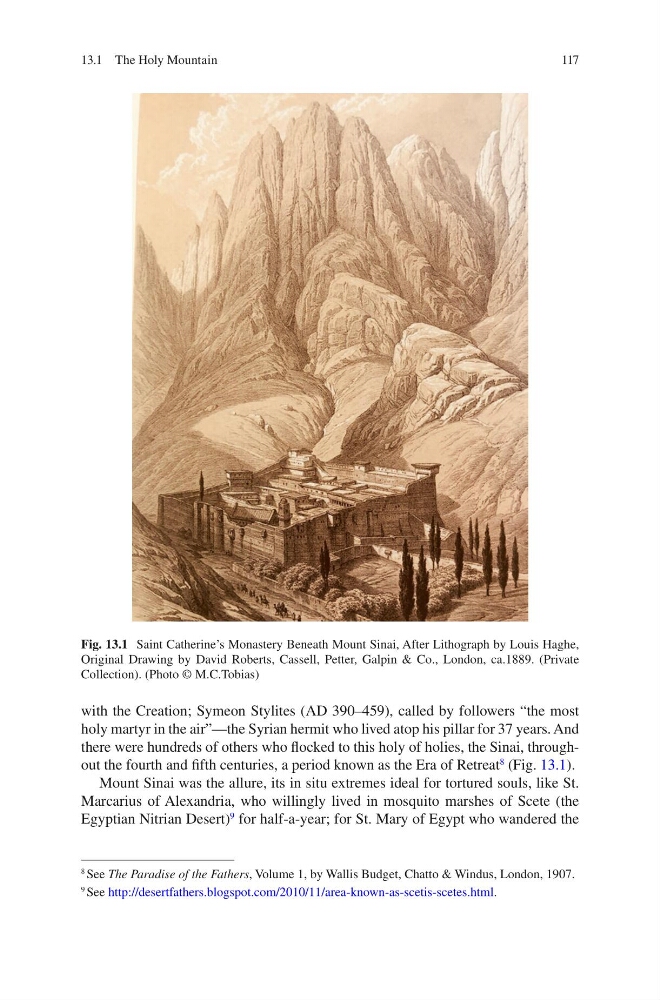
there were hundreds of others who flocked to this holy of holies, the Sinai, throughout the fourth and fifth centuries, a period known as the Era of Retreat
8
(Fig. 13.1).
Mount Sinai was the allure, its in situ extremes ideal for tortured souls, like St.
Marcarius of Alexandria, who willingly lived in mosquito marshes of Scete (the
Egyptian Nitrian Desert)
9
for half-a-year; for St. Mary of Egypt who wandered the
8 See The Paradise of the Fathers, Volume 1, by Wallis Budget, Chatto & Windus, London, 1907.
9 See http://desertfathers.blogspot.com/2010/11/area-known-as-scetis-scetes.html.
Fig. 13.1 Saint Catherine’s Monastery Beneath Mount Sinai, After Lithograph by Louis Haghe,
Original Drawing by David Roberts, Cassell, Petter, Galpin & Co., London, ca.1889. (Private
Collection). (Photo © M.C.Tobias)
13.1 The Holy Mountain
with the Creation; Symeon Stylites (AD 390–459), called by followers “the most
holy martyr in the air”—the Syrian hermit who lived atop his pillar for 37 years. And
there were hundreds of others who flocked to this holy of holies, the Sinai, throughout the fourth and fifth centuries, a period known as the Era of Retreat
8
(Fig. 13.1).
Mount Sinai was the allure, its in situ extremes ideal for tortured souls, like St.
Marcarius of Alexandria, who willingly lived in mosquito marshes of Scete (the
Egyptian Nitrian Desert)
9
for half-a-year; for St. Mary of Egypt who wandered the
8 See The Paradise of the Fathers, Volume 1, by Wallis Budget, Chatto & Windus, London, 1907.
9 See http://desertfathers.blogspot.com/2010/11/area-known-as-scetis-scetes.html.
Fig. 13.1 Saint Catherine’s Monastery Beneath Mount Sinai, After Lithograph by Louis Haghe,
Original Drawing by David Roberts, Cassell, Petter, Galpin & Co., London, ca.1889. (Private
Collection). (Photo © M.C.Tobias)
13.1 The Holy Mountain