

The geochemical evidence of biotic activity (what may arguably be considered
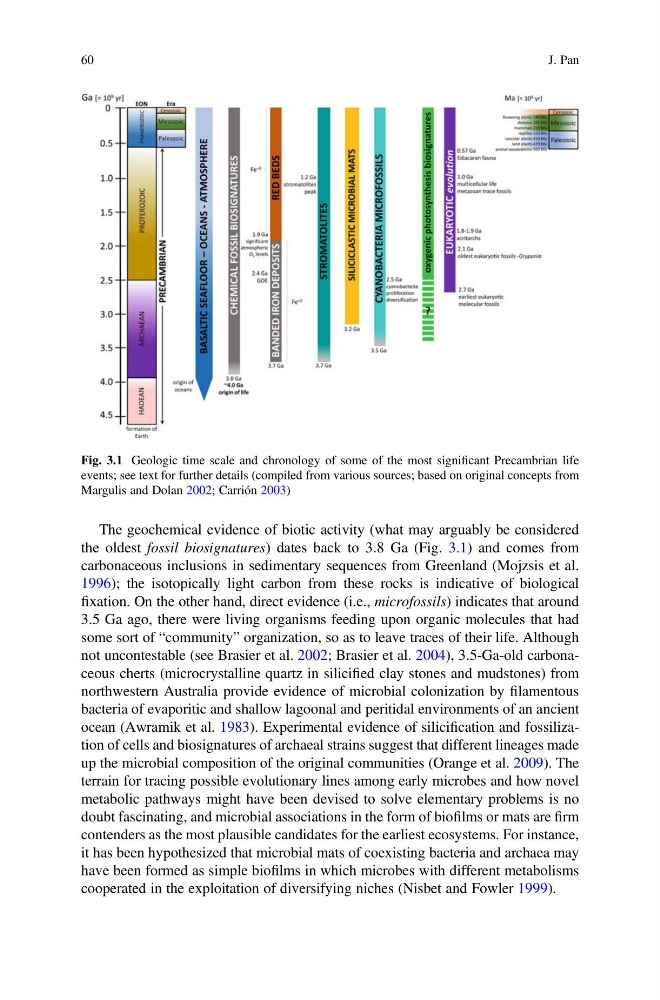
the oldest fossil biosignatures) dates back to 3.8 Ga (Fig. 3.1) and comes from
carbonaceous inclusions in sedimentary sequences from Greenland (Mojzsis et al.
1996); the isotopically light carbon from these rocks is indicative of biological
fixation. On the other hand, direct evidence (i.e., microfossils) indicates that around
3.5 Ga ago, there were living organisms feeding upon organic molecules that had
some sort of “community” organization, so as to leave traces of their life. Although
not uncontestable (see Brasier et al. 2002; Brasier et al. 2004), 3.5-Ga-old carbonaceous cherts (microcrystalline quartz in silicified clay stones and mudstones) from
northwestern Australia provide evidence of microbial colonization by filamentous
bacteria of evaporitic and shallow lagoonal and peritidal environments of an ancient
ocean (Awramik et al. 1983). Experimental evidence of silicification and fossilization of cells and biosignatures of archaeal strains suggest that different lineages made
up the microbial composition of the original communities (Orange et al. 2009). The
terrain for tracing possible evolutionary lines among early microbes and how novel
metabolic pathways might have been devised to solve elementary problems is no
doubt fascinating, and microbial associations in the form of biofilms or mats are firm
contenders as the most plausible candidates for the earliest ecosystems. For instance,
it has been hypothesized that microbial mats of coexisting bacteria and archaea may
have been formed as simple biofilms in which microbes with different metabolisms
cooperated in the exploitation of diversifying niches (Nisbet and Fowler 1999).
Fig. 3.1 Geologic time scale and chronology of some of the most significant Precambrian life
events; see text for further details (compiled from various sources; based on original concepts from
Margulis and Dolan 2002; Carrión 2003)
60
J. Pan
the oldest fossil biosignatures) dates back to 3.8 Ga (Fig. 3.1) and comes from
carbonaceous inclusions in sedimentary sequences from Greenland (Mojzsis et al.
1996); the isotopically light carbon from these rocks is indicative of biological
fixation. On the other hand, direct evidence (i.e., microfossils) indicates that around
3.5 Ga ago, there were living organisms feeding upon organic molecules that had
some sort of “community” organization, so as to leave traces of their life. Although
not uncontestable (see Brasier et al. 2002; Brasier et al. 2004), 3.5-Ga-old carbonaceous cherts (microcrystalline quartz in silicified clay stones and mudstones) from
northwestern Australia provide evidence of microbial colonization by filamentous
bacteria of evaporitic and shallow lagoonal and peritidal environments of an ancient
ocean (Awramik et al. 1983). Experimental evidence of silicification and fossilization of cells and biosignatures of archaeal strains suggest that different lineages made
up the microbial composition of the original communities (Orange et al. 2009). The
terrain for tracing possible evolutionary lines among early microbes and how novel
metabolic pathways might have been devised to solve elementary problems is no
doubt fascinating, and microbial associations in the form of biofilms or mats are firm
contenders as the most plausible candidates for the earliest ecosystems. For instance,
it has been hypothesized that microbial mats of coexisting bacteria and archaea may
have been formed as simple biofilms in which microbes with different metabolisms
cooperated in the exploitation of diversifying niches (Nisbet and Fowler 1999).
Fig. 3.1 Geologic time scale and chronology of some of the most significant Precambrian life
events; see text for further details (compiled from various sources; based on original concepts from
Margulis and Dolan 2002; Carrión 2003)
60
J. Pan