

to Mono Lake with colleagues (e.g., Alex Sessions, Jerad Leadbetter, Victoria
Orphan) from Caltech. The International Geobiology Course instituted a leg of its
summer field instruction at Mono Lake, which Larry, Mike Rosen, and myself
eagerly took part in when it was first under the auspices of University of Southern
California and Colorado School of Mines, then shifting to Caltech. We were able to
make use of the fine auditorium of the interpretive Visitor Center in Lee Vining to
facilitate our lectures before spending a day sampling the lake. The enthusiasm of the
students (and faculty) for this unique location is gratifying, because it assures me that
research will likely continue into the foreseeable future.
Lee Vining itself is a curious, small town (2010 population ¼ 222). Yet on a
summer day you can sit on the benches outside its only market and see people
wander by that are not just locals, native American Indians, and Bay Area tourists,
but often visitors from overseas (Europe, Asia, Middle East) speaking their diverse
languages and obviously enchanted by the wide open spaces of the region and the
public’s easy access to them. Sometimes I would fantasize about having a research
facility erected on Mono’s shores, maybe proximate to the Mono Inn, a restaurant
owned by the Adams Family, descendants of the photographer the late Ansel
Adams, whose collected works glorified Yosemite.
Well, it is time now to thank those with whom I have worked over the years and
who all helped out in the writing of this essay by keeping me on track, correcting my
mistakes, and providing photos of our exploits: Chuck Culbertson, Larry Miller,
Mike Rosen, and John Stolz. Along with Tim Hollibaugh, Chad Saltikov, Jodi
Switzer Blum, Shelley Hoeft McCann, and Shaun Baesman, I thank them from the
bottom of my heart along with many other folks too numerous to mention.
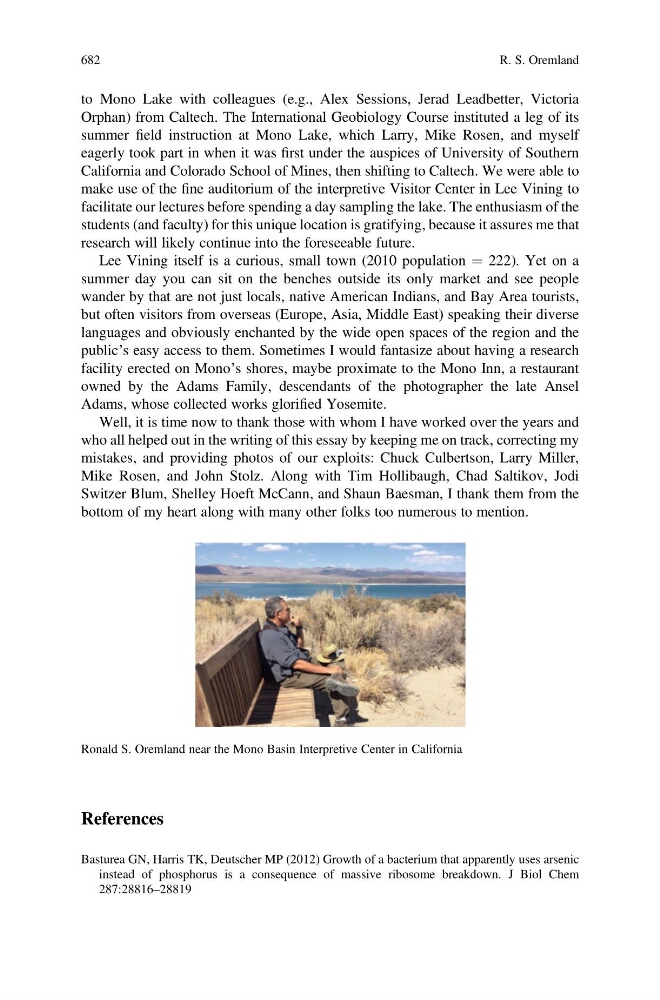
Ronald S. Oremland near the Mono Basin Interpretive Center in California
References
Basturea GN, Harris TK, Deutscher MP (2012) Growth of a bacterium that apparently uses arsenic
instead of phosphorus is a consequence of massive ribosome breakdown. J Biol Chem
287:28816–28819
682
R. S. Oremland