

this proto-biofilm/biomat, as he determined the in situ porewater concentration of
dimethylsulfide to be about 1 mM. It reeked.
On one morning, after clearing the fence, I noticed off to my left about a quarter
mile away a large bull walking briskly in my direction, following the lake’s fenced
boundary perimeter. How he got there and to where he was headed were questions I
wished answered but did not dare to await to interview the subject. Great horned
male bovines like these are reputed to be quite irritable, readily insulted, and easily
aroused to violence. I did not wish to inflame the wandering ruminant by my towel’s
rotary motions, thereby becoming the Mono Basin’s first (and last) amateur matadorscientist, in an American parody of what occurs in Pamplona. If gored, I would suffer
my wounds in the great isolation of the region, likely bleeding out well before
anyone back at the motel would notice my absence (this was the pre-cell phone era).
Fortunately, by the time I finished sampling the chambers, the bull had disappeared
westward in search of its grazing herd from which he became separated, thereby
leaving only the aforementioned horseflies as the only serious hazard I encountered
upon hiking back up to my vehicle.
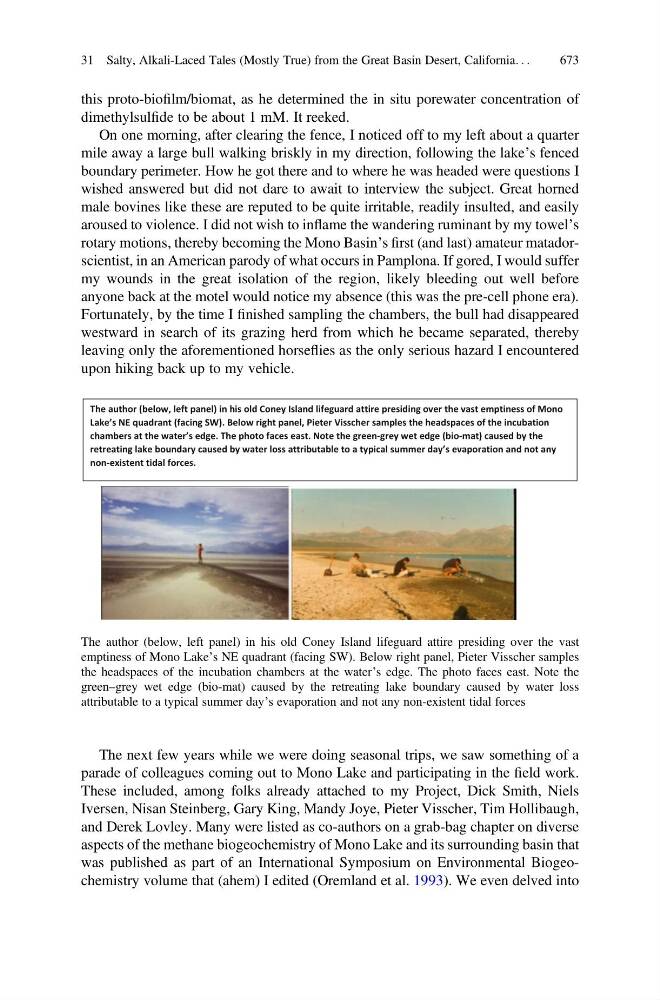
The author (below, left panel) in his old Coney Island lifeguard attire presiding over the vast emptiness of Mono
Lake’s NE quadrant (facing SW). Below right panel, Pieter Visscher samples the headspaces of the incubation
chambers at the water’s edge. The photo faces east. Note the green-grey wet edge (bio-mat) caused by the
retreating lake boundary caused by water loss attributable to a typical summer day’s evaporation and not any
non-existent tidal forces.
The author (below, left panel) in his old Coney Island lifeguard attire presiding over the vast
emptiness of Mono Lake’s NE quadrant (facing SW). Below right panel, Pieter Visscher samples
the headspaces of the incubation chambers at the water’s edge. The photo faces east. Note the
green–grey wet edge (bio-mat) caused by the retreating lake boundary caused by water loss
attributable to a typical summer day’s evaporation and not any non-existent tidal forces
The next few years while we were doing seasonal trips, we saw something of a
parade of colleagues coming out to Mono Lake and participating in the field work.
These included, among folks already attached to my Project, Dick Smith, Niels
Iversen, Nisan Steinberg, Gary King, Mandy Joye, Pieter Visscher, Tim Hollibaugh,
and Derek Lovley. Many were listed as co-authors on a grab-bag chapter on diverse
aspects of the methane biogeochemistry of Mono Lake and its surrounding basin that
was published as part of an International Symposium on Environmental Biogeochemistry volume that (ahem) I edited (Oremland et al. 1993). We even delved into
31 Salty, Alkali-Laced Tales (Mostly True) from the Great Basin Desert, California. . .
673