

In recent years the lake’s surface
waters appear to have a connuous
bloom of Picocyss, turning them
green where the once were clear.
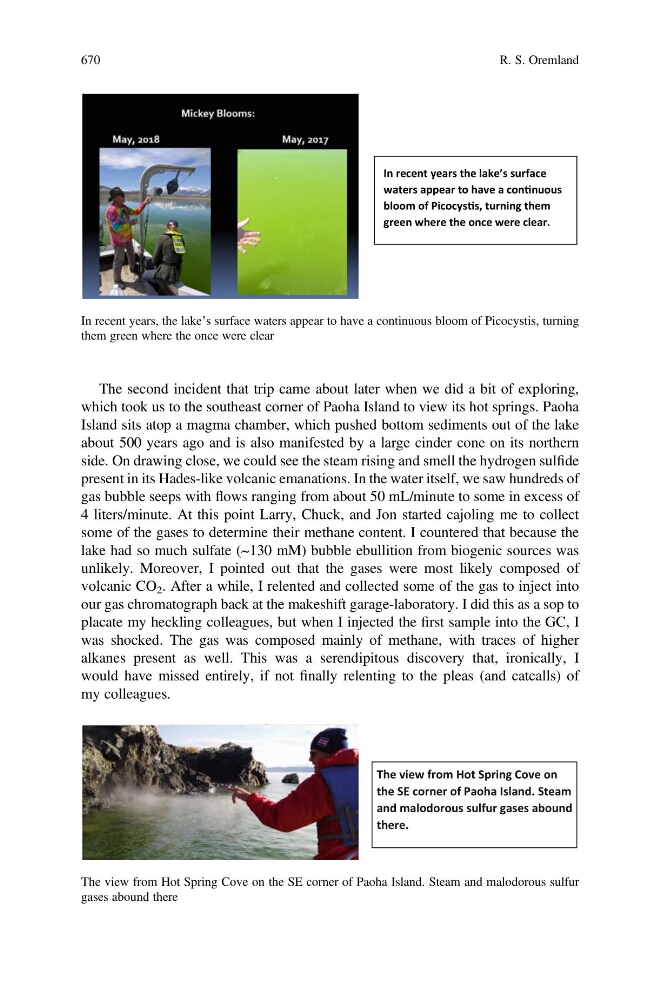
In recent years, the lake’s surface waters appear to have a continuous bloom of Picocystis, turning
them green where the once were clear
The second incident that trip came about later when we did a bit of exploring,
which took us to the southeast corner of Paoha Island to view its hot springs. Paoha
Island sits atop a magma chamber, which pushed bottom sediments out of the lake
about 500 years ago and is also manifested by a large cinder cone on its northern
side. On drawing close, we could see the steam rising and smell the hydrogen sulfide
present in its Hades-like volcanic emanations. In the water itself, we saw hundreds of
gas bubble seeps with flows ranging from about 50 mL/minute to some in excess of
4 liters/minute. At this point Larry, Chuck, and Jon started cajoling me to collect
some of the gases to determine their methane content. I countered that because the
lake had so much sulfate (~130 mM) bubble ebullition from biogenic sources was
unlikely. Moreover, I pointed out that the gases were most likely composed of
volcanic CO 2 . After a while, I relented and collected some of the gas to inject into
our gas chromatograph back at the makeshift garage-laboratory. I did this as a sop to
placate my heckling colleagues, but when I injected the first sample into the GC, I
was shocked. The gas was composed mainly of methane, with traces of higher
alkanes present as well. This was a serendipitous discovery that, ironically, I
would have missed entirely, if not finally relenting to the pleas (and catcalls) of
my colleagues.
The view from Hot Spring Cove on
the SE corner of Paoha Island. Steam
and malodorous sulfur gases abound
there.
The view from Hot Spring Cove on the SE corner of Paoha Island. Steam and malodorous sulfur
gases abound there
670
R. S. Oremland