

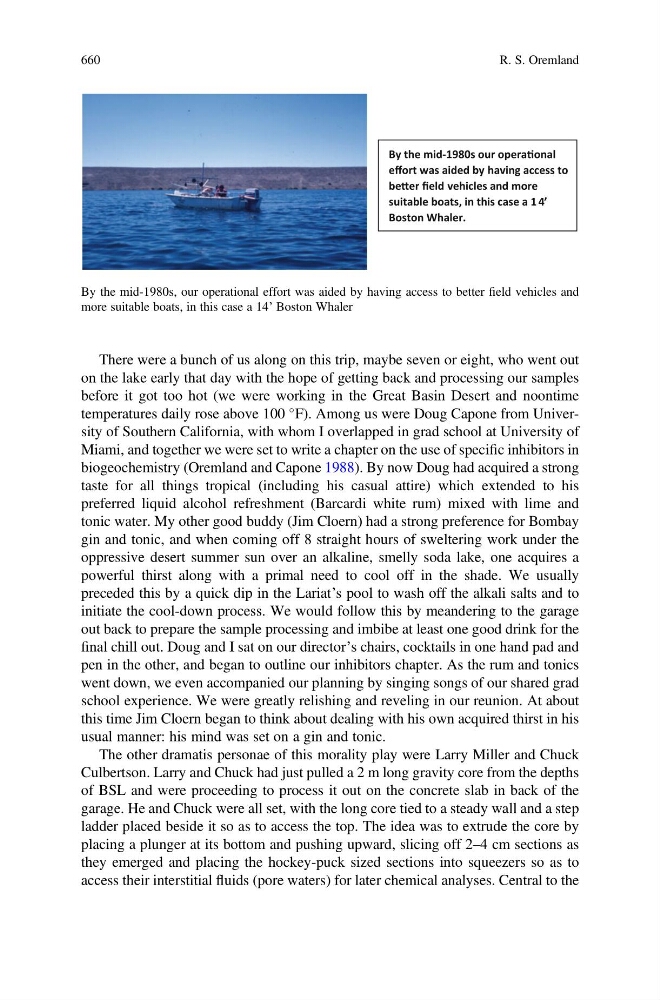
By the mid-1980s our operaonal
effort was aided by having access to
beer field vehicles and more
suitable boats, in this case a 1 4’
Boston Whaler.
By the mid-1980s, our operational effort was aided by having access to better field vehicles and
more suitable boats, in this case a 14’ Boston Whaler
There were a bunch of us along on this trip, maybe seven or eight, who went out
on the lake early that day with the hope of getting back and processing our samples
before it got too hot (we were working in the Great Basin Desert and noontime
temperatures daily rose above 100
F). Among us were Doug Capone from University of Southern California, with whom I overlapped in grad school at University of
Miami, and together we were set to write a chapter on the use of specific inhibitors in
biogeochemistry (Oremland and Capone 1988). By now Doug had acquired a strong
taste for all things tropical (including his casual attire) which extended to his
preferred liquid alcohol refreshment (Barcardi white rum) mixed with lime and
tonic water. My other good buddy (Jim Cloern) had a strong preference for Bombay
gin and tonic, and when coming off 8 straight hours of sweltering work under the
oppressive desert summer sun over an alkaline, smelly soda lake, one acquires a
powerful thirst along with a primal need to cool off in the shade. We usually
preceded this by a quick dip in the Lariat’s pool to wash off the alkali salts and to
initiate the cool-down process. We would follow this by meandering to the garage
out back to prepare the sample processing and imbibe at least one good drink for the
final chill out. Doug and I sat on our director’s chairs, cocktails in one hand pad and
pen in the other, and began to outline our inhibitors chapter. As the rum and tonics
went down, we even accompanied our planning by singing songs of our shared grad
school experience. We were greatly relishing and reveling in our reunion. At about
this time Jim Cloern began to think about dealing with his own acquired thirst in his
usual manner: his mind was set on a gin and tonic.
The other dramatis personae of this morality play were Larry Miller and Chuck
Culbertson. Larry and Chuck had just pulled a 2 m long gravity core from the depths
of BSL and were proceeding to process it out on the concrete slab in back of the
garage. He and Chuck were all set, with the long core tied to a steady wall and a step
ladder placed beside it so as to access the top. The idea was to extrude the core by
placing a plunger at its bottom and pushing upward, slicing off 2–4 cm sections as
they emerged and placing the hockey-puck sized sections into squeezers so as to
access their interstitial fluids (pore waters) for later chemical analyses. Central to the
660
R. S. Oremland