

toward and past Reno, Sparks, and Mustang (home of the Mustang Ranch brothel).
The route is accompanied by the Truckee River which drains Lake Tahoe and runs
east, eventually turning north at Fernley (then but a tiny, one flashing stoplight town)
to empty into Pyramid Lake, while we turned south on 95A to drive another 25 miles
to Fallon. Pyramid Lake is a site sacred to the Paiute Indian Tribe, and lies entirely
within the bounds of their reservation. Indeed, it was what happened to the Truckee
River, namely a man-made diversion (Newlands Reclamation Act of 1903) of some
of its flow southward to fill the Lahontan Reservoir, thereby allowing for irrigation to
sustain farming and cattle ranching in Churchill County that forms the basis of our
story. The importation of surface water to the area recharged the groundwater and
raised the water table so much so that Big Soda Lake filled up with an 18 m rise by
1920. It became meromictic (permanently stratified), its lower salinity surface water,
the mixolimnion (27‰) overlying the higher salinity bottom water (89‰), the
monimolimnion by a sharp pycnocline located at 35 m and extending to a depth of
62 m (Zehr et al. 1987). Hence, the monimolimnion had been anoxic for nearly
60 years, and that definitely piqued my interest. The lake level rise completely
submerged the pumping station which in the early 1900s was still used to pump
out lake-water for evaporative harvesting of its abundant “trona” (carbonate/sulfate
salts). It also led to the rapid growth of submerged tufa towers, some ~5–10 m high,
along the shore of its northern rim (Rosen et al. 2004).
First we drove to our lodgings: The Lariat Motel in Fallon owned and operated by
an older couple (Al and Julia), immigrants from Lithuania after the war, and with
whom I would come to know and cherish over the next several years. Inexpensive
and well within our per diem financial limits, it certainly wasn’t plush but it was
adequate. Moreover, as I spent more and more time there over the years doing
fieldwork, I brought my colleagues along as well. Al and Julia became very
accommodating of our needs. They even allowed us to set up a makeshift lab in
the spacious garage out back, where they had installed bench tops along the wall that
we used for setting up instrumentation like gyratory incubators, pH meters, and gas
chromatographs that we had schlepped along for the ride.
31.1.3 The Lake and the Lariat
Panoramic
photo shot of
BSL, courtesy
of Michael
Rosen.
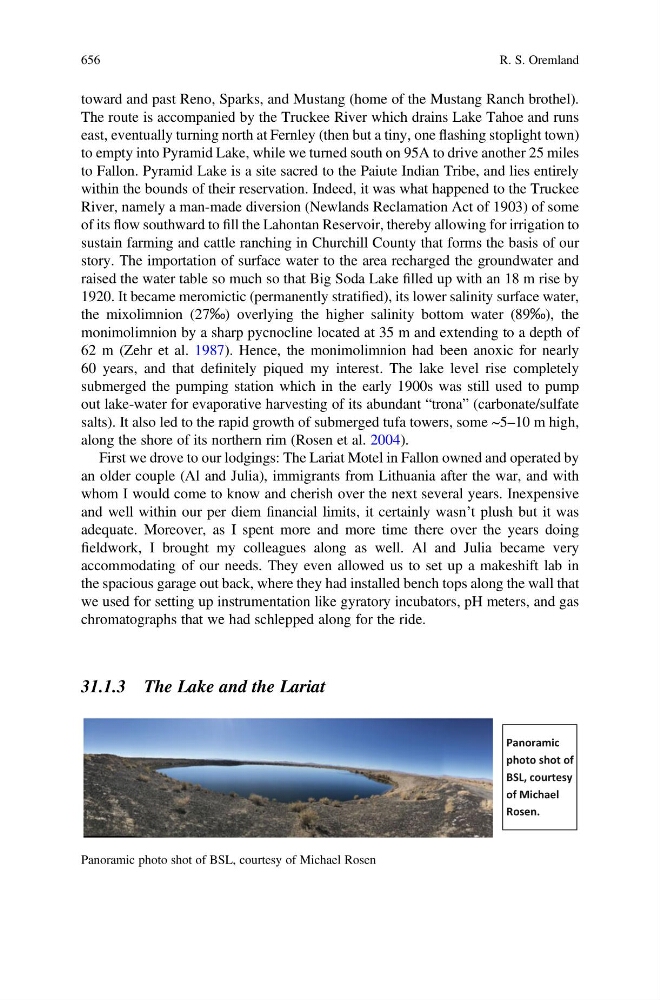
Panoramic photo shot of BSL, courtesy of Michael Rosen
656
R. S. Oremland