

microscopy, his first love (Haas Jr 2000). He concluded his 1887 President’s
Address to the Royal Microscopical Society by saying about his 7-year thermal
adaptation experiment:
I can only claim for this fragment its suggestiveness, and its possible value as an incentive to
others to treat the lower and minuter forms of life in corresponding manners, and as showing
that such work cannot be without value. (Dallinger 1887b)
No one seems to have been incentivized by his work, however, and this kind of
prolonged laboratory evolution study to address aspects of Darwin’s work was not
taken up again for almost 100 years.
Lamarck’s view of the inheritance of acquired characters continued to be held by
many biologists at the end of the nineteenth century. It was not until the rediscovery of
Gregory Mendel’s work that those ideas were largely abandoned. But not so among
those interested in bacterial evolution. Dallinger’s study and those of others showed
that bacteria could adapt to new conditions and display new characteristics as a result.
It was not clear whether this resulted from the appearance of a variant in the population
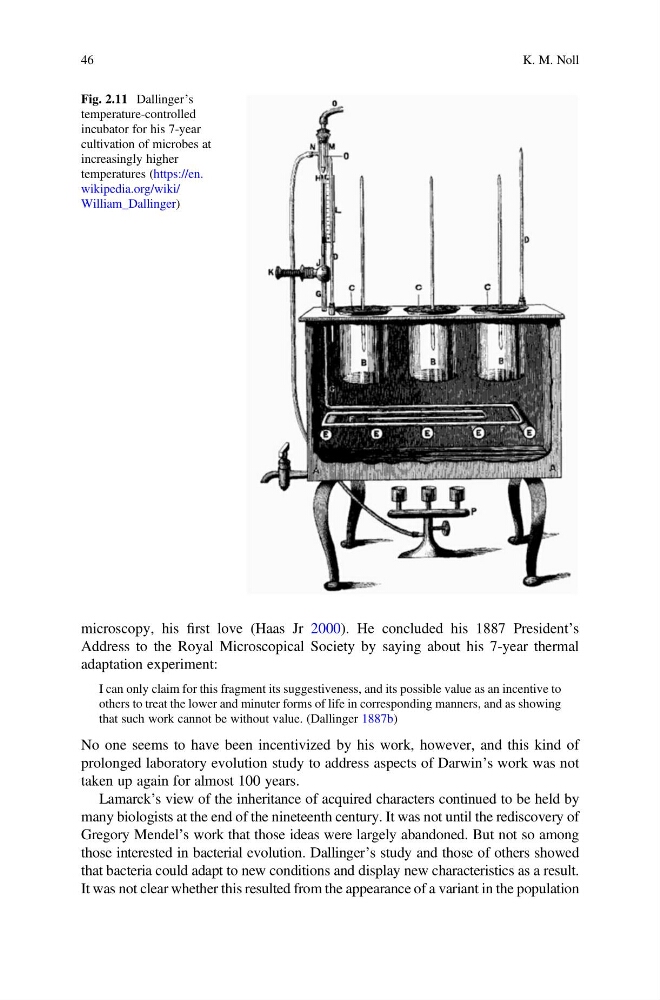
Fig. 2.11 Dallinger’s
temperature-controlled
incubator for his 7-year
cultivation of microbes at
increasingly higher
temperatures (https://en.
wikipedia.org/wiki/
William_Dallinger)
46
K. M. Noll
Address to the Royal Microscopical Society by saying about his 7-year thermal
adaptation experiment:
I can only claim for this fragment its suggestiveness, and its possible value as an incentive to
others to treat the lower and minuter forms of life in corresponding manners, and as showing
that such work cannot be without value. (Dallinger 1887b)
No one seems to have been incentivized by his work, however, and this kind of
prolonged laboratory evolution study to address aspects of Darwin’s work was not
taken up again for almost 100 years.
Lamarck’s view of the inheritance of acquired characters continued to be held by
many biologists at the end of the nineteenth century. It was not until the rediscovery of
Gregory Mendel’s work that those ideas were largely abandoned. But not so among
those interested in bacterial evolution. Dallinger’s study and those of others showed
that bacteria could adapt to new conditions and display new characteristics as a result.
It was not clear whether this resulted from the appearance of a variant in the population
Fig. 2.11 Dallinger’s
temperature-controlled
incubator for his 7-year
cultivation of microbes at
increasingly higher
temperatures (https://en.
wikipedia.org/wiki/
William_Dallinger)
46
K. M. Noll