

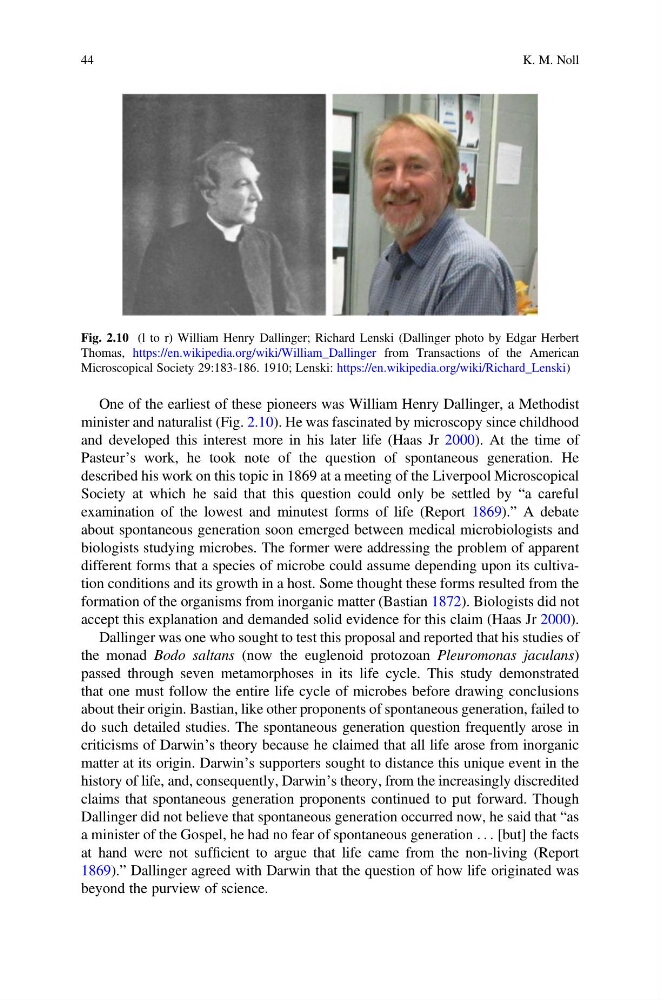
One of the earliest of these pioneers was William Henry Dallinger, a Methodist
minister and naturalist (Fig. 2.10). He was fascinated by microscopy since childhood
and developed this interest more in his later life (Haas Jr 2000). At the time of
Pasteur’s work, he took note of the question of spontaneous generation. He
described his work on this topic in 1869 at a meeting of the Liverpool Microscopical
Society at which he said that this question could only be settled by “a careful
examination of the lowest and minutest forms of life (Report 1869).” A debate
about spontaneous generation soon emerged between medical microbiologists and
biologists studying microbes. The former were addressing the problem of apparent
different forms that a species of microbe could assume depending upon its cultivation conditions and its growth in a host. Some thought these forms resulted from the
formation of the organisms from inorganic matter (Bastian 1872). Biologists did not
accept this explanation and demanded solid evidence for this claim (Haas Jr 2000).
Dallinger was one who sought to test this proposal and reported that his studies of
the monad Bodo saltans (now the euglenoid protozoan Pleuromonas jaculans)
passed through seven metamorphoses in its life cycle. This study demonstrated
that one must follow the entire life cycle of microbes before drawing conclusions
about their origin. Bastian, like other proponents of spontaneous generation, failed to
do such detailed studies. The spontaneous generation question frequently arose in
criticisms of Darwin’s theory because he claimed that all life arose from inorganic
matter at its origin. Darwin’s supporters sought to distance this unique event in the
history of life, and, consequently, Darwin’s theory, from the increasingly discredited
claims that spontaneous generation proponents continued to put forward. Though
Dallinger did not believe that spontaneous generation occurred now, he said that “as
a minister of the Gospel, he had no fear of spontaneous generation . . . [but] the facts
at hand were not sufficient to argue that life came from the non-living (Report
1869).” Dallinger agreed with Darwin that the question of how life originated was
beyond the purview of science.
Fig. 2.10 (l to r) William Henry Dallinger; Richard Lenski (Dallinger photo by Edgar Herbert
Thomas, https://en.wikipedia.org/wiki/William_Dallinger from Transactions of the American
Microscopical Society 29:183-186. 1910; Lenski: https://en.wikipedia.org/wiki/Richard_Lenski)
44
K. M. Noll
minister and naturalist (Fig. 2.10). He was fascinated by microscopy since childhood
and developed this interest more in his later life (Haas Jr 2000). At the time of
Pasteur’s work, he took note of the question of spontaneous generation. He
described his work on this topic in 1869 at a meeting of the Liverpool Microscopical
Society at which he said that this question could only be settled by “a careful
examination of the lowest and minutest forms of life (Report 1869).” A debate
about spontaneous generation soon emerged between medical microbiologists and
biologists studying microbes. The former were addressing the problem of apparent
different forms that a species of microbe could assume depending upon its cultivation conditions and its growth in a host. Some thought these forms resulted from the
formation of the organisms from inorganic matter (Bastian 1872). Biologists did not
accept this explanation and demanded solid evidence for this claim (Haas Jr 2000).
Dallinger was one who sought to test this proposal and reported that his studies of
the monad Bodo saltans (now the euglenoid protozoan Pleuromonas jaculans)
passed through seven metamorphoses in its life cycle. This study demonstrated
that one must follow the entire life cycle of microbes before drawing conclusions
about their origin. Bastian, like other proponents of spontaneous generation, failed to
do such detailed studies. The spontaneous generation question frequently arose in
criticisms of Darwin’s theory because he claimed that all life arose from inorganic
matter at its origin. Darwin’s supporters sought to distance this unique event in the
history of life, and, consequently, Darwin’s theory, from the increasingly discredited
claims that spontaneous generation proponents continued to put forward. Though
Dallinger did not believe that spontaneous generation occurred now, he said that “as
a minister of the Gospel, he had no fear of spontaneous generation . . . [but] the facts
at hand were not sufficient to argue that life came from the non-living (Report
1869).” Dallinger agreed with Darwin that the question of how life originated was
beyond the purview of science.
Fig. 2.10 (l to r) William Henry Dallinger; Richard Lenski (Dallinger photo by Edgar Herbert
Thomas, https://en.wikipedia.org/wiki/William_Dallinger from Transactions of the American
Microscopical Society 29:183-186. 1910; Lenski: https://en.wikipedia.org/wiki/Richard_Lenski)
44
K. M. Noll