

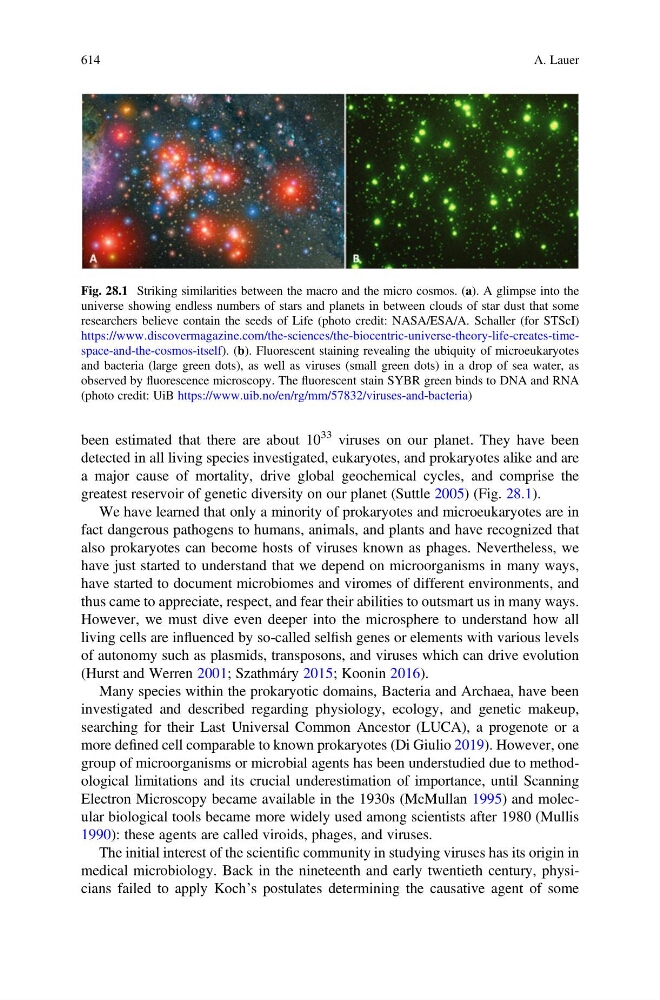
been estimated that there are about 10
33 viruses on our planet. They have been
detected in all living species investigated, eukaryotes, and prokaryotes alike and are
a major cause of mortality, drive global geochemical cycles, and comprise the
greatest reservoir of genetic diversity on our planet (Suttle 2005) (Fig. 28.1).
We have learned that only a minority of prokaryotes and microeukaryotes are in
fact dangerous pathogens to humans, animals, and plants and have recognized that
also prokaryotes can become hosts of viruses known as phages. Nevertheless, we
have just started to understand that we depend on microorganisms in many ways,
have started to document microbiomes and viromes of different environments, and
thus came to appreciate, respect, and fear their abilities to outsmart us in many ways.
However, we must dive even deeper into the microsphere to understand how all
living cells are influenced by so-called selfish genes or elements with various levels
of autonomy such as plasmids, transposons, and viruses which can drive evolution
(Hurst and Werren 2001; Szathmáry 2015; Koonin 2016).
Many species within the prokaryotic domains, Bacteria and Archaea, have been
investigated and described regarding physiology, ecology, and genetic makeup,
searching for their Last Universal Common Ancestor (LUCA), a progenote or a
more defined cell comparable to known prokaryotes (Di Giulio 2019). However, one
group of microorganisms or microbial agents has been understudied due to methodological limitations and its crucial underestimation of importance, until Scanning
Electron Microscopy became available in the 1930s (McMullan 1995) and molecular biological tools became more widely used among scientists after 1980 (Mullis
1990): these agents are called viroids, phages, and viruses.
The initial interest of the scientific community in studying viruses has its origin in
medical microbiology. Back in the nineteenth and early twentieth century, physicians failed to apply Koch’s postulates determining the causative agent of some
Fig. 28.1 Striking similarities between the macro and the micro cosmos. (a). A glimpse into the
universe showing endless numbers of stars and planets in between clouds of star dust that some
researchers believe contain the seeds of Life (photo credit: NASA/ESA/A. Schaller (for STScI)
https://www.discovermagazine.com/the-sciences/the-biocentric-universe-theory-life-creates-timespace-and-the-cosmos-itself). (b). Fluorescent staining revealing the ubiquity of microeukaryotes
and bacteria (large green dots), as well as viruses (small green dots) in a drop of sea water, as
observed by fluorescence microscopy. The fluorescent stain SYBR green binds to DNA and RNA
(photo credit: UiB https://www.uib.no/en/rg/mm/57832/viruses-and-bacteria)
614
A. Lauer