

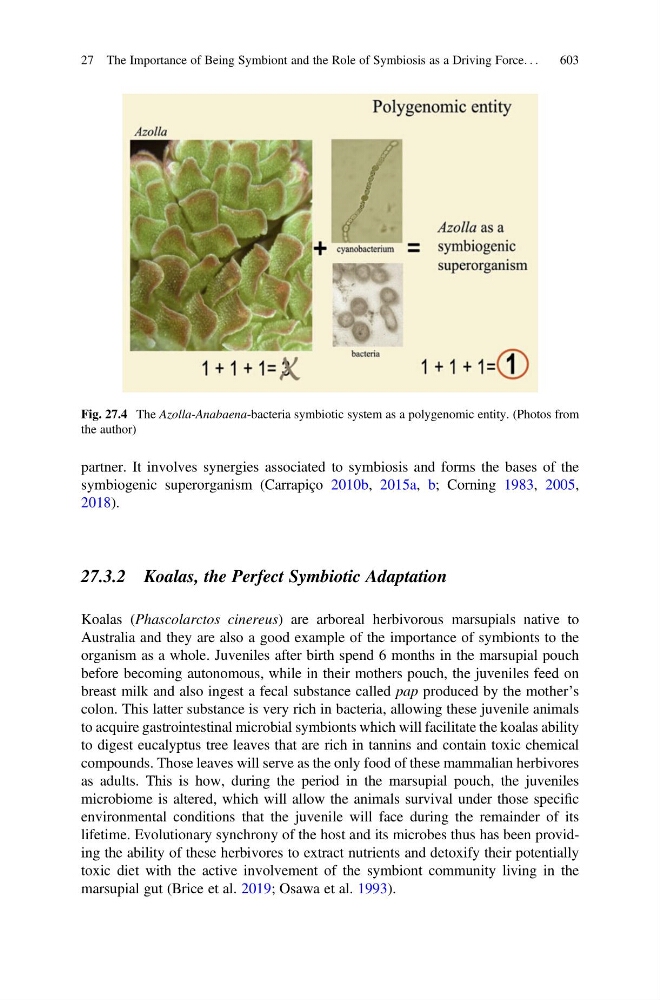
partner. It involves synergies associated to symbiosis and forms the bases of the
symbiogenic superorganism (Carrapiço 2010b, 2015a, b; Corning 1983, 2005,
2018).
27.3.2 Koalas, the Perfect Symbiotic Adaptation
Koalas (Phascolarctos cinereus) are arboreal herbivorous marsupials native to
Australia and they are also a good example of the importance of symbionts to the
organism as a whole. Juveniles after birth spend 6 months in the marsupial pouch
before becoming autonomous, while in their mothers pouch, the juveniles feed on
breast milk and also ingest a fecal substance called pap produced by the mother’s
colon. This latter substance is very rich in bacteria, allowing these juvenile animals
to acquire gastrointestinal microbial symbionts which will facilitate the koalas ability
to digest eucalyptus tree leaves that are rich in tannins and contain toxic chemical
compounds. Those leaves will serve as the only food of these mammalian herbivores
as adults. This is how, during the period in the marsupial pouch, the juveniles
microbiome is altered, which will allow the animals survival under those specific
environmental conditions that the juvenile will face during the remainder of its
lifetime. Evolutionary synchrony of the host and its microbes thus has been providing the ability of these herbivores to extract nutrients and detoxify their potentially
toxic diet with the active involvement of the symbiont community living in the
marsupial gut (Brice et al. 2019; Osawa et al. 1993).
Fig. 27.4 The Azolla-Anabaena-bacteria symbiotic system as a polygenomic entity. (Photos from
the author)
27 The Importance of Being Symbiont and the Role of Symbiosis as a Driving Force. . .
603