

work and a coherent contribution to the field. In 1913, he published Evolution by
co-operation. A study in bio-economics, followed by the 1915 Symbiogenesis: the
universal law of progressive evolution and the 1920 book Symbiosis: A sociophysiological study of evolution. In these books, Reinheimer points out the importance of specific interrelations in the development of organisms as a whole, giving a
holistic perspective on organismal evolution and the importance of cooperation in
the evolutive process (Carrapiço 2015a).
Several other authors published key studies that were related to the development
of symbiogenic ideas in biology during the first decades of the twentieth century.
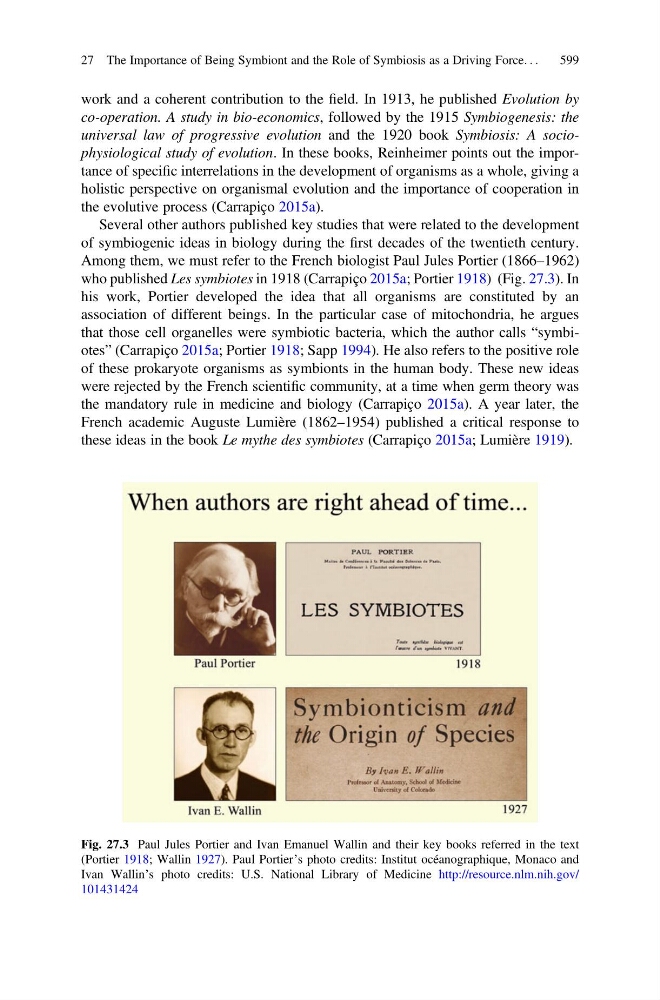
Among them, we must refer to the French biologist Paul Jules Portier (1866–1962)
who published Les symbiotes in 1918 (Carrapiço 2015a; Portier 1918) (Fig. 27.3). In
his work, Portier developed the idea that all organisms are constituted by an
association of different beings. In the particular case of mitochondria, he argues
that those cell organelles were symbiotic bacteria, which the author calls “symbiotes” (Carrapiço 2015a; Portier 1918; Sapp 1994). He also refers to the positive role
of these prokaryote organisms as symbionts in the human body. These new ideas
were rejected by the French scientific community, at a time when germ theory was
the mandatory rule in medicine and biology (Carrapiço 2015a). A year later, the
French academic Auguste Lumière (1862–1954) published a critical response to
these ideas in the book Le mythe des symbiotes (Carrapiço 2015a; Lumière 1919).
Fig. 27.3 Paul Jules Portier and Ivan Emanuel Wallin and their key books referred in the text
(Portier 1918; Wallin 1927). Paul Portier’s photo credits: Institut océanographique, Monaco and
Ivan Wallin’s photo credits: U.S. National Library of Medicine http://resource.nlm.nih.gov/
101431424
27 The Importance of Being Symbiont and the Role of Symbiosis as a Driving Force. . .
599