

so. Woese unfairly complained later (Woese 1994) that such sequencing methods
were largely overlooked by the microbiology community, but he does not consider
that few were interested in the subject at that time for the reasons described above.
Whole generations of researchers were not exposed to evolutionary thinking in their
work with bacteria. Those who perhaps were still interested, like Stanier, were in the
later stages of their careers and had moved on to other research topics and so were
unlikely to adopt a new, unfamiliar method at that point in their careers.
Woese later adapted RNA cataloging to the 16S rRNA molecule since it provided
more reliable classifications than the 5S molecule and was more manageable than the
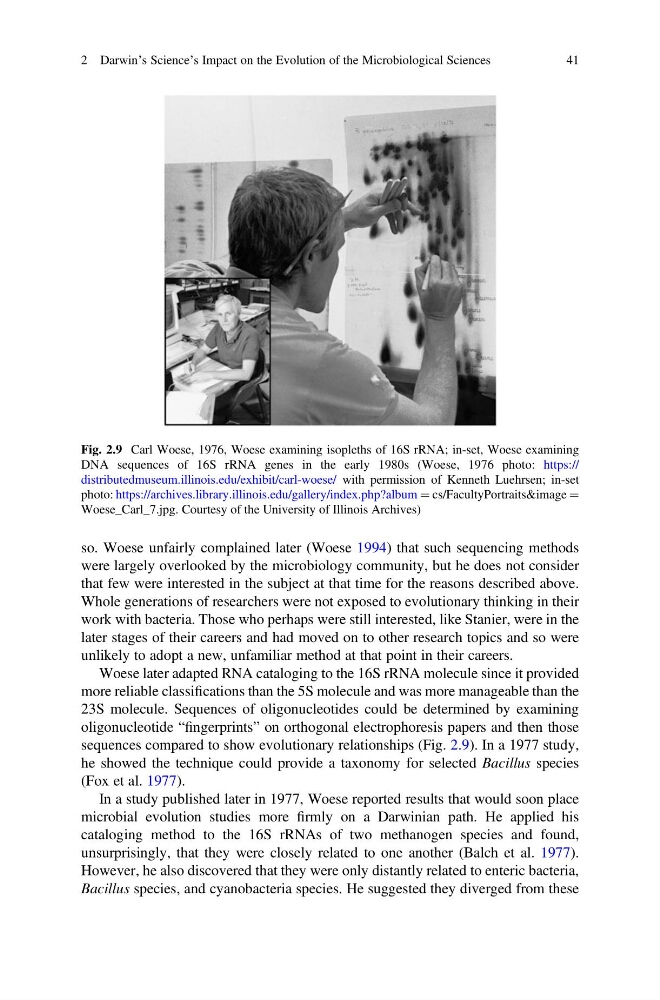
23S molecule. Sequences of oligonucleotides could be determined by examining
oligonucleotide “fingerprints” on orthogonal electrophoresis papers and then those
sequences compared to show evolutionary relationships (Fig. 2.9). In a 1977 study,
he showed the technique could provide a taxonomy for selected Bacillus species
(Fox et al. 1977).
In a study published later in 1977, Woese reported results that would soon place
microbial evolution studies more firmly on a Darwinian path. He applied his
cataloging method to the 16S rRNAs of two methanogen species and found,
unsurprisingly, that they were closely related to one another (Balch et al. 1977).
However, he also discovered that they were only distantly related to enteric bacteria,
Bacillus species, and cyanobacteria species. He suggested they diverged from these
Fig. 2.9 Carl Woese, 1976, Woese examining isopleths of 16S rRNA; in-set, Woese examining
DNA sequences of 16S rRNA genes in the early 1980s (Woese, 1976 photo: https://
distributedmuseum.illinois.edu/exhibit/carl-woese/ with permission of Kenneth Luehrsen; in-set
photo: https://archives.library.illinois.edu/gallery/index.php?album ¼ cs/FacultyPortraits&image ¼
Woese_Carl_7.jpg. Courtesy of the University of Illinois Archives)
2 Darwin’s Science’s Impact on the Evolution of the Microbiological Sciences
41
were largely overlooked by the microbiology community, but he does not consider
that few were interested in the subject at that time for the reasons described above.
Whole generations of researchers were not exposed to evolutionary thinking in their
work with bacteria. Those who perhaps were still interested, like Stanier, were in the
later stages of their careers and had moved on to other research topics and so were
unlikely to adopt a new, unfamiliar method at that point in their careers.
Woese later adapted RNA cataloging to the 16S rRNA molecule since it provided
more reliable classifications than the 5S molecule and was more manageable than the
23S molecule. Sequences of oligonucleotides could be determined by examining
oligonucleotide “fingerprints” on orthogonal electrophoresis papers and then those
sequences compared to show evolutionary relationships (Fig. 2.9). In a 1977 study,
he showed the technique could provide a taxonomy for selected Bacillus species
(Fox et al. 1977).
In a study published later in 1977, Woese reported results that would soon place
microbial evolution studies more firmly on a Darwinian path. He applied his
cataloging method to the 16S rRNAs of two methanogen species and found,
unsurprisingly, that they were closely related to one another (Balch et al. 1977).
However, he also discovered that they were only distantly related to enteric bacteria,
Bacillus species, and cyanobacteria species. He suggested they diverged from these
Fig. 2.9 Carl Woese, 1976, Woese examining isopleths of 16S rRNA; in-set, Woese examining
DNA sequences of 16S rRNA genes in the early 1980s (Woese, 1976 photo: https://
distributedmuseum.illinois.edu/exhibit/carl-woese/ with permission of Kenneth Luehrsen; in-set
photo: https://archives.library.illinois.edu/gallery/index.php?album ¼ cs/FacultyPortraits&image ¼
Woese_Carl_7.jpg. Courtesy of the University of Illinois Archives)
2 Darwin’s Science’s Impact on the Evolution of the Microbiological Sciences
41