

1. There could be more cyanobacterial genera inside both these symbiotic systems. Its just
that some people need to do a proper global sampling collaboration to discover and
describe them. Example: Last year another famous symbiont Trichormus azollae was
reclassified to the new genus Desikacharya.
2. There could also be a complex of cyanobacterial symbionts and they may differ from
place to place and with climatic conditions too at the same place.
3. Lastly, the filaments inside the root usually look very short (at least
in case of the samples we have seen here in India). So, they could resemble Anabaena
appearing straight and being less curved.
26.6.2 Proteobacteria as Symbionts that Provide Fixed
Nitrogen for Their Host Plants
Proteobacteria also have developed a root-associated symbiosis in which they
provide fixed nitrogen to their plant host, presumably in exchange for compounds
provided by the plant. This section of the essay is about those proteobacteria known
as Rhizobium, and I have included other members of the order Rhizobiales.
Hermann Hellriegel and Hermann Wilfarth were agricultural chemists who
performed studies at the Anhalt Research Station in Bernburg, Germany.
Hellriegel and Wilfarth were studying legumes, which are plants of the family
Fabaceae. Legumes are capable of forming very obvious root nodules. We have
since learned that these nodules represent an association between the plants and
symbiotic proteobacteria. There, in Bernburg, these two researchers examined the
role of legume root nodules as a source of nitrogen for supporting plant growth
(Hellriegel and Wilfarth 1888). Hermann Hellriegel was born October 21, 1831 in
Mausitz, Germany and died September 24, 1895 in Bernburg, Germany. Hermann
Wilfarth was born May 21, 1853 in Hamburg, Germany and died November
27, 1904 in Bernburg, Germany. Figure 26.25 is a photograph of Hermann
Hellriegel. Unfortunately, I could not find a photograph of Hermann Wilfarth.
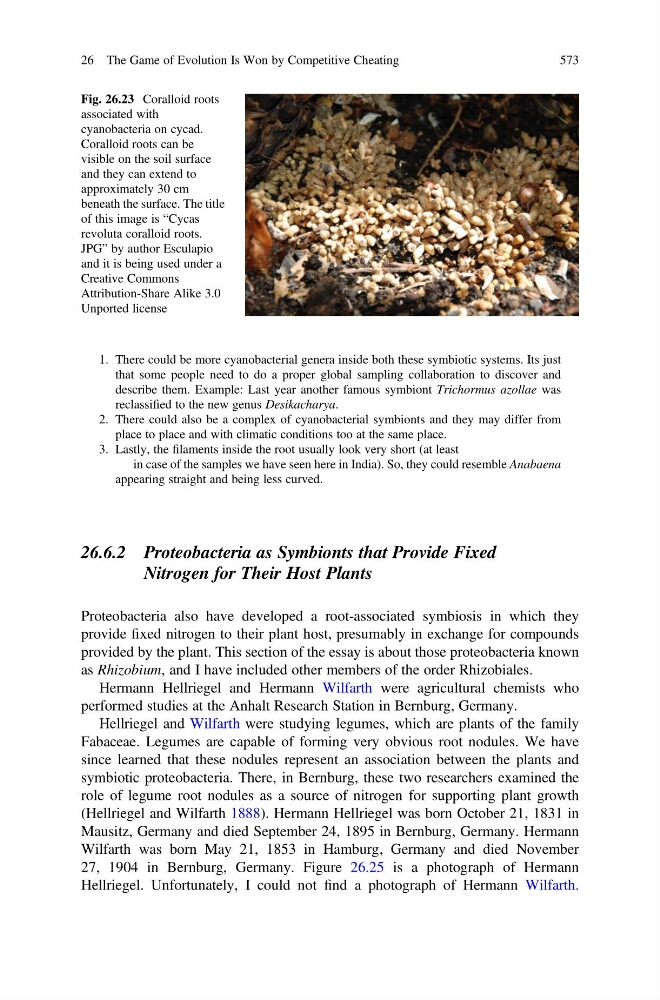
Fig. 26.23 Coralloid roots
associated with
cyanobacteria on cycad.
Coralloid roots can be
visible on the soil surface
and they can extend to
approximately 30 cm
beneath the surface. The title
of this image is “Cycas
revoluta coralloid roots.
JPG” by author Esculapio
and it is being used under a
Creative Commons
Attribution-Share Alike 3.0
Unported license
26 The Game of Evolution Is Won by Competitive Cheating
573
that some people need to do a proper global sampling collaboration to discover and
describe them. Example: Last year another famous symbiont Trichormus azollae was
reclassified to the new genus Desikacharya.
2. There could also be a complex of cyanobacterial symbionts and they may differ from
place to place and with climatic conditions too at the same place.
3. Lastly, the filaments inside the root usually look very short (at least
in case of the samples we have seen here in India). So, they could resemble Anabaena
appearing straight and being less curved.
26.6.2 Proteobacteria as Symbionts that Provide Fixed
Nitrogen for Their Host Plants
Proteobacteria also have developed a root-associated symbiosis in which they
provide fixed nitrogen to their plant host, presumably in exchange for compounds
provided by the plant. This section of the essay is about those proteobacteria known
as Rhizobium, and I have included other members of the order Rhizobiales.
Hermann Hellriegel and Hermann Wilfarth were agricultural chemists who
performed studies at the Anhalt Research Station in Bernburg, Germany.
Hellriegel and Wilfarth were studying legumes, which are plants of the family
Fabaceae. Legumes are capable of forming very obvious root nodules. We have
since learned that these nodules represent an association between the plants and
symbiotic proteobacteria. There, in Bernburg, these two researchers examined the
role of legume root nodules as a source of nitrogen for supporting plant growth
(Hellriegel and Wilfarth 1888). Hermann Hellriegel was born October 21, 1831 in
Mausitz, Germany and died September 24, 1895 in Bernburg, Germany. Hermann
Wilfarth was born May 21, 1853 in Hamburg, Germany and died November
27, 1904 in Bernburg, Germany. Figure 26.25 is a photograph of Hermann
Hellriegel. Unfortunately, I could not find a photograph of Hermann Wilfarth.
Fig. 26.23 Coralloid roots
associated with
cyanobacteria on cycad.
Coralloid roots can be
visible on the soil surface
and they can extend to
approximately 30 cm
beneath the surface. The title
of this image is “Cycas
revoluta coralloid roots.
JPG” by author Esculapio
and it is being used under a
Creative Commons
Attribution-Share Alike 3.0
Unported license
26 The Game of Evolution Is Won by Competitive Cheating
573