

proceed to accumulate mutations independently. In the latter case all the cytochromes c should be equally different from all others.”
Cytochrome c played an interesting role later in one of the first suggestions of
horizontal acquisition of genes. A 1979 report by Richard Ambler touched on the
issues of interspecies gene sharing and the evolutionary deficiency of determinative
bacterial taxonomies. Ambler was first author on a study that indicated that genes
encoding cytochromes c in the purple nonsulfur photosynthetic bacteria had been
shared among different lineages so that their relations to one another did not match
the relations among the organisms that encoded them as determined by Bergey’s
Manual (Ambler et al. 1979). This conclusion was later refuted by both Richard
Dickerson and Woese in contiguous articles in Nature in 1980 (Dickerson 1980;
Woese et al. 1980). They found that grouping these cytochromes c by their structural
features did align with the grouping by their corresponding organism’s 16S rRNA
sequences, a better phylogenetic marker, and so interspecies gene transfer was not
evident.
In 1965 Émile Zuckerkandl and Linus Pauling published an article that expanded
on an earlier publication of theirs (Zuckerkandl and Pauling 1962) by defining
“semantides,” molecules that carry the information of the genes or a transcript
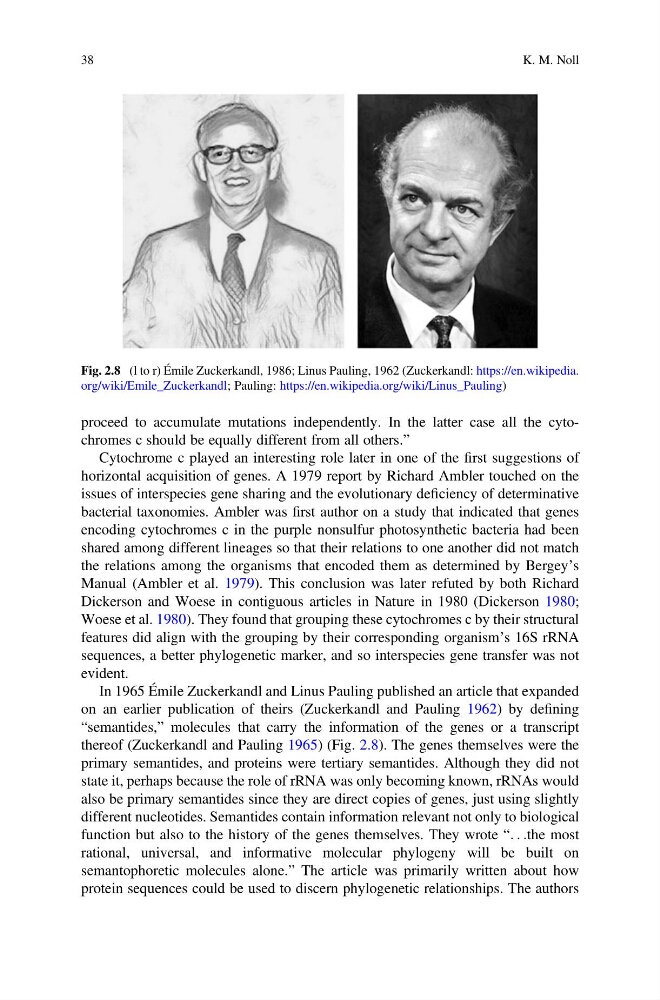
thereof (Zuckerkandl and Pauling 1965) (Fig. 2.8). The genes themselves were the
primary semantides, and proteins were tertiary semantides. Although they did not
state it, perhaps because the role of rRNA was only becoming known, rRNAs would
also be primary semantides since they are direct copies of genes, just using slightly
different nucleotides. Semantides contain information relevant not only to biological
function but also to the history of the genes themselves. They wrote “. . .the most
rational, universal, and informative molecular phylogeny will be built on
semantophoretic molecules alone.” The article was primarily written about how
protein sequences could be used to discern phylogenetic relationships. The authors
Fig. 2.8 (l to r) Émile Zuckerkandl, 1986; Linus Pauling, 1962 (Zuckerkandl: https://en.wikipedia.
org/wiki/Emile_Zuckerkandl; Pauling: https://en.wikipedia.org/wiki/Linus_Pauling)
38
K. M. Noll
Cytochrome c played an interesting role later in one of the first suggestions of
horizontal acquisition of genes. A 1979 report by Richard Ambler touched on the
issues of interspecies gene sharing and the evolutionary deficiency of determinative
bacterial taxonomies. Ambler was first author on a study that indicated that genes
encoding cytochromes c in the purple nonsulfur photosynthetic bacteria had been
shared among different lineages so that their relations to one another did not match
the relations among the organisms that encoded them as determined by Bergey’s
Manual (Ambler et al. 1979). This conclusion was later refuted by both Richard
Dickerson and Woese in contiguous articles in Nature in 1980 (Dickerson 1980;
Woese et al. 1980). They found that grouping these cytochromes c by their structural
features did align with the grouping by their corresponding organism’s 16S rRNA
sequences, a better phylogenetic marker, and so interspecies gene transfer was not
evident.
In 1965 Émile Zuckerkandl and Linus Pauling published an article that expanded
on an earlier publication of theirs (Zuckerkandl and Pauling 1962) by defining
“semantides,” molecules that carry the information of the genes or a transcript
thereof (Zuckerkandl and Pauling 1965) (Fig. 2.8). The genes themselves were the
primary semantides, and proteins were tertiary semantides. Although they did not
state it, perhaps because the role of rRNA was only becoming known, rRNAs would
also be primary semantides since they are direct copies of genes, just using slightly
different nucleotides. Semantides contain information relevant not only to biological
function but also to the history of the genes themselves. They wrote “. . .the most
rational, universal, and informative molecular phylogeny will be built on
semantophoretic molecules alone.” The article was primarily written about how
protein sequences could be used to discern phylogenetic relationships. The authors
Fig. 2.8 (l to r) Émile Zuckerkandl, 1986; Linus Pauling, 1962 (Zuckerkandl: https://en.wikipedia.
org/wiki/Emile_Zuckerkandl; Pauling: https://en.wikipedia.org/wiki/Linus_Pauling)
38
K. M. Noll