

the summer program on morphology and taxonomy (Stanier 1980). He spent a third
year at the Station and, using his new-found interest in taxonomy and his relationship
with van Niel, he co-authored a paper on taxonomy with him in 1941.
The use of Kluyver’s comparative biochemistry findings to gain insight into
Darwin’s early ancestors through a “natural” system of taxonomy soon failed. In
1941 Stanier and van Niel made a classification exclusively using morphological
criteria and abandoned the use of biochemical traits as criteria. They did so because a
physiology-based system necessitates making many highly speculative assumptions
as to what constitute primitive and advanced metabolic types as well as unsupported
speculations about the state of early Earth conditions. This problem haunted such
systems for decades to come causing evolutionary studies to be largely dismissed by
most microbiologists, thus beginning the “Dark Age” (below).
By 1946 van Niel gave up on creating a phylogenetic scheme altogether (van Niel
1946). He capitulated to the “realist” doctrine and created a determinative taxonomic
scheme. He recognized that morphology in plants and animals is associated with
reproduction and so their taxonomies based on morphology carry phylogenetic
value. This is not so in bacteria where their morphology is unrelated to their mode
of passing traits on to progeny and so cannot carry evolutionary information (Cohan
2002). He knew that groupings based on morphology sometimes create undesirable
polyphyletic groupings, but in the absence of true evolutionary characters, true
bacterial phylogenies would be very hard to determine. Nevertheless, he did not
dispair of the need for a bacterial phylogeny and stated, “However, . . . the search for
a basis upon which a ‘natural system’ can be constructed must continue.”
In 1962 Stanier also abandoned the earlier effort at a natural system of taxonomy
for bacteria, and he published, along with van Niel, a paper stating that they could no
longer defend their 1941 effort (Stanier and van Niel 1962). They argued that, as a
practical matter, microbiology needed a definition of a bacterium. Stanier noted later,
“One of the intellectual scandals of general microbiology was an absence of a clear
definition of the bacteria. . . .I was deeply puzzled about this” (Stanier 1980). They
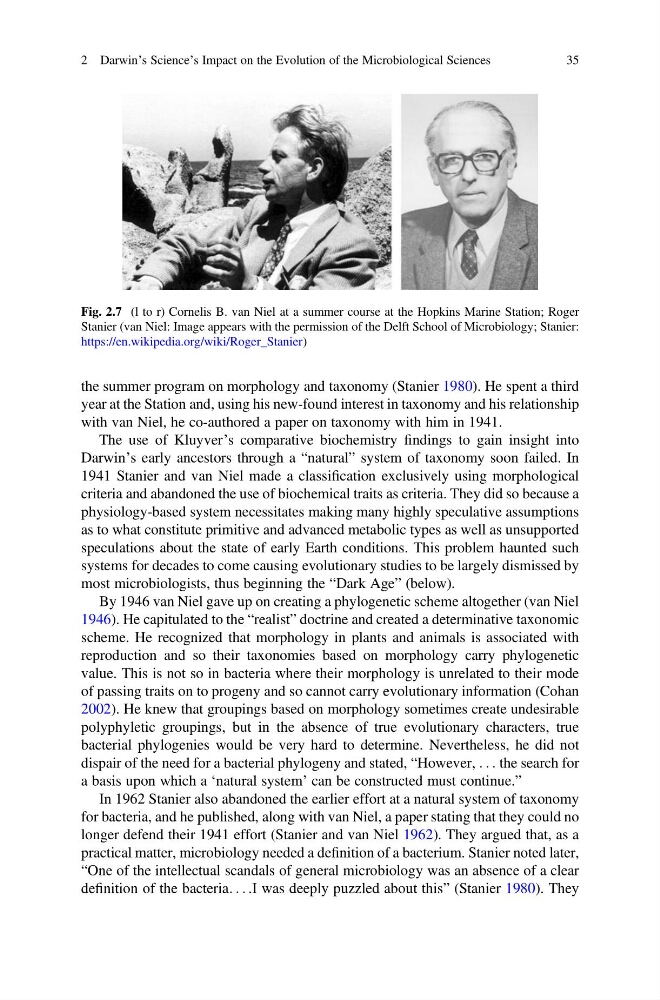
Fig. 2.7 (l to r) Cornelis B. van Niel at a summer course at the Hopkins Marine Station; Roger
Stanier (van Niel: Image appears with the permission of the Delft School of Microbiology; Stanier:
https://en.wikipedia.org/wiki/Roger_Stanier)
2 Darwin’s Science’s Impact on the Evolution of the Microbiological Sciences
35
year at the Station and, using his new-found interest in taxonomy and his relationship
with van Niel, he co-authored a paper on taxonomy with him in 1941.
The use of Kluyver’s comparative biochemistry findings to gain insight into
Darwin’s early ancestors through a “natural” system of taxonomy soon failed. In
1941 Stanier and van Niel made a classification exclusively using morphological
criteria and abandoned the use of biochemical traits as criteria. They did so because a
physiology-based system necessitates making many highly speculative assumptions
as to what constitute primitive and advanced metabolic types as well as unsupported
speculations about the state of early Earth conditions. This problem haunted such
systems for decades to come causing evolutionary studies to be largely dismissed by
most microbiologists, thus beginning the “Dark Age” (below).
By 1946 van Niel gave up on creating a phylogenetic scheme altogether (van Niel
1946). He capitulated to the “realist” doctrine and created a determinative taxonomic
scheme. He recognized that morphology in plants and animals is associated with
reproduction and so their taxonomies based on morphology carry phylogenetic
value. This is not so in bacteria where their morphology is unrelated to their mode
of passing traits on to progeny and so cannot carry evolutionary information (Cohan
2002). He knew that groupings based on morphology sometimes create undesirable
polyphyletic groupings, but in the absence of true evolutionary characters, true
bacterial phylogenies would be very hard to determine. Nevertheless, he did not
dispair of the need for a bacterial phylogeny and stated, “However, . . . the search for
a basis upon which a ‘natural system’ can be constructed must continue.”
In 1962 Stanier also abandoned the earlier effort at a natural system of taxonomy
for bacteria, and he published, along with van Niel, a paper stating that they could no
longer defend their 1941 effort (Stanier and van Niel 1962). They argued that, as a
practical matter, microbiology needed a definition of a bacterium. Stanier noted later,
“One of the intellectual scandals of general microbiology was an absence of a clear
definition of the bacteria. . . .I was deeply puzzled about this” (Stanier 1980). They
Fig. 2.7 (l to r) Cornelis B. van Niel at a summer course at the Hopkins Marine Station; Roger
Stanier (van Niel: Image appears with the permission of the Delft School of Microbiology; Stanier:
https://en.wikipedia.org/wiki/Roger_Stanier)
2 Darwin’s Science’s Impact on the Evolution of the Microbiological Sciences
35