

biologists in being a reflection of the relations among organisms based on their
evolutionary descent.
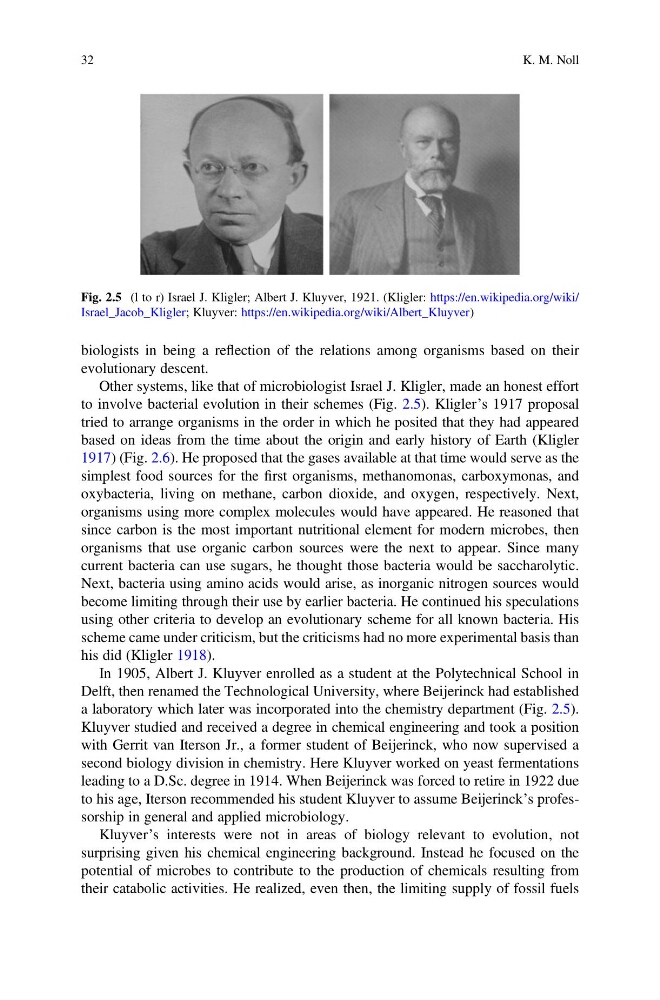
Other systems, like that of microbiologist Israel J. Kligler, made an honest effort
to involve bacterial evolution in their schemes (Fig. 2.5). Kligler’s 1917 proposal
tried to arrange organisms in the order in which he posited that they had appeared
based on ideas from the time about the origin and early history of Earth (Kligler
1917) (Fig. 2.6). He proposed that the gases available at that time would serve as the
simplest food sources for the first organisms, methanomonas, carboxymonas, and
oxybacteria, living on methane, carbon dioxide, and oxygen, respectively. Next,
organisms using more complex molecules would have appeared. He reasoned that
since carbon is the most important nutritional element for modern microbes, then
organisms that use organic carbon sources were the next to appear. Since many
current bacteria can use sugars, he thought those bacteria would be saccharolytic.
Next, bacteria using amino acids would arise, as inorganic nitrogen sources would
become limiting through their use by earlier bacteria. He continued his speculations
using other criteria to develop an evolutionary scheme for all known bacteria. His
scheme came under criticism, but the criticisms had no more experimental basis than
his did (Kligler 1918).
In 1905, Albert J. Kluyver enrolled as a student at the Polytechnical School in
Delft, then renamed the Technological University, where Beijerinck had established
a laboratory which later was incorporated into the chemistry department (Fig. 2.5).
Kluyver studied and received a degree in chemical engineering and took a position
with Gerrit van Iterson Jr., a former student of Beijerinck, who now supervised a
second biology division in chemistry. Here Kluyver worked on yeast fermentations
leading to a D.Sc. degree in 1914. When Beijerinck was forced to retire in 1922 due
to his age, Iterson recommended his student Kluyver to assume Beijerinck’s professorship in general and applied microbiology.
Kluyver’s interests were not in areas of biology relevant to evolution, not
surprising given his chemical engineering background. Instead he focused on the
potential of microbes to contribute to the production of chemicals resulting from
their catabolic activities. He realized, even then, the limiting supply of fossil fuels
Fig. 2.5 (l to r) Israel J. Kligler; Albert J. Kluyver, 1921. (Kligler: https://en.wikipedia.org/wiki/
Israel_Jacob_Kligler; Kluyver: https://en.wikipedia.org/wiki/Albert_Kluyver)
32
K. M. Noll
evolutionary descent.
Other systems, like that of microbiologist Israel J. Kligler, made an honest effort
to involve bacterial evolution in their schemes (Fig. 2.5). Kligler’s 1917 proposal
tried to arrange organisms in the order in which he posited that they had appeared
based on ideas from the time about the origin and early history of Earth (Kligler
1917) (Fig. 2.6). He proposed that the gases available at that time would serve as the
simplest food sources for the first organisms, methanomonas, carboxymonas, and
oxybacteria, living on methane, carbon dioxide, and oxygen, respectively. Next,
organisms using more complex molecules would have appeared. He reasoned that
since carbon is the most important nutritional element for modern microbes, then
organisms that use organic carbon sources were the next to appear. Since many
current bacteria can use sugars, he thought those bacteria would be saccharolytic.
Next, bacteria using amino acids would arise, as inorganic nitrogen sources would
become limiting through their use by earlier bacteria. He continued his speculations
using other criteria to develop an evolutionary scheme for all known bacteria. His
scheme came under criticism, but the criticisms had no more experimental basis than
his did (Kligler 1918).
In 1905, Albert J. Kluyver enrolled as a student at the Polytechnical School in
Delft, then renamed the Technological University, where Beijerinck had established
a laboratory which later was incorporated into the chemistry department (Fig. 2.5).
Kluyver studied and received a degree in chemical engineering and took a position
with Gerrit van Iterson Jr., a former student of Beijerinck, who now supervised a
second biology division in chemistry. Here Kluyver worked on yeast fermentations
leading to a D.Sc. degree in 1914. When Beijerinck was forced to retire in 1922 due
to his age, Iterson recommended his student Kluyver to assume Beijerinck’s professorship in general and applied microbiology.
Kluyver’s interests were not in areas of biology relevant to evolution, not
surprising given his chemical engineering background. Instead he focused on the
potential of microbes to contribute to the production of chemicals resulting from
their catabolic activities. He realized, even then, the limiting supply of fossil fuels
Fig. 2.5 (l to r) Israel J. Kligler; Albert J. Kluyver, 1921. (Kligler: https://en.wikipedia.org/wiki/
Israel_Jacob_Kligler; Kluyver: https://en.wikipedia.org/wiki/Albert_Kluyver)
32
K. M. Noll