

(Ahemad and Kibret 2014). PGPR additionally produce various defensive lytic
enzymes such as chitinase, glucanase, cellulase, protease, chitosanase, peroxidase,
catalase, phenolic lyase, superoxide dismutase, etc. (Aloo et al. 2019) which can act
to protect plants from the pathogens. Pathogens responsible for several plant diseases are directly liable for plant growth inhibition and these are mainly fungi and
insects (Banerjee and Mandal 2019). The lytic enzymes like chitinase, chitosanase,
glucanase and cellulases produced by PGPR act in a straight line biocontrol mechanism against the chitin and glucan cell wall components of those fungi and insects.
Disease control management by the PGPR is additionally accomplished not only by
means of antibiotics produced like zwittermicin, mycosubtilin, gramicidin S,
polymyxin B, bacilysin, rhizocticins, etc. but also by bacteriocins (Saraf et al.
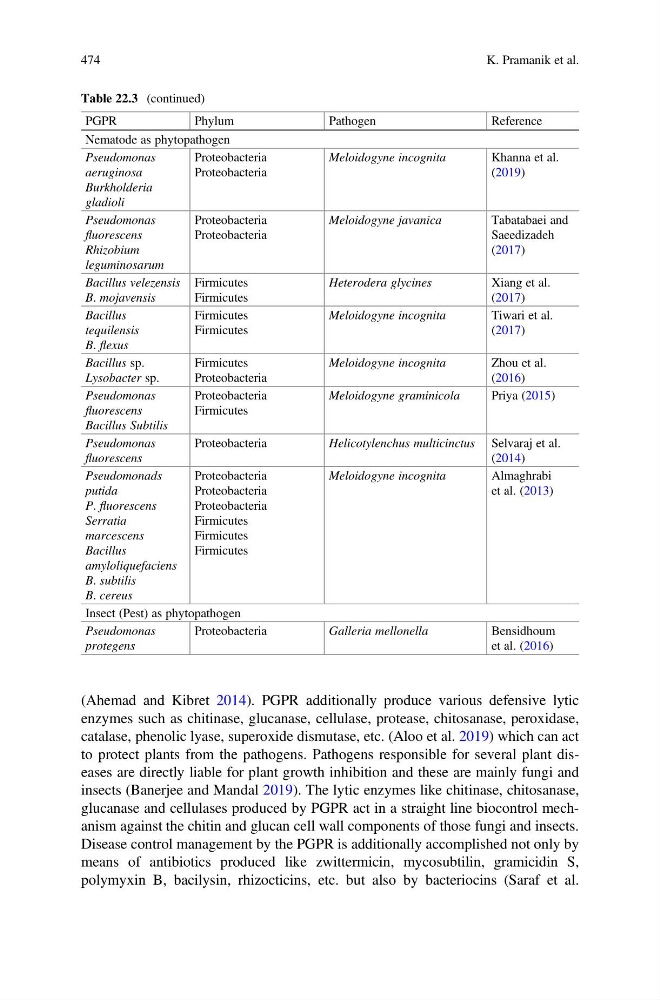
Table 22.3 (continued)
PGPR
Phylum
Pathogen
Reference
Nematode as phytopathogen
Pseudomonas
aeruginosa
Burkholderia
gladioli
Proteobacteria
Proteobacteria
Meloidogyne incognita
Khanna et al.
(2019)
Pseudomonas
fluorescens
Rhizobium
leguminosarum
Proteobacteria
Proteobacteria
Meloidogyne javanica
Tabatabaei and
Saeedizadeh
(2017)
Bacillus velezensis
B. mojavensis
Firmicutes
Firmicutes
Heterodera glycines
Xiang et al.
(2017)
Bacillus
tequilensis
B. flexus
Firmicutes
Firmicutes
Meloidogyne incognita
Tiwari et al.
(2017)
Bacillus sp.
Lysobacter sp.
Firmicutes
Proteobacteria
Meloidogyne incognita
Zhou et al.
(2016)
Pseudomonas
fluorescens
Bacillus Subtilis
Proteobacteria
Firmicutes
Meloidogyne graminicola
Priya (2015)
Pseudomonas
fluorescens
Proteobacteria
Helicotylenchus multicinctus Selvaraj et al.
(2014)
Pseudomonads
putida
P. fluorescens
Serratia
marcescens
Bacillus
amyloliquefaciens
B. subtilis
B. cereus
Proteobacteria
Proteobacteria
Proteobacteria
Firmicutes
Firmicutes
Firmicutes
Meloidogyne incognita
Almaghrabi
et al. (2013)
Insect (Pest) as phytopathogen
Pseudomonas
protegens
Proteobacteria
Galleria mellonella
Bensidhoum
et al. (2016)
474
K. Pramanik et al.
enzymes such as chitinase, glucanase, cellulase, protease, chitosanase, peroxidase,
catalase, phenolic lyase, superoxide dismutase, etc. (Aloo et al. 2019) which can act
to protect plants from the pathogens. Pathogens responsible for several plant diseases are directly liable for plant growth inhibition and these are mainly fungi and
insects (Banerjee and Mandal 2019). The lytic enzymes like chitinase, chitosanase,
glucanase and cellulases produced by PGPR act in a straight line biocontrol mechanism against the chitin and glucan cell wall components of those fungi and insects.
Disease control management by the PGPR is additionally accomplished not only by
means of antibiotics produced like zwittermicin, mycosubtilin, gramicidin S,
polymyxin B, bacilysin, rhizocticins, etc. but also by bacteriocins (Saraf et al.
Table 22.3 (continued)
PGPR
Phylum
Pathogen
Reference
Nematode as phytopathogen
Pseudomonas
aeruginosa
Burkholderia
gladioli
Proteobacteria
Proteobacteria
Meloidogyne incognita
Khanna et al.
(2019)
Pseudomonas
fluorescens
Rhizobium
leguminosarum
Proteobacteria
Proteobacteria
Meloidogyne javanica
Tabatabaei and
Saeedizadeh
(2017)
Bacillus velezensis
B. mojavensis
Firmicutes
Firmicutes
Heterodera glycines
Xiang et al.
(2017)
Bacillus
tequilensis
B. flexus
Firmicutes
Firmicutes
Meloidogyne incognita
Tiwari et al.
(2017)
Bacillus sp.
Lysobacter sp.
Firmicutes
Proteobacteria
Meloidogyne incognita
Zhou et al.
(2016)
Pseudomonas
fluorescens
Bacillus Subtilis
Proteobacteria
Firmicutes
Meloidogyne graminicola
Priya (2015)
Pseudomonas
fluorescens
Proteobacteria
Helicotylenchus multicinctus Selvaraj et al.
(2014)
Pseudomonads
putida
P. fluorescens
Serratia
marcescens
Bacillus
amyloliquefaciens
B. subtilis
B. cereus
Proteobacteria
Proteobacteria
Proteobacteria
Firmicutes
Firmicutes
Firmicutes
Meloidogyne incognita
Almaghrabi
et al. (2013)
Insect (Pest) as phytopathogen
Pseudomonas
protegens
Proteobacteria
Galleria mellonella
Bensidhoum
et al. (2016)
474
K. Pramanik et al.