

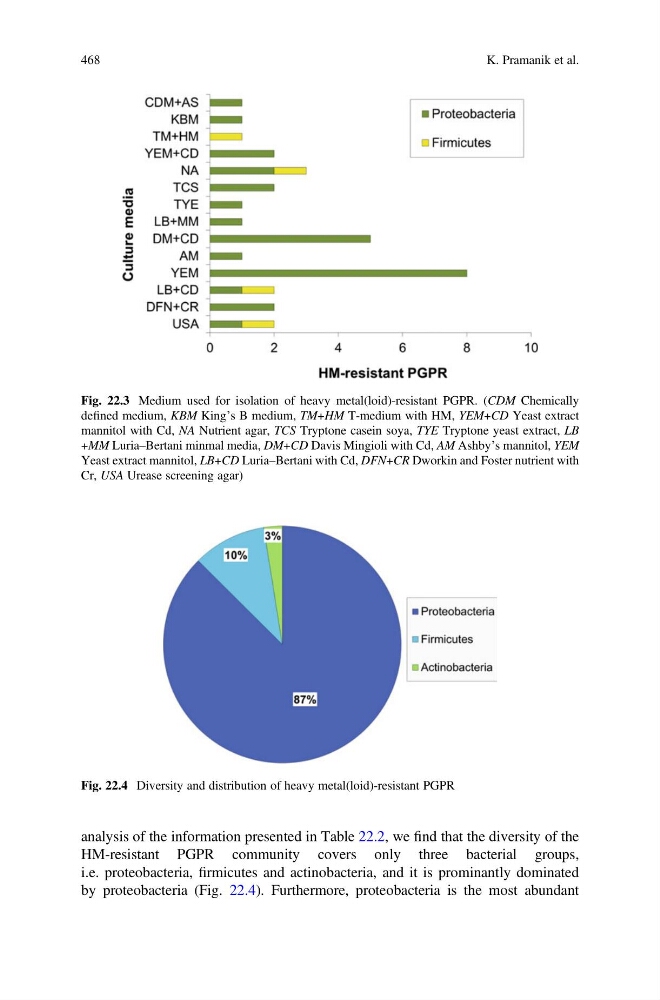
analysis of the information presented in Table 22.2, we find that the diversity of the
HM-resistant PGPR community covers only three bacterial groups,
i.e. proteobacteria, firmicutes and actinobacteria, and it is prominantly dominated
by proteobacteria (Fig. 22.4). Furthermore, proteobacteria is the most abundant
Fig. 22.3 Medium used for isolation of heavy metal(loid)-resistant PGPR. (CDM Chemically
defined medium, KBM King’s B medium, TM+HM T-medium with HM, YEM+CD Yeast extract
mannitol with Cd, NA Nutrient agar, TCS Tryptone casein soya, TYE Tryptone yeast extract, LB
+MM Luria–Bertani minmal media, DM+CD Davis Mingioli with Cd, AM Ashby’s mannitol, YEM
Yeast extract mannitol, LB+CD Luria–Bertani with Cd, DFN+CR Dworkin and Foster nutrient with
Cr, USA Urease screening agar)
Fig. 22.4 Diversity and distribution of heavy metal(loid)-resistant PGPR
468
K. Pramanik et al.
HM-resistant PGPR community covers only three bacterial groups,
i.e. proteobacteria, firmicutes and actinobacteria, and it is prominantly dominated
by proteobacteria (Fig. 22.4). Furthermore, proteobacteria is the most abundant
Fig. 22.3 Medium used for isolation of heavy metal(loid)-resistant PGPR. (CDM Chemically
defined medium, KBM King’s B medium, TM+HM T-medium with HM, YEM+CD Yeast extract
mannitol with Cd, NA Nutrient agar, TCS Tryptone casein soya, TYE Tryptone yeast extract, LB
+MM Luria–Bertani minmal media, DM+CD Davis Mingioli with Cd, AM Ashby’s mannitol, YEM
Yeast extract mannitol, LB+CD Luria–Bertani with Cd, DFN+CR Dworkin and Foster nutrient with
Cr, USA Urease screening agar)
Fig. 22.4 Diversity and distribution of heavy metal(loid)-resistant PGPR
468
K. Pramanik et al.