

20.3.3.12 Anabena
Anabena belonging to cyanobacteria also called blue green algae that fix atmospheric nitrogen are well known for their symbiotic relationship with Azolla, which
is a heterosporous aquatic fern (Ladha and Watanabe 1984). The symbiont Anabena
azollae habits in specialized cavities formed in the dorsal leaf lobes and the apex of
the stem of the fern (Ladha and Watanabe 1984). Also, many other cyanobacteria are
reported to cohabit with rice, proliferating as planktonic cells on the soil-water
surface. The inoculation studies of Anabena to rice had been also conducted to
exploit nitrogen supplement in paddy fields, specifically in several countries of
South East Asia (Prasanna et al. 2009). There are two ways to input nitrogen supply
based microbes in wetland rice cultivation. The first one includes indigenous
organisms of heterotrophic aerobic, microaerophilic and anaerobic bacteria in soil
that associated with rice, photosynthetic bacteria, and cyanobacteria (Bray 1986).
The other one uses amending green manures of fern Azolla and legumes. Traditional
cultivation of wetland rice has been highly sustainable because biological N 2 fixation
has allowed a moderate but stable rice yield in practice to be maintained for years
without amending N fertilizer (Bray 1986). It is well known that the exchange of
nitrogen from the cyano-symbiont for carbohydrates of the host plant had been
attractive for scientists to have intensive studies mainly because of the potential
for AzoIla and Anabaena to be in practice as organic fertilizer in wetland rice soils,
and even as nitrogenous food sources for various animals (Van Hove et al. 1987;
Van Hove 1989; Watanabe et al. 1989). However, the molecular studies on the
specific genes associated for interaction of Anabena and Azolla seems not to be
much conducted. However, update advances in molecular genetic techniques would
allow us to understand genetic relationship of Anabena and Azolla which are
symbiotically competent in near future.
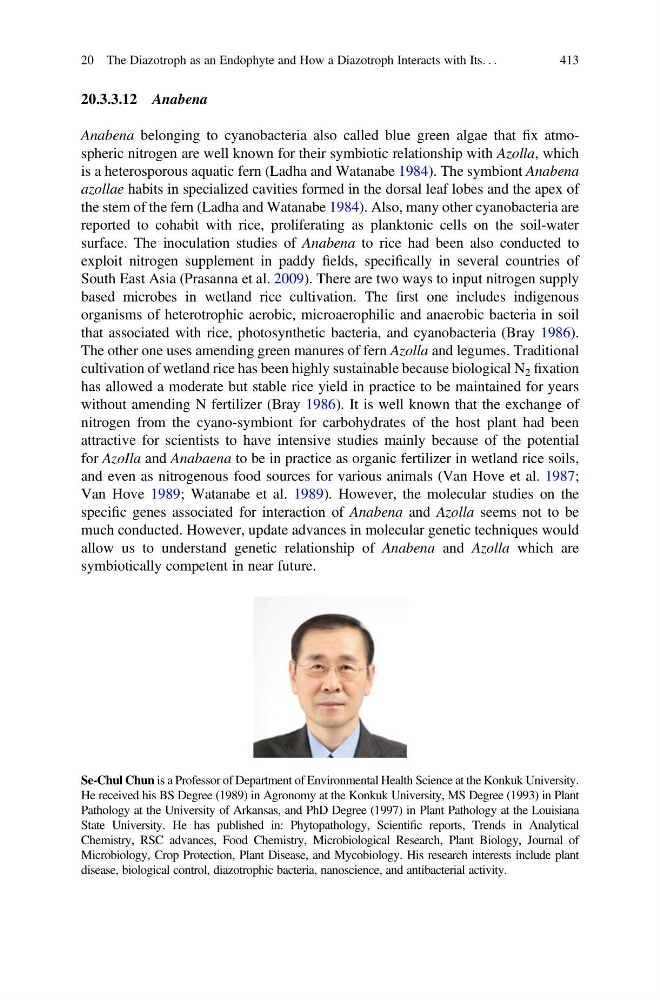
Se-Chul Chun is a Professor of Department of Environmental Health Science at the Konkuk University.
He received his BS Degree (1989) in Agronomy at the Konkuk University, MS Degree (1993) in Plant
Pathology at the University of Arkansas, and PhD Degree (1997) in Plant Pathology at the Louisiana
State University. He has published in: Phytopathology, Scientific reports, Trends in Analytical
Chemistry, RSC advances, Food Chemistry, Microbiological Research, Plant Biology, Journal of
Microbiology, Crop Protection, Plant Disease, and Mycobiology. His research interests include plant
disease, biological control, diazotrophic bacteria, nanoscience, and antibacterial activity.
20 The Diazotroph as an Endophyte and How a Diazotroph Interacts with Its. . .
413
Anabena belonging to cyanobacteria also called blue green algae that fix atmospheric nitrogen are well known for their symbiotic relationship with Azolla, which
is a heterosporous aquatic fern (Ladha and Watanabe 1984). The symbiont Anabena
azollae habits in specialized cavities formed in the dorsal leaf lobes and the apex of
the stem of the fern (Ladha and Watanabe 1984). Also, many other cyanobacteria are
reported to cohabit with rice, proliferating as planktonic cells on the soil-water
surface. The inoculation studies of Anabena to rice had been also conducted to
exploit nitrogen supplement in paddy fields, specifically in several countries of
South East Asia (Prasanna et al. 2009). There are two ways to input nitrogen supply
based microbes in wetland rice cultivation. The first one includes indigenous
organisms of heterotrophic aerobic, microaerophilic and anaerobic bacteria in soil
that associated with rice, photosynthetic bacteria, and cyanobacteria (Bray 1986).
The other one uses amending green manures of fern Azolla and legumes. Traditional
cultivation of wetland rice has been highly sustainable because biological N 2 fixation
has allowed a moderate but stable rice yield in practice to be maintained for years
without amending N fertilizer (Bray 1986). It is well known that the exchange of
nitrogen from the cyano-symbiont for carbohydrates of the host plant had been
attractive for scientists to have intensive studies mainly because of the potential
for AzoIla and Anabaena to be in practice as organic fertilizer in wetland rice soils,
and even as nitrogenous food sources for various animals (Van Hove et al. 1987;
Van Hove 1989; Watanabe et al. 1989). However, the molecular studies on the
specific genes associated for interaction of Anabena and Azolla seems not to be
much conducted. However, update advances in molecular genetic techniques would
allow us to understand genetic relationship of Anabena and Azolla which are
symbiotically competent in near future.
Se-Chul Chun is a Professor of Department of Environmental Health Science at the Konkuk University.
He received his BS Degree (1989) in Agronomy at the Konkuk University, MS Degree (1993) in Plant
Pathology at the University of Arkansas, and PhD Degree (1997) in Plant Pathology at the Louisiana
State University. He has published in: Phytopathology, Scientific reports, Trends in Analytical
Chemistry, RSC advances, Food Chemistry, Microbiological Research, Plant Biology, Journal of
Microbiology, Crop Protection, Plant Disease, and Mycobiology. His research interests include plant
disease, biological control, diazotrophic bacteria, nanoscience, and antibacterial activity.
20 The Diazotroph as an Endophyte and How a Diazotroph Interacts with Its. . .
413