

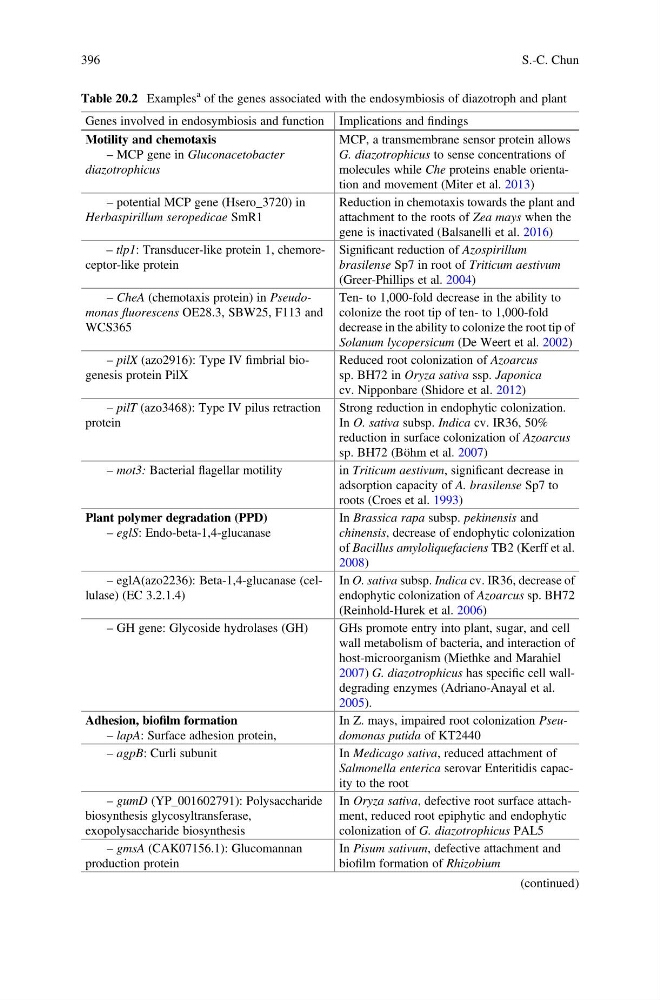
Table 20.2 Examples
a of the genes associated with the endosymbiosis of diazotroph and plant
Genes involved in endosymbiosis and function Implications and findings
Motility and chemotaxis
– MCP gene in Gluconacetobacter
diazotrophicus
MCP, a transmembrane sensor protein allows
G. diazotrophicus to sense concentrations of
molecules while Che proteins enable orientation and movement (Miter et al. 2013)
– potential MCP gene (Hsero_3720) in
Herbaspirillum seropedicae SmR1
Reduction in chemotaxis towards the plant and
attachment to the roots of Zea mays when the
gene is inactivated (Balsanelli et al. 2016)
– tlp1: Transducer-like protein 1, chemoreceptor-like protein
Significant reduction of Azospirillum
brasilense Sp7 in root of Triticum aestivum
(Greer-Phillips et al. 2004)
– CheA (chemotaxis protein) in Pseudomonas fluorescens OE28.3, SBW25, F113 and
WCS365
Ten- to 1,000-fold decrease in the ability to
colonize the root tip of ten- to 1,000-fold
decrease in the ability to colonize the root tip of
Solanum lycopersicum (De Weert et al. 2002)
– pilX (azo2916): Type IV fimbrial biogenesis protein PilX
Reduced root colonization of Azoarcus
sp. BH72 in Oryza sativa ssp. Japonica
cv. Nipponbare (Shidore et al. 2012)
– pilT (azo3468): Type IV pilus retraction
protein
Strong reduction in endophytic colonization.
In O. sativa subsp. Indica cv. IR36, 50%
reduction in surface colonization of Azoarcus
sp. BH72 (Böhm et al. 2007)
– mot3: Bacterial flagellar motility
in Triticum aestivum, significant decrease in
adsorption capacity of A. brasilense Sp7 to
roots (Croes et al. 1993)
Plant polymer degradation (PPD)
– eglS: Endo-beta-1,4-glucanase
In Brassica rapa subsp. pekinensis and
chinensis, decrease of endophytic colonization
of Bacillus amyloliquefaciens TB2 (Kerff et al.
2008)
– eglA(azo2236): Beta-1,4-glucanase (cellulase) (EC 3.2.1.4)
In O. sativa subsp. Indica cv. IR36, decrease of
endophytic colonization of Azoarcus sp. BH72
(Reinhold-Hurek et al. 2006)
– GH gene: Glycoside hydrolases (GH)
GHs promote entry into plant, sugar, and cell
wall metabolism of bacteria, and interaction of
host-microorganism (Miethke and Marahiel
2007) G. diazotrophicus has specific cell walldegrading enzymes (Adriano-Anayal et al.
2005).
Adhesion, biofilm formation
– lapA: Surface adhesion protein,
In Z. mays, impaired root colonization Pseudomonas putida of KT2440
– agpB: Curli subunit
In Medicago sativa, reduced attachment of
Salmonella enterica serovar Enteritidis capacity to the root
– gumD (YP_001602791): Polysaccharide
biosynthesis glycosyltransferase,
exopolysaccharide biosynthesis
In Oryza sativa, defective root surface attachment, reduced root epiphytic and endophytic
colonization of G. diazotrophicus PAL5
– gmsA (CAK07156.1): Glucomannan
production protein
In Pisum sativum, defective attachment and
biofilm formation of Rhizobium
(continued)
396
S.-C. Chun
a of the genes associated with the endosymbiosis of diazotroph and plant
Genes involved in endosymbiosis and function Implications and findings
Motility and chemotaxis
– MCP gene in Gluconacetobacter
diazotrophicus
MCP, a transmembrane sensor protein allows
G. diazotrophicus to sense concentrations of
molecules while Che proteins enable orientation and movement (Miter et al. 2013)
– potential MCP gene (Hsero_3720) in
Herbaspirillum seropedicae SmR1
Reduction in chemotaxis towards the plant and
attachment to the roots of Zea mays when the
gene is inactivated (Balsanelli et al. 2016)
– tlp1: Transducer-like protein 1, chemoreceptor-like protein
Significant reduction of Azospirillum
brasilense Sp7 in root of Triticum aestivum
(Greer-Phillips et al. 2004)
– CheA (chemotaxis protein) in Pseudomonas fluorescens OE28.3, SBW25, F113 and
WCS365
Ten- to 1,000-fold decrease in the ability to
colonize the root tip of ten- to 1,000-fold
decrease in the ability to colonize the root tip of
Solanum lycopersicum (De Weert et al. 2002)
– pilX (azo2916): Type IV fimbrial biogenesis protein PilX
Reduced root colonization of Azoarcus
sp. BH72 in Oryza sativa ssp. Japonica
cv. Nipponbare (Shidore et al. 2012)
– pilT (azo3468): Type IV pilus retraction
protein
Strong reduction in endophytic colonization.
In O. sativa subsp. Indica cv. IR36, 50%
reduction in surface colonization of Azoarcus
sp. BH72 (Böhm et al. 2007)
– mot3: Bacterial flagellar motility
in Triticum aestivum, significant decrease in
adsorption capacity of A. brasilense Sp7 to
roots (Croes et al. 1993)
Plant polymer degradation (PPD)
– eglS: Endo-beta-1,4-glucanase
In Brassica rapa subsp. pekinensis and
chinensis, decrease of endophytic colonization
of Bacillus amyloliquefaciens TB2 (Kerff et al.
2008)
– eglA(azo2236): Beta-1,4-glucanase (cellulase) (EC 3.2.1.4)
In O. sativa subsp. Indica cv. IR36, decrease of
endophytic colonization of Azoarcus sp. BH72
(Reinhold-Hurek et al. 2006)
– GH gene: Glycoside hydrolases (GH)
GHs promote entry into plant, sugar, and cell
wall metabolism of bacteria, and interaction of
host-microorganism (Miethke and Marahiel
2007) G. diazotrophicus has specific cell walldegrading enzymes (Adriano-Anayal et al.
2005).
Adhesion, biofilm formation
– lapA: Surface adhesion protein,
In Z. mays, impaired root colonization Pseudomonas putida of KT2440
– agpB: Curli subunit
In Medicago sativa, reduced attachment of
Salmonella enterica serovar Enteritidis capacity to the root
– gumD (YP_001602791): Polysaccharide
biosynthesis glycosyltransferase,
exopolysaccharide biosynthesis
In Oryza sativa, defective root surface attachment, reduced root epiphytic and endophytic
colonization of G. diazotrophicus PAL5
– gmsA (CAK07156.1): Glucomannan
production protein
In Pisum sativum, defective attachment and
biofilm formation of Rhizobium
(continued)
396
S.-C. Chun