

1830s (Barnett 2003). Organic chemistry was a new field at the time, and it held that
the chemical transformation of the “ferments” (fermentation broths used to produce
products) was caused by the vibrations of organic molecules or some catalytic
process. Yeast cells seen in these ferments were thought to play some secondary
role. Among those holding these views was Justus von Liebig, who argued against a
causative role of yeast cells well into the late nineteenth century (Hein 1961). Louis
Pasteur’s experiments in the 1850s and 1860s conclusively demonstrated that living
organisms were responsible for the alcoholic and lactic acid fermentations. With the
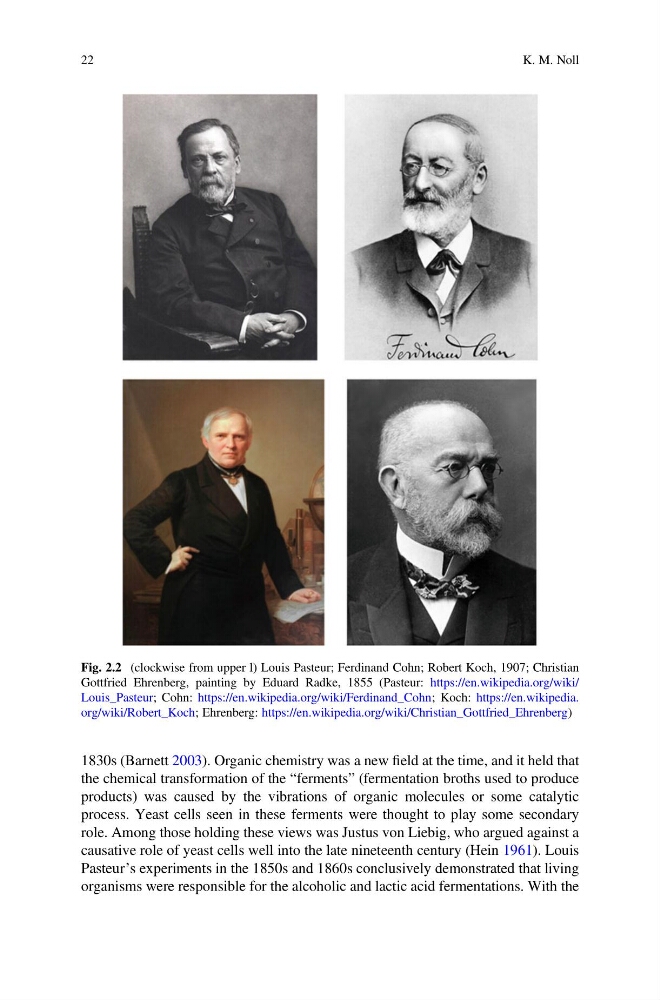
Fig. 2.2 (clockwise from upper l) Louis Pasteur; Ferdinand Cohn; Robert Koch, 1907; Christian
Gottfried Ehrenberg, painting by Eduard Radke, 1855 (Pasteur: https://en.wikipedia.org/wiki/
Louis_Pasteur; Cohn: https://en.wikipedia.org/wiki/Ferdinand_Cohn; Koch: https://en.wikipedia.
org/wiki/Robert_Koch; Ehrenberg: https://en.wikipedia.org/wiki/Christian_Gottfried_Ehrenberg)
22
K. M. Noll
the chemical transformation of the “ferments” (fermentation broths used to produce
products) was caused by the vibrations of organic molecules or some catalytic
process. Yeast cells seen in these ferments were thought to play some secondary
role. Among those holding these views was Justus von Liebig, who argued against a
causative role of yeast cells well into the late nineteenth century (Hein 1961). Louis
Pasteur’s experiments in the 1850s and 1860s conclusively demonstrated that living
organisms were responsible for the alcoholic and lactic acid fermentations. With the
Fig. 2.2 (clockwise from upper l) Louis Pasteur; Ferdinand Cohn; Robert Koch, 1907; Christian
Gottfried Ehrenberg, painting by Eduard Radke, 1855 (Pasteur: https://en.wikipedia.org/wiki/
Louis_Pasteur; Cohn: https://en.wikipedia.org/wiki/Ferdinand_Cohn; Koch: https://en.wikipedia.
org/wiki/Robert_Koch; Ehrenberg: https://en.wikipedia.org/wiki/Christian_Gottfried_Ehrenberg)
22
K. M. Noll