

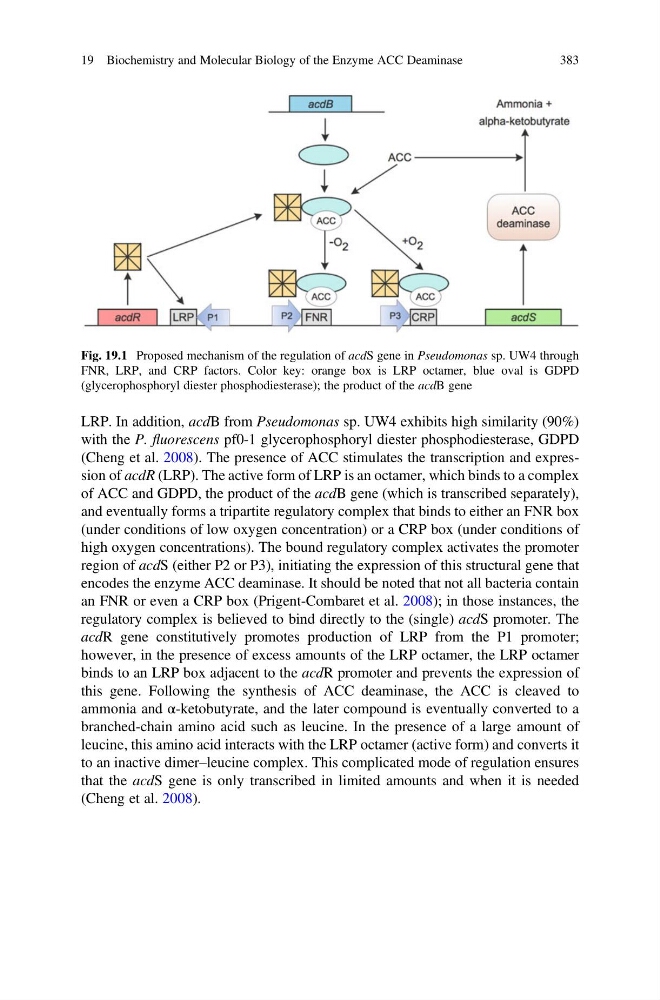
LRP. In addition, acdB from Pseudomonas sp. UW4 exhibits high similarity (90%)
with the P. fluorescens pf0-1 glycerophosphoryl diester phosphodiesterase, GDPD
(Cheng et al. 2008). The presence of ACC stimulates the transcription and expression of acdR (LRP). The active form of LRP is an octamer, which binds to a complex
of ACC and GDPD, the product of the acdB gene (which is transcribed separately),
and eventually forms a tripartite regulatory complex that binds to either an FNR box
(under conditions of low oxygen concentration) or a CRP box (under conditions of
high oxygen concentrations). The bound regulatory complex activates the promoter
region of acdS (either P2 or P3), initiating the expression of this structural gene that
encodes the enzyme ACC deaminase. It should be noted that not all bacteria contain
an FNR or even a CRP box (Prigent-Combaret et al. 2008); in those instances, the
regulatory complex is believed to bind directly to the (single) acdS promoter. The
acdR gene constitutively promotes production of LRP from the P1 promoter;
however, in the presence of excess amounts of the LRP octamer, the LRP octamer
binds to an LRP box adjacent to the acdR promoter and prevents the expression of
this gene. Following the synthesis of ACC deaminase, the ACC is cleaved to
ammonia and α-ketobutyrate, and the later compound is eventually converted to a
branched-chain amino acid such as leucine. In the presence of a large amount of
leucine, this amino acid interacts with the LRP octamer (active form) and converts it
to an inactive dimer–leucine complex. This complicated mode of regulation ensures
that the acdS gene is only transcribed in limited amounts and when it is needed
(Cheng et al. 2008).
Fig. 19.1 Proposed mechanism of the regulation of acdS gene in Pseudomonas sp. UW4 through
FNR, LRP, and CRP factors. Color key: orange box is LRP octamer, blue oval is GDPD
(glycerophosphoryl diester phosphodiesterase); the product of the acdB gene
19 Biochemistry and Molecular Biology of the Enzyme ACC Deaminase
383
with the P. fluorescens pf0-1 glycerophosphoryl diester phosphodiesterase, GDPD
(Cheng et al. 2008). The presence of ACC stimulates the transcription and expression of acdR (LRP). The active form of LRP is an octamer, which binds to a complex
of ACC and GDPD, the product of the acdB gene (which is transcribed separately),
and eventually forms a tripartite regulatory complex that binds to either an FNR box
(under conditions of low oxygen concentration) or a CRP box (under conditions of
high oxygen concentrations). The bound regulatory complex activates the promoter
region of acdS (either P2 or P3), initiating the expression of this structural gene that
encodes the enzyme ACC deaminase. It should be noted that not all bacteria contain
an FNR or even a CRP box (Prigent-Combaret et al. 2008); in those instances, the
regulatory complex is believed to bind directly to the (single) acdS promoter. The
acdR gene constitutively promotes production of LRP from the P1 promoter;
however, in the presence of excess amounts of the LRP octamer, the LRP octamer
binds to an LRP box adjacent to the acdR promoter and prevents the expression of
this gene. Following the synthesis of ACC deaminase, the ACC is cleaved to
ammonia and α-ketobutyrate, and the later compound is eventually converted to a
branched-chain amino acid such as leucine. In the presence of a large amount of
leucine, this amino acid interacts with the LRP octamer (active form) and converts it
to an inactive dimer–leucine complex. This complicated mode of regulation ensures
that the acdS gene is only transcribed in limited amounts and when it is needed
(Cheng et al. 2008).
Fig. 19.1 Proposed mechanism of the regulation of acdS gene in Pseudomonas sp. UW4 through
FNR, LRP, and CRP factors. Color key: orange box is LRP octamer, blue oval is GDPD
(glycerophosphoryl diester phosphodiesterase); the product of the acdB gene
19 Biochemistry and Molecular Biology of the Enzyme ACC Deaminase
383