

and pure cultures were formulated. The reality is very different. In this article I will
attempt to show that Darwin’s knowledge of microbes was very current for his time
and he did a small amount of work with microbes and microscopic organisms. He
also included them in his thinking about the evolution of life. Finally, I will show
how his work greatly impacted the thinking of those who founded modern microbiology and how his work has been rediscovered in recent years and now underpins
revolutionary new thinking in the field.
2.2 Darwin’s Research Topics
Charles Darwin is best known, of course, for positing that species arise from variants
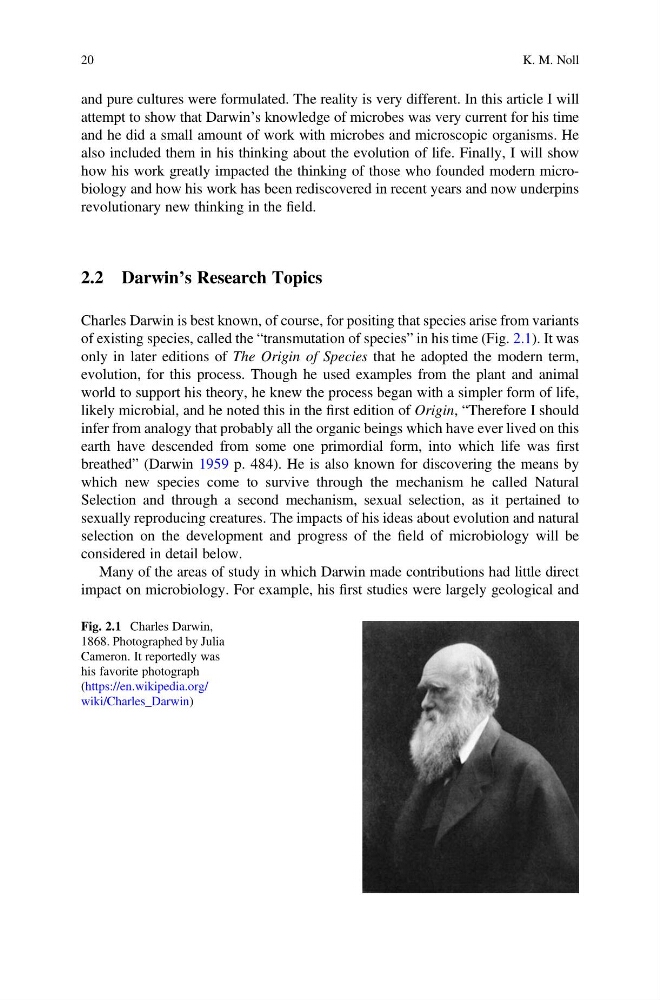
of existing species, called the “transmutation of species” in his time (Fig. 2.1). It was
only in later editions of The Origin of Species that he adopted the modern term,
evolution, for this process. Though he used examples from the plant and animal
world to support his theory, he knew the process began with a simpler form of life,
likely microbial, and he noted this in the first edition of Origin, “Therefore I should
infer from analogy that probably all the organic beings which have ever lived on this
earth have descended from some one primordial form, into which life was first
breathed” (Darwin 1959 p. 484). He is also known for discovering the means by
which new species come to survive through the mechanism he called Natural
Selection and through a second mechanism, sexual selection, as it pertained to
sexually reproducing creatures. The impacts of his ideas about evolution and natural
selection on the development and progress of the field of microbiology will be
considered in detail below.
Many of the areas of study in which Darwin made contributions had little direct
impact on microbiology. For example, his first studies were largely geological and
Fig. 2.1 Charles Darwin,
1868. Photographed by Julia
Cameron. It reportedly was
his favorite photograph
(https://en.wikipedia.org/
wiki/Charles_Darwin)
20
K. M. Noll
attempt to show that Darwin’s knowledge of microbes was very current for his time
and he did a small amount of work with microbes and microscopic organisms. He
also included them in his thinking about the evolution of life. Finally, I will show
how his work greatly impacted the thinking of those who founded modern microbiology and how his work has been rediscovered in recent years and now underpins
revolutionary new thinking in the field.
2.2 Darwin’s Research Topics
Charles Darwin is best known, of course, for positing that species arise from variants
of existing species, called the “transmutation of species” in his time (Fig. 2.1). It was
only in later editions of The Origin of Species that he adopted the modern term,
evolution, for this process. Though he used examples from the plant and animal
world to support his theory, he knew the process began with a simpler form of life,
likely microbial, and he noted this in the first edition of Origin, “Therefore I should
infer from analogy that probably all the organic beings which have ever lived on this
earth have descended from some one primordial form, into which life was first
breathed” (Darwin 1959 p. 484). He is also known for discovering the means by
which new species come to survive through the mechanism he called Natural
Selection and through a second mechanism, sexual selection, as it pertained to
sexually reproducing creatures. The impacts of his ideas about evolution and natural
selection on the development and progress of the field of microbiology will be
considered in detail below.
Many of the areas of study in which Darwin made contributions had little direct
impact on microbiology. For example, his first studies were largely geological and
Fig. 2.1 Charles Darwin,
1868. Photographed by Julia
Cameron. It reportedly was
his favorite photograph
(https://en.wikipedia.org/
wiki/Charles_Darwin)
20
K. M. Noll