

18.4.6 Spore-Forming Organisms That Set Up
Immunoregulation
The previous sections make the point that microbial components such as LPS
provide signals via TLR and other PRR in the airways and gut that set up immunoregulatory pathways. This process does not necessarily imply colonization, and can
be mediated by fragments of dead microorganisms in inhaled dust. However some
strains, including several spore-forming organisms, need to colonise in order to drive
immunoregulation. Spores can persist in the environment for hundreds, perhaps
thousands, of years (Nicholson 2002). Therefore, wherever humans (or indeed
other vertebrates with similar guts and diets) have lived, the environment is seeded
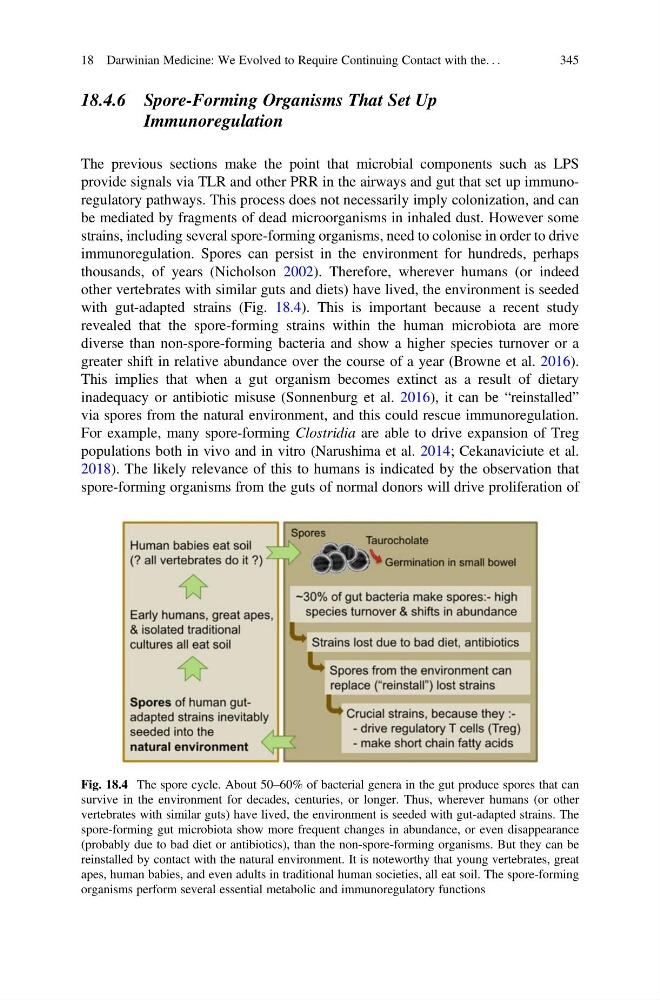
with gut-adapted strains (Fig. 18.4). This is important because a recent study
revealed that the spore-forming strains within the human microbiota are more
diverse than non-spore-forming bacteria and show a higher species turnover or a
greater shift in relative abundance over the course of a year (Browne et al. 2016).
This implies that when a gut organism becomes extinct as a result of dietary
inadequacy or antibiotic misuse (Sonnenburg et al. 2016), it can be “reinstalled”
via spores from the natural environment, and this could rescue immunoregulation.
For example, many spore-forming Clostridia are able to drive expansion of Treg
populations both in vivo and in vitro (Narushima et al. 2014; Cekanaviciute et al.
2018). The likely relevance of this to humans is indicated by the observation that
spore-forming organisms from the guts of normal donors will drive proliferation of
Fig. 18.4 The spore cycle. About 50–60% of bacterial genera in the gut produce spores that can
survive in the environment for decades, centuries, or longer. Thus, wherever humans (or other
vertebrates with similar guts) have lived, the environment is seeded with gut-adapted strains. The
spore-forming gut microbiota show more frequent changes in abundance, or even disappearance
(probably due to bad diet or antibiotics), than the non-spore-forming organisms. But they can be
reinstalled by contact with the natural environment. It is noteworthy that young vertebrates, great
apes, human babies, and even adults in traditional human societies, all eat soil. The spore-forming
organisms perform several essential metabolic and immunoregulatory functions
18 Darwinian Medicine: We Evolved to Require Continuing Contact with the. . .
345
Immunoregulation
The previous sections make the point that microbial components such as LPS
provide signals via TLR and other PRR in the airways and gut that set up immunoregulatory pathways. This process does not necessarily imply colonization, and can
be mediated by fragments of dead microorganisms in inhaled dust. However some
strains, including several spore-forming organisms, need to colonise in order to drive
immunoregulation. Spores can persist in the environment for hundreds, perhaps
thousands, of years (Nicholson 2002). Therefore, wherever humans (or indeed
other vertebrates with similar guts and diets) have lived, the environment is seeded
with gut-adapted strains (Fig. 18.4). This is important because a recent study
revealed that the spore-forming strains within the human microbiota are more
diverse than non-spore-forming bacteria and show a higher species turnover or a
greater shift in relative abundance over the course of a year (Browne et al. 2016).
This implies that when a gut organism becomes extinct as a result of dietary
inadequacy or antibiotic misuse (Sonnenburg et al. 2016), it can be “reinstalled”
via spores from the natural environment, and this could rescue immunoregulation.
For example, many spore-forming Clostridia are able to drive expansion of Treg
populations both in vivo and in vitro (Narushima et al. 2014; Cekanaviciute et al.
2018). The likely relevance of this to humans is indicated by the observation that
spore-forming organisms from the guts of normal donors will drive proliferation of
Fig. 18.4 The spore cycle. About 50–60% of bacterial genera in the gut produce spores that can
survive in the environment for decades, centuries, or longer. Thus, wherever humans (or other
vertebrates with similar guts) have lived, the environment is seeded with gut-adapted strains. The
spore-forming gut microbiota show more frequent changes in abundance, or even disappearance
(probably due to bad diet or antibiotics), than the non-spore-forming organisms. But they can be
reinstalled by contact with the natural environment. It is noteworthy that young vertebrates, great
apes, human babies, and even adults in traditional human societies, all eat soil. The spore-forming
organisms perform several essential metabolic and immunoregulatory functions
18 Darwinian Medicine: We Evolved to Require Continuing Contact with the. . .
345