

a custom-made repertoire, and eliminates the lymphocytes that recognise nothing.
The diversity of this repertoire needs to be large. All biological entities are built from
variants of the same building blocks, so the more diverse the lymphocyte repertoire,
the more likely it is to include memory cells that by chance recognise a novel virus,
such as HIV (Su et al. 2013). Such T cells are not found in the blood of newborns,
and seem to be induced by cross-reactivity of the T cell receptor with environmental
antigens. They can be induced by vaccinations, and this probably represents one of
the mechanisms that cause vaccines, particularly live polio, measles, and BCG, to
benefit health more broadly than can be accounted for by protection from the
targeted infection (Aaby and Benn 2020).
18.4.2 Modified Regulation of the Microbiota
This extended repertoire of lymphocytes is also needed for controlling and tolerating
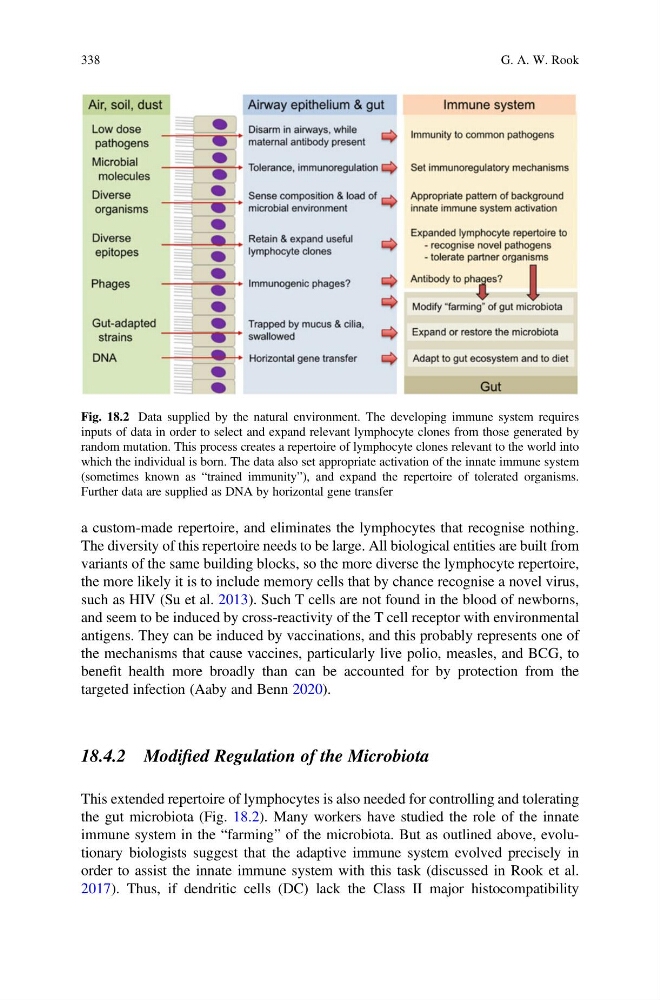
the gut microbiota (Fig. 18.2). Many workers have studied the role of the innate
immune system in the “farming” of the microbiota. But as outlined above, evolutionary biologists suggest that the adaptive immune system evolved precisely in
order to assist the innate immune system with this task (discussed in Rook et al.
2017). Thus, if dendritic cells (DC) lack the Class II major histocompatibility
Fig. 18.2 Data supplied by the natural environment. The developing immune system requires
inputs of data in order to select and expand relevant lymphocyte clones from those generated by
random mutation. This process creates a repertoire of lymphocyte clones relevant to the world into
which the individual is born. The data also set appropriate activation of the innate immune system
(sometimes known as “trained immunity”), and expand the repertoire of tolerated organisms.
Further data are supplied as DNA by horizontal gene transfer
338
G. A. W. Rook
The diversity of this repertoire needs to be large. All biological entities are built from
variants of the same building blocks, so the more diverse the lymphocyte repertoire,
the more likely it is to include memory cells that by chance recognise a novel virus,
such as HIV (Su et al. 2013). Such T cells are not found in the blood of newborns,
and seem to be induced by cross-reactivity of the T cell receptor with environmental
antigens. They can be induced by vaccinations, and this probably represents one of
the mechanisms that cause vaccines, particularly live polio, measles, and BCG, to
benefit health more broadly than can be accounted for by protection from the
targeted infection (Aaby and Benn 2020).
18.4.2 Modified Regulation of the Microbiota
This extended repertoire of lymphocytes is also needed for controlling and tolerating
the gut microbiota (Fig. 18.2). Many workers have studied the role of the innate
immune system in the “farming” of the microbiota. But as outlined above, evolutionary biologists suggest that the adaptive immune system evolved precisely in
order to assist the innate immune system with this task (discussed in Rook et al.
2017). Thus, if dendritic cells (DC) lack the Class II major histocompatibility
Fig. 18.2 Data supplied by the natural environment. The developing immune system requires
inputs of data in order to select and expand relevant lymphocyte clones from those generated by
random mutation. This process creates a repertoire of lymphocyte clones relevant to the world into
which the individual is born. The data also set appropriate activation of the innate immune system
(sometimes known as “trained immunity”), and expand the repertoire of tolerated organisms.
Further data are supplied as DNA by horizontal gene transfer
338
G. A. W. Rook