

predicting changes in microbial function remains an unexplored frontier (Schlaeppi
and Bulgarelli 2014).
Patterns and processes described in Sects. 17.3.1 and 17.3.2 only consider localscale processes, including the effects of host tissue characteristics and microbe–
microbe interactions that control diversity and community composition. Importantly,
dispersal and colonization are traditionally disregarded, even if they can influence
diversity and function. In fact, there are several scenarios where dispersal processes
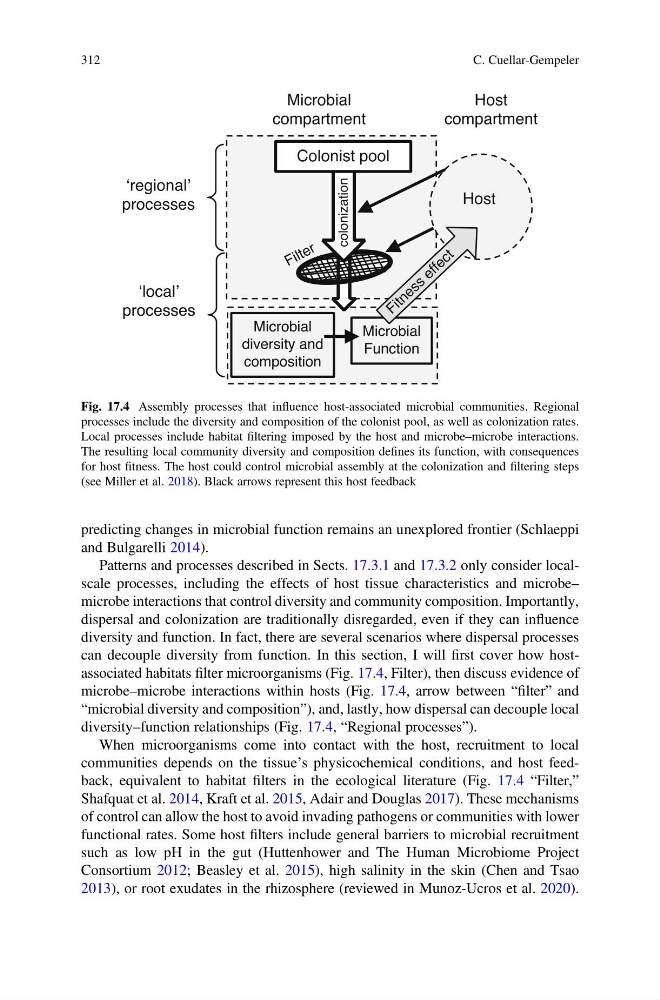
can decouple diversity from function. In this section, I will first cover how hostassociated habitats filter microorganisms (Fig. 17.4, Filter), then discuss evidence of
microbe–microbe interactions within hosts (Fig. 17.4, arrow between “filter” and
“microbial diversity and composition”), and, lastly, how dispersal can decouple local
diversity–function relationships (Fig. 17.4, “Regional processes”).
When microorganisms come into contact with the host, recruitment to local
communities depends on the tissue’s physicochemical conditions, and host feedback, equivalent to habitat filters in the ecological literature (Fig. 17.4 “Filter,”
Shafquat et al. 2014, Kraft et al. 2015, Adair and Douglas 2017). These mechanisms
of control can allow the host to avoid invading pathogens or communities with lower
functional rates. Some host filters include general barriers to microbial recruitment
such as low pH in the gut (Huttenhower and The Human Microbiome Project
Consortium 2012; Beasley et al. 2015), high salinity in the skin (Chen and Tsao
2013), or root exudates in the rhizosphere (reviewed in Munoz-Ucros et al. 2020).
Fig. 17.4 Assembly processes that influence host-associated microbial communities. Regional
processes include the diversity and composition of the colonist pool, as well as colonization rates.
Local processes include habitat filtering imposed by the host and microbe–microbe interactions.
The resulting local community diversity and composition defines its function, with consequences
for host fitness. The host could control microbial assembly at the colonization and filtering steps
(see Miller et al. 2018). Black arrows represent this host feedback
312
C. Cuellar-Gempeler
and Bulgarelli 2014).
Patterns and processes described in Sects. 17.3.1 and 17.3.2 only consider localscale processes, including the effects of host tissue characteristics and microbe–
microbe interactions that control diversity and community composition. Importantly,
dispersal and colonization are traditionally disregarded, even if they can influence
diversity and function. In fact, there are several scenarios where dispersal processes
can decouple diversity from function. In this section, I will first cover how hostassociated habitats filter microorganisms (Fig. 17.4, Filter), then discuss evidence of
microbe–microbe interactions within hosts (Fig. 17.4, arrow between “filter” and
“microbial diversity and composition”), and, lastly, how dispersal can decouple local
diversity–function relationships (Fig. 17.4, “Regional processes”).
When microorganisms come into contact with the host, recruitment to local
communities depends on the tissue’s physicochemical conditions, and host feedback, equivalent to habitat filters in the ecological literature (Fig. 17.4 “Filter,”
Shafquat et al. 2014, Kraft et al. 2015, Adair and Douglas 2017). These mechanisms
of control can allow the host to avoid invading pathogens or communities with lower
functional rates. Some host filters include general barriers to microbial recruitment
such as low pH in the gut (Huttenhower and The Human Microbiome Project
Consortium 2012; Beasley et al. 2015), high salinity in the skin (Chen and Tsao
2013), or root exudates in the rhizosphere (reviewed in Munoz-Ucros et al. 2020).
Fig. 17.4 Assembly processes that influence host-associated microbial communities. Regional
processes include the diversity and composition of the colonist pool, as well as colonization rates.
Local processes include habitat filtering imposed by the host and microbe–microbe interactions.
The resulting local community diversity and composition defines its function, with consequences
for host fitness. The host could control microbial assembly at the colonization and filtering steps
(see Miller et al. 2018). Black arrows represent this host feedback
312
C. Cuellar-Gempeler