

Cardinale et al. 2012). Evidence from a study that followed a single infant for 2.5
years supports this model, showing a gradual increase in phylogenetic diversity was
linked with progressive enrichment in pathways involved in carbohydrate metabolism, lactate utilization, breakdown of glycans from breast milk, and use of plantderived polysaccharides (Koenig et al. 2011). On the other end of human development, species are lost from gut communities as we reach old age, resulting in reduced
production of anti-inflammatory secondary metabolites, limited carbon utilization
pathways, and increased rates of invasion by opportunistic facultative anaerobic
pathogens (Biagi et al. 2010).
Other hosts maintain a taxonomically diverse and variable microbial community
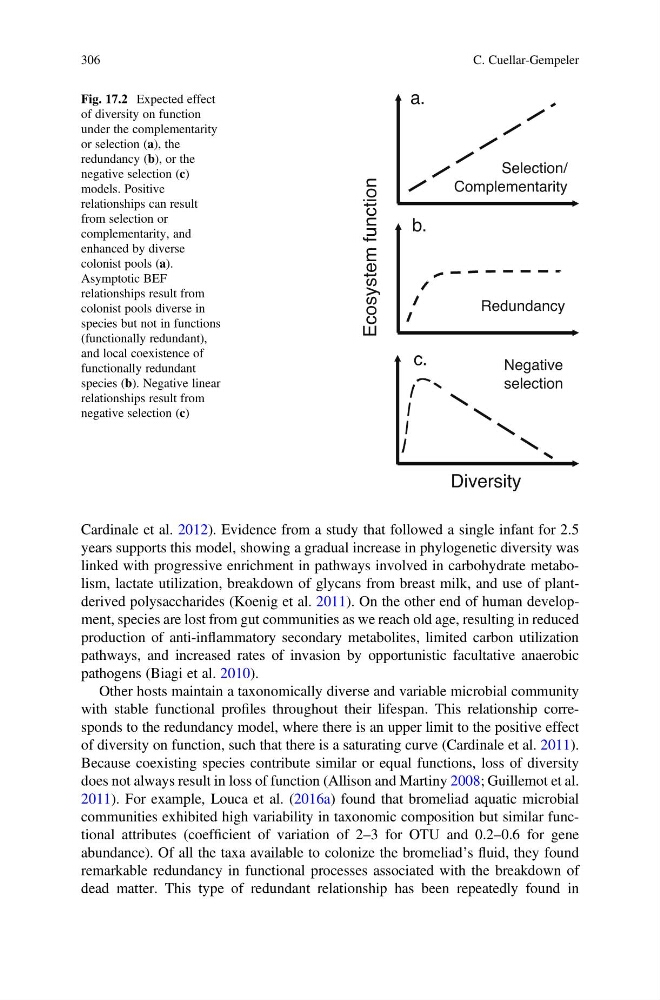
with stable functional profiles throughout their lifespan. This relationship corresponds to the redundancy model, where there is an upper limit to the positive effect
of diversity on function, such that there is a saturating curve (Cardinale et al. 2011).
Because coexisting species contribute similar or equal functions, loss of diversity
does not always result in loss of function (Allison and Martiny 2008; Guillemot et al.
2011). For example, Louca et al. (2016a) found that bromeliad aquatic microbial
communities exhibited high variability in taxonomic composition but similar functional attributes (coefficient of variation of 2–3 for OTU and 0.2–0.6 for gene
abundance). Of all the taxa available to colonize the bromeliad’s fluid, they found
remarkable redundancy in functional processes associated with the breakdown of
dead matter. This type of redundant relationship has been repeatedly found in
Fig. 17.2 Expected effect
of diversity on function
under the complementarity
or selection (a), the
redundancy (b), or the
negative selection (c)
models. Positive
relationships can result
from selection or
complementarity, and
enhanced by diverse
colonist pools (a).
Asymptotic BEF
relationships result from
colonist pools diverse in
species but not in functions
(functionally redundant),
and local coexistence of
functionally redundant
species (b). Negative linear
relationships result from
negative selection (c)
306
C. Cuellar-Gempeler
years supports this model, showing a gradual increase in phylogenetic diversity was
linked with progressive enrichment in pathways involved in carbohydrate metabolism, lactate utilization, breakdown of glycans from breast milk, and use of plantderived polysaccharides (Koenig et al. 2011). On the other end of human development, species are lost from gut communities as we reach old age, resulting in reduced
production of anti-inflammatory secondary metabolites, limited carbon utilization
pathways, and increased rates of invasion by opportunistic facultative anaerobic
pathogens (Biagi et al. 2010).
Other hosts maintain a taxonomically diverse and variable microbial community
with stable functional profiles throughout their lifespan. This relationship corresponds to the redundancy model, where there is an upper limit to the positive effect
of diversity on function, such that there is a saturating curve (Cardinale et al. 2011).
Because coexisting species contribute similar or equal functions, loss of diversity
does not always result in loss of function (Allison and Martiny 2008; Guillemot et al.
2011). For example, Louca et al. (2016a) found that bromeliad aquatic microbial
communities exhibited high variability in taxonomic composition but similar functional attributes (coefficient of variation of 2–3 for OTU and 0.2–0.6 for gene
abundance). Of all the taxa available to colonize the bromeliad’s fluid, they found
remarkable redundancy in functional processes associated with the breakdown of
dead matter. This type of redundant relationship has been repeatedly found in
Fig. 17.2 Expected effect
of diversity on function
under the complementarity
or selection (a), the
redundancy (b), or the
negative selection (c)
models. Positive
relationships can result
from selection or
complementarity, and
enhanced by diverse
colonist pools (a).
Asymptotic BEF
relationships result from
colonist pools diverse in
species but not in functions
(functionally redundant),
and local coexistence of
functionally redundant
species (b). Negative linear
relationships result from
negative selection (c)
306
C. Cuellar-Gempeler