

communities and when they should invest in stringent filtering and other systems to
optimize function.
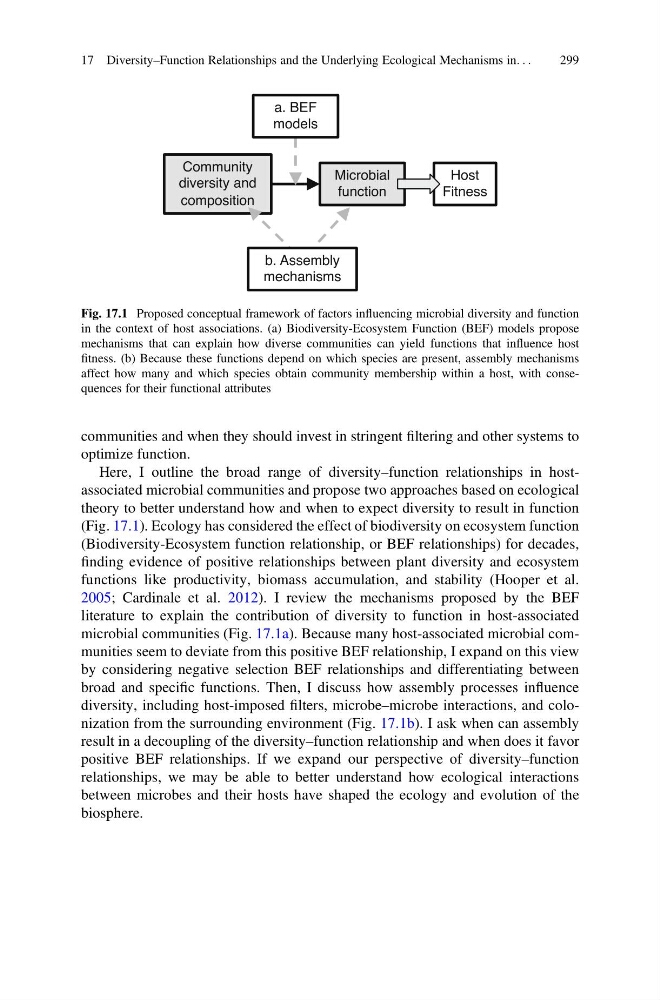
Here, I outline the broad range of diversity–function relationships in hostassociated microbial communities and propose two approaches based on ecological
theory to better understand how and when to expect diversity to result in function
(Fig. 17.1). Ecology has considered the effect of biodiversity on ecosystem function
(Biodiversity-Ecosystem function relationship, or BEF relationships) for decades,
finding evidence of positive relationships between plant diversity and ecosystem
functions like productivity, biomass accumulation, and stability (Hooper et al.
2005; Cardinale et al. 2012). I review the mechanisms proposed by the BEF
literature to explain the contribution of diversity to function in host-associated
microbial communities (Fig. 17.1a). Because many host-associated microbial communities seem to deviate from this positive BEF relationship, I expand on this view
by considering negative selection BEF relationships and differentiating between
broad and specific functions. Then, I discuss how assembly processes influence
diversity, including host-imposed filters, microbe–microbe interactions, and colonization from the surrounding environment (Fig. 17.1b). I ask when can assembly
result in a decoupling of the diversity–function relationship and when does it favor
positive BEF relationships. If we expand our perspective of diversity–function
relationships, we may be able to better understand how ecological interactions
between microbes and their hosts have shaped the ecology and evolution of the
biosphere.
Fig. 17.1 Proposed conceptual framework of factors influencing microbial diversity and function
in the context of host associations. (a) Biodiversity-Ecosystem Function (BEF) models propose
mechanisms that can explain how diverse communities can yield functions that influence host
fitness. (b) Because these functions depend on which species are present, assembly mechanisms
affect how many and which species obtain community membership within a host, with consequences for their functional attributes
17 Diversity–Function Relationships and the Underlying Ecological Mechanisms in. . .
299
optimize function.
Here, I outline the broad range of diversity–function relationships in hostassociated microbial communities and propose two approaches based on ecological
theory to better understand how and when to expect diversity to result in function
(Fig. 17.1). Ecology has considered the effect of biodiversity on ecosystem function
(Biodiversity-Ecosystem function relationship, or BEF relationships) for decades,
finding evidence of positive relationships between plant diversity and ecosystem
functions like productivity, biomass accumulation, and stability (Hooper et al.
2005; Cardinale et al. 2012). I review the mechanisms proposed by the BEF
literature to explain the contribution of diversity to function in host-associated
microbial communities (Fig. 17.1a). Because many host-associated microbial communities seem to deviate from this positive BEF relationship, I expand on this view
by considering negative selection BEF relationships and differentiating between
broad and specific functions. Then, I discuss how assembly processes influence
diversity, including host-imposed filters, microbe–microbe interactions, and colonization from the surrounding environment (Fig. 17.1b). I ask when can assembly
result in a decoupling of the diversity–function relationship and when does it favor
positive BEF relationships. If we expand our perspective of diversity–function
relationships, we may be able to better understand how ecological interactions
between microbes and their hosts have shaped the ecology and evolution of the
biosphere.
Fig. 17.1 Proposed conceptual framework of factors influencing microbial diversity and function
in the context of host associations. (a) Biodiversity-Ecosystem Function (BEF) models propose
mechanisms that can explain how diverse communities can yield functions that influence host
fitness. (b) Because these functions depend on which species are present, assembly mechanisms
affect how many and which species obtain community membership within a host, with consequences for their functional attributes
17 Diversity–Function Relationships and the Underlying Ecological Mechanisms in. . .
299