

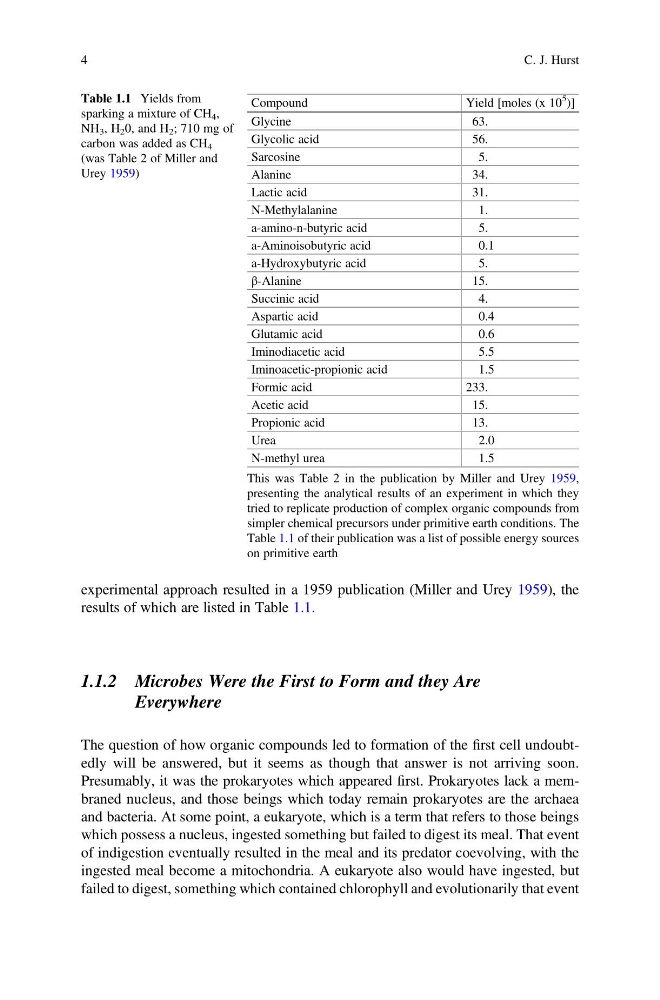
experimental approach resulted in a 1959 publication (Miller and Urey 1959), the
results of which are listed in Table 1.1.
1.1.2 Microbes Were the First to Form and they Are
Everywhere
The question of how organic compounds led to formation of the first cell undoubtedly will be answered, but it seems as though that answer is not arriving soon.
Presumably, it was the prokaryotes which appeared first. Prokaryotes lack a membraned nucleus, and those beings which today remain prokaryotes are the archaea
and bacteria. At some point, a eukaryote, which is a term that refers to those beings
which possess a nucleus, ingested something but failed to digest its meal. That event
of indigestion eventually resulted in the meal and its predator coevolving, with the
ingested meal become a mitochondria. A eukaryote also would have ingested, but
failed to digest, something which contained chlorophyll and evolutionarily that event
Table 1.1 Yields from
sparking a mixture of CH 4 ,
NH 3 , H 2 0, and H 2 ; 710 mg of
carbon was added as CH 4
(was Table 2 of Miller and
Urey 1959)
Compound
Yield [moles (x 10
5 )]
Glycine
63.
Glycolic acid
56.
Sarcosine
5.
Alanine
34.
Lactic acid
31.
N-Methylalanine
1.
a-amino-n-butyric acid
5.
a-Aminoisobutyric acid
0.1
a-Hydroxybutyric acid
5.
β-Alanine
15.
Succinic acid
4.
Aspartic acid
0.4
Glutamic acid
0.6
Iminodiacetic acid
5.5
Iminoacetic-propionic acid
1.5
Formic acid
233.
Acetic acid
15.
Propionic acid
13.
Urea
2.0
N-methyl urea
1.5
This was Table 2 in the publication by Miller and Urey 1959,
presenting the analytical results of an experiment in which they
tried to replicate production of complex organic compounds from
simpler chemical precursors under primitive earth conditions. The
Table 1.1 of their publication was a list of possible energy sources
on primitive earth
4
C. J. Hurst
results of which are listed in Table 1.1.
1.1.2 Microbes Were the First to Form and they Are
Everywhere
The question of how organic compounds led to formation of the first cell undoubtedly will be answered, but it seems as though that answer is not arriving soon.
Presumably, it was the prokaryotes which appeared first. Prokaryotes lack a membraned nucleus, and those beings which today remain prokaryotes are the archaea
and bacteria. At some point, a eukaryote, which is a term that refers to those beings
which possess a nucleus, ingested something but failed to digest its meal. That event
of indigestion eventually resulted in the meal and its predator coevolving, with the
ingested meal become a mitochondria. A eukaryote also would have ingested, but
failed to digest, something which contained chlorophyll and evolutionarily that event
Table 1.1 Yields from
sparking a mixture of CH 4 ,
NH 3 , H 2 0, and H 2 ; 710 mg of
carbon was added as CH 4
(was Table 2 of Miller and
Urey 1959)
Compound
Yield [moles (x 10
5 )]
Glycine
63.
Glycolic acid
56.
Sarcosine
5.
Alanine
34.
Lactic acid
31.
N-Methylalanine
1.
a-amino-n-butyric acid
5.
a-Aminoisobutyric acid
0.1
a-Hydroxybutyric acid
5.
β-Alanine
15.
Succinic acid
4.
Aspartic acid
0.4
Glutamic acid
0.6
Iminodiacetic acid
5.5
Iminoacetic-propionic acid
1.5
Formic acid
233.
Acetic acid
15.
Propionic acid
13.
Urea
2.0
N-methyl urea
1.5
This was Table 2 in the publication by Miller and Urey 1959,
presenting the analytical results of an experiment in which they
tried to replicate production of complex organic compounds from
simpler chemical precursors under primitive earth conditions. The
Table 1.1 of their publication was a list of possible energy sources
on primitive earth
4
C. J. Hurst