

Thus, Nitrospira performing complete oxidation of ammonium to nitrate may be a
key component of nitrogen-cycling microbial communities (Daims et al. 2015).
10.3 The Anammox Reaction: From a Hypothetical
Mechanism for Dinitrogen Fixation to a Major Process
in the Global Nitrogen Cycle
The latest editions of textbooks of general and environmental microbiology mention
the anammox reaction as part of the nitrogen cycle in nature. In the anammox
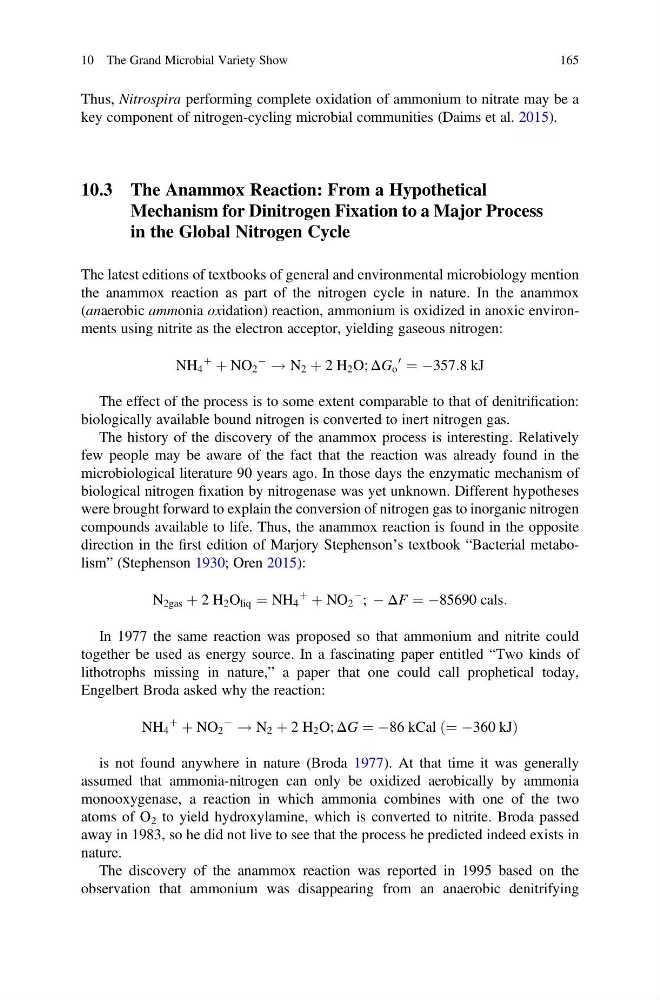
(anaerobic ammonia oxidation) reaction, ammonium is oxidized in anoxic environments using nitrite as the electron acceptor, yielding gaseous nitrogen:
NH 4
þ
þ NO 2
À
! N 2 þ 2 H 2 O; ΔG o
0
¼ À357:8 kJ
The effect of the process is to some extent comparable to that of denitrification:
biologically available bound nitrogen is converted to inert nitrogen gas.
The history of the discovery of the anammox process is interesting. Relatively
few people may be aware of the fact that the reaction was already found in the
microbiological literature 90 years ago. In those days the enzymatic mechanism of
biological nitrogen fixation by nitrogenase was yet unknown. Different hypotheses
were brought forward to explain the conversion of nitrogen gas to inorganic nitrogen
compounds available to life. Thus, the anammox reaction is found in the opposite
direction in the first edition of Marjory Stephenson’s textbook “Bacterial metabolism” (Stephenson 1930; Oren 2015):
N 2gas þ 2 H 2 O liq ¼ NH 4
þ
þ NO 2
À ; À ΔF ¼ À85690 cals:
In 1977 the same reaction was proposed so that ammonium and nitrite could
together be used as energy source. In a fascinating paper entitled “Two kinds of
lithotrophs missing in nature,” a paper that one could call prophetical today,
Engelbert Broda asked why the reaction:
NH 4
þ
þ NO 2
À
! N 2 þ 2 H 2 O; ΔG ¼ À86 kCal ¼ À360 kJ
ð
Þ
is not found anywhere in nature (Broda 1977). At that time it was generally
assumed that ammonia-nitrogen can only be oxidized aerobically by ammonia
monooxygenase, a reaction in which ammonia combines with one of the two
atoms of O 2 to yield hydroxylamine, which is converted to nitrite. Broda passed
away in 1983, so he did not live to see that the process he predicted indeed exists in
nature.
The discovery of the anammox reaction was reported in 1995 based on the
observation that ammonium was disappearing from an anaerobic denitrifying
10 The Grand Microbial Variety Show
165
key component of nitrogen-cycling microbial communities (Daims et al. 2015).
10.3 The Anammox Reaction: From a Hypothetical
Mechanism for Dinitrogen Fixation to a Major Process
in the Global Nitrogen Cycle
The latest editions of textbooks of general and environmental microbiology mention
the anammox reaction as part of the nitrogen cycle in nature. In the anammox
(anaerobic ammonia oxidation) reaction, ammonium is oxidized in anoxic environments using nitrite as the electron acceptor, yielding gaseous nitrogen:
NH 4
þ
þ NO 2
À
! N 2 þ 2 H 2 O; ΔG o
0
¼ À357:8 kJ
The effect of the process is to some extent comparable to that of denitrification:
biologically available bound nitrogen is converted to inert nitrogen gas.
The history of the discovery of the anammox process is interesting. Relatively
few people may be aware of the fact that the reaction was already found in the
microbiological literature 90 years ago. In those days the enzymatic mechanism of
biological nitrogen fixation by nitrogenase was yet unknown. Different hypotheses
were brought forward to explain the conversion of nitrogen gas to inorganic nitrogen
compounds available to life. Thus, the anammox reaction is found in the opposite
direction in the first edition of Marjory Stephenson’s textbook “Bacterial metabolism” (Stephenson 1930; Oren 2015):
N 2gas þ 2 H 2 O liq ¼ NH 4
þ
þ NO 2
À ; À ΔF ¼ À85690 cals:
In 1977 the same reaction was proposed so that ammonium and nitrite could
together be used as energy source. In a fascinating paper entitled “Two kinds of
lithotrophs missing in nature,” a paper that one could call prophetical today,
Engelbert Broda asked why the reaction:
NH 4
þ
þ NO 2
À
! N 2 þ 2 H 2 O; ΔG ¼ À86 kCal ¼ À360 kJ
ð
Þ
is not found anywhere in nature (Broda 1977). At that time it was generally
assumed that ammonia-nitrogen can only be oxidized aerobically by ammonia
monooxygenase, a reaction in which ammonia combines with one of the two
atoms of O 2 to yield hydroxylamine, which is converted to nitrite. Broda passed
away in 1983, so he did not live to see that the process he predicted indeed exists in
nature.
The discovery of the anammox reaction was reported in 1995 based on the
observation that ammonium was disappearing from an anaerobic denitrifying
10 The Grand Microbial Variety Show
165