

evidence that microorganisms and their activities are “the foundation stone of the
biosphere.”
The human invention of the dinitrogen-fixing Haber-Bosch process has, in less
than 100 years, doubled the concentration of reactive nitrogen in the biosphere that
before was entirely limited by the activity of diazotrophic microorganisms. While
the reasoning behind the Haber-Bosch process was to inexpensively increase the
food supply for humans, the unintended consequence has been a rapid acceleration
of the many redox-active functions of nitrogen-cycling microorganisms, leading to
steep increases in concentrations of harmful molecules like nitrate, NO, and nitrous
oxide in many of Earth’s ecosystems. Over 25% of the human population owes their
lives to the Haber-Bosch process due to its success in increasing crop yields, yet
climbing atmospheric levels of nitrous oxide, a greenhouse gas over 300 times more
potent than carbon dioxide in holding heat, is leading to a warmer climate year upon
year, thus putting the survival of humanity and multitudes of animal and plant
species at great risk. This is a lesson to us that while microorganisms can adapt
and evolve in response to any number of redox-active molecules that feed and
regulate their catabolic modules, we are entirely dependent on microbial activities,
their control over biogeochemical cycles, and the balance of reactive molecules from
these cycles that evolved long before the first metazoans. Not only did the microbial
nitrogen cycle pave the way for our existence, it is also the key that we must
understand and work with for its continuation to guaranty “a safe operating space
for humanity.”
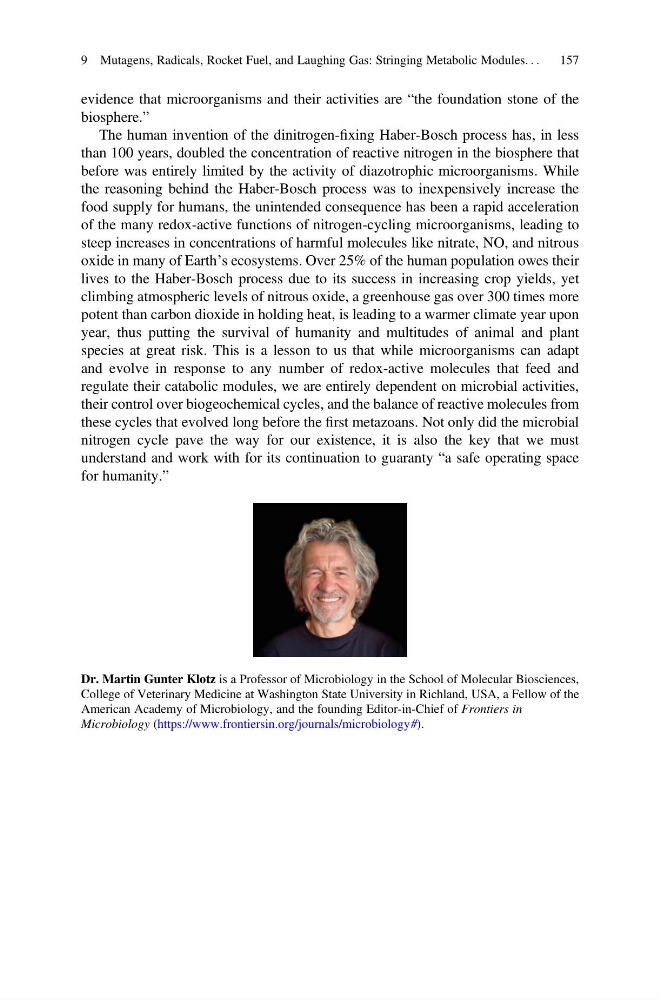
Dr. Martin Gunter Klotz is a Professor of Microbiology in the School of Molecular Biosciences,
College of Veterinary Medicine at Washington State University in Richland, USA, a Fellow of the
American Academy of Microbiology, and the founding Editor-in-Chief of Frontiers in
Microbiology (https://www.frontiersin.org/journals/microbiology#).
9 Mutagens, Radicals, Rocket Fuel, and Laughing Gas: Stringing Metabolic Modules. . .
157
biosphere.”
The human invention of the dinitrogen-fixing Haber-Bosch process has, in less
than 100 years, doubled the concentration of reactive nitrogen in the biosphere that
before was entirely limited by the activity of diazotrophic microorganisms. While
the reasoning behind the Haber-Bosch process was to inexpensively increase the
food supply for humans, the unintended consequence has been a rapid acceleration
of the many redox-active functions of nitrogen-cycling microorganisms, leading to
steep increases in concentrations of harmful molecules like nitrate, NO, and nitrous
oxide in many of Earth’s ecosystems. Over 25% of the human population owes their
lives to the Haber-Bosch process due to its success in increasing crop yields, yet
climbing atmospheric levels of nitrous oxide, a greenhouse gas over 300 times more
potent than carbon dioxide in holding heat, is leading to a warmer climate year upon
year, thus putting the survival of humanity and multitudes of animal and plant
species at great risk. This is a lesson to us that while microorganisms can adapt
and evolve in response to any number of redox-active molecules that feed and
regulate their catabolic modules, we are entirely dependent on microbial activities,
their control over biogeochemical cycles, and the balance of reactive molecules from
these cycles that evolved long before the first metazoans. Not only did the microbial
nitrogen cycle pave the way for our existence, it is also the key that we must
understand and work with for its continuation to guaranty “a safe operating space
for humanity.”
Dr. Martin Gunter Klotz is a Professor of Microbiology in the School of Molecular Biosciences,
College of Veterinary Medicine at Washington State University in Richland, USA, a Fellow of the
American Academy of Microbiology, and the founding Editor-in-Chief of Frontiers in
Microbiology (https://www.frontiersin.org/journals/microbiology#).
9 Mutagens, Radicals, Rocket Fuel, and Laughing Gas: Stringing Metabolic Modules. . .
157