

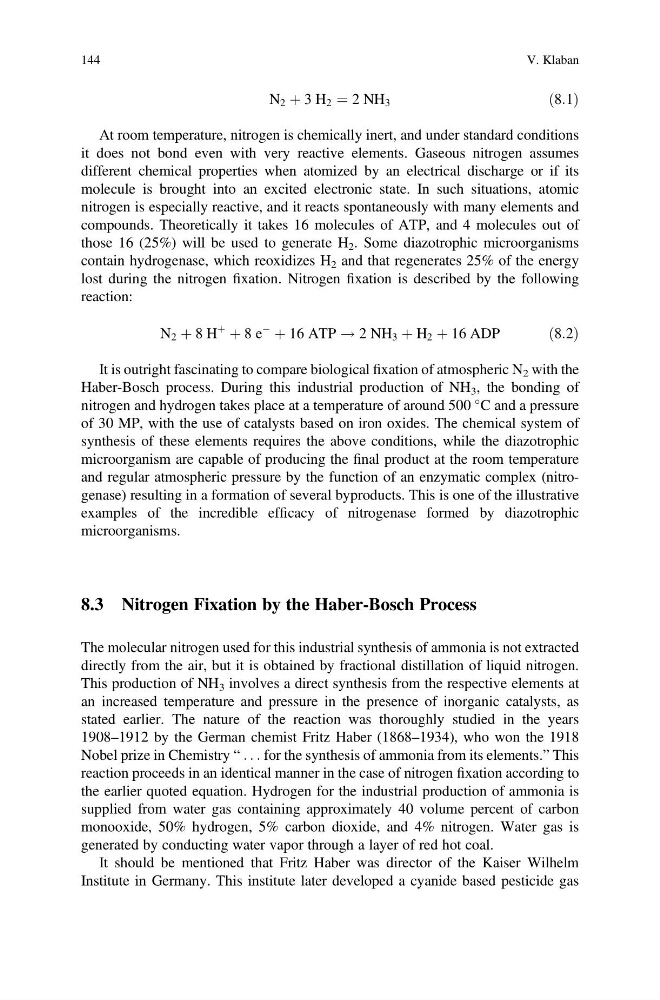
N 2 þ 3 H 2 ¼ 2 NH 3
ð8:1Þ
At room temperature, nitrogen is chemically inert, and under standard conditions
it does not bond even with very reactive elements. Gaseous nitrogen assumes
different chemical properties when atomized by an electrical discharge or if its
molecule is brought into an excited electronic state. In such situations, atomic
nitrogen is especially reactive, and it reacts spontaneously with many elements and
compounds. Theoretically it takes 16 molecules of ATP, and 4 molecules out of
those 16 (25%) will be used to generate H 2 . Some diazotrophic microorganisms
contain hydrogenase, which reoxidizes H 2 and that regenerates 25% of the energy
lost during the nitrogen fixation. Nitrogen fixation is described by the following
reaction:
N 2 þ 8 H
þ
þ 8 e
À
þ 16 ATP ! 2 NH 3 þ H 2 þ 16 ADP
ð8:2Þ
It is outright fascinating to compare biological fixation of atmospheric N 2 with the
Haber-Bosch process. During this industrial production of NH 3 , the bonding of
nitrogen and hydrogen takes place at a temperature of around 500
C and a pressure
of 30 MP, with the use of catalysts based on iron oxides. The chemical system of
synthesis of these elements requires the above conditions, while the diazotrophic
microorganism are capable of producing the final product at the room temperature
and regular atmospheric pressure by the function of an enzymatic complex (nitrogenase) resulting in a formation of several byproducts. This is one of the illustrative
examples of the incredible efficacy of nitrogenase formed by diazotrophic
microorganisms.
8.3 Nitrogen Fixation by the Haber-Bosch Process
The molecular nitrogen used for this industrial synthesis of ammonia is not extracted
directly from the air, but it is obtained by fractional distillation of liquid nitrogen.
This production of NH 3 involves a direct synthesis from the respective elements at
an increased temperature and pressure in the presence of inorganic catalysts, as
stated earlier. The nature of the reaction was thoroughly studied in the years
1908–1912 by the German chemist Fritz Haber (1868–1934), who won the 1918
Nobel prize in Chemistry “ . . . for the synthesis of ammonia from its elements.” This
reaction proceeds in an identical manner in the case of nitrogen fixation according to
the earlier quoted equation. Hydrogen for the industrial production of ammonia is
supplied from water gas containing approximately 40 volume percent of carbon
monooxide, 50% hydrogen, 5% carbon dioxide, and 4% nitrogen. Water gas is
generated by conducting water vapor through a layer of red hot coal.
It should be mentioned that Fritz Haber was director of the Kaiser Wilhelm
Institute in Germany. This institute later developed a cyanide based pesticide gas
144
V. Klaban
ð8:1Þ
At room temperature, nitrogen is chemically inert, and under standard conditions
it does not bond even with very reactive elements. Gaseous nitrogen assumes
different chemical properties when atomized by an electrical discharge or if its
molecule is brought into an excited electronic state. In such situations, atomic
nitrogen is especially reactive, and it reacts spontaneously with many elements and
compounds. Theoretically it takes 16 molecules of ATP, and 4 molecules out of
those 16 (25%) will be used to generate H 2 . Some diazotrophic microorganisms
contain hydrogenase, which reoxidizes H 2 and that regenerates 25% of the energy
lost during the nitrogen fixation. Nitrogen fixation is described by the following
reaction:
N 2 þ 8 H
þ
þ 8 e
À
þ 16 ATP ! 2 NH 3 þ H 2 þ 16 ADP
ð8:2Þ
It is outright fascinating to compare biological fixation of atmospheric N 2 with the
Haber-Bosch process. During this industrial production of NH 3 , the bonding of
nitrogen and hydrogen takes place at a temperature of around 500
C and a pressure
of 30 MP, with the use of catalysts based on iron oxides. The chemical system of
synthesis of these elements requires the above conditions, while the diazotrophic
microorganism are capable of producing the final product at the room temperature
and regular atmospheric pressure by the function of an enzymatic complex (nitrogenase) resulting in a formation of several byproducts. This is one of the illustrative
examples of the incredible efficacy of nitrogenase formed by diazotrophic
microorganisms.
8.3 Nitrogen Fixation by the Haber-Bosch Process
The molecular nitrogen used for this industrial synthesis of ammonia is not extracted
directly from the air, but it is obtained by fractional distillation of liquid nitrogen.
This production of NH 3 involves a direct synthesis from the respective elements at
an increased temperature and pressure in the presence of inorganic catalysts, as
stated earlier. The nature of the reaction was thoroughly studied in the years
1908–1912 by the German chemist Fritz Haber (1868–1934), who won the 1918
Nobel prize in Chemistry “ . . . for the synthesis of ammonia from its elements.” This
reaction proceeds in an identical manner in the case of nitrogen fixation according to
the earlier quoted equation. Hydrogen for the industrial production of ammonia is
supplied from water gas containing approximately 40 volume percent of carbon
monooxide, 50% hydrogen, 5% carbon dioxide, and 4% nitrogen. Water gas is
generated by conducting water vapor through a layer of red hot coal.
It should be mentioned that Fritz Haber was director of the Kaiser Wilhelm
Institute in Germany. This institute later developed a cyanide based pesticide gas
144
V. Klaban