

6.2 University Valley, Antarctica: A Unique Example of a
Solely “Microbial” Environment
The McMurdo Dry Valleys in Antarctica are the coldest and driest place on Earth
and consist of over a 4500 km
2 (Levy 2013) ice-free region, which can be subdivided
based on environmental conditions. Temperatures and aridity get colder and drier,
respectively, from the lower-elevation and coastal Dry Valleys to the high-elevation
inland Dry Valleys. Mean air temperatures in the coastal valleys are À5
C, and
valleys may experience annual precipitation (in the form of snow) of up to 100 mm
per year. The stable upland zone (SUZ) microclimatic zone (elevations >1000 m.a.s.
l., meters above sea level) (Marchant and Head III 2007) experiences average air
temperatures of À10
C and less than 10 mm snowfall annually. As a result of the
cold and arid conditions, the high elevations of the dry valleys are one of the rare
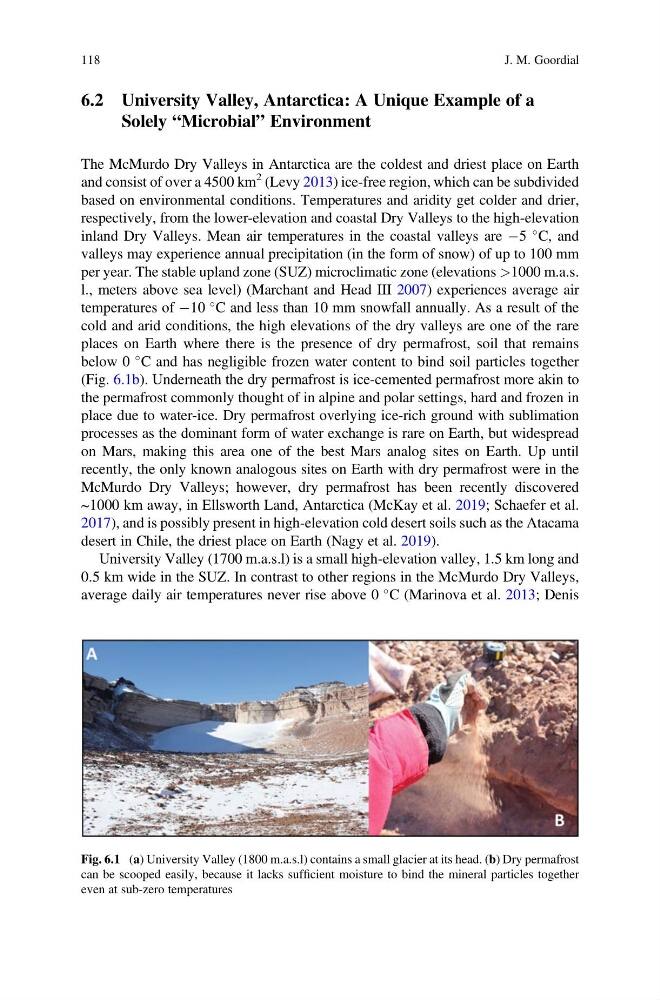
places on Earth where there is the presence of dry permafrost, soil that remains
below 0
C and has negligible frozen water content to bind soil particles together
(Fig. 6.1b). Underneath the dry permafrost is ice-cemented permafrost more akin to
the permafrost commonly thought of in alpine and polar settings, hard and frozen in
place due to water-ice. Dry permafrost overlying ice-rich ground with sublimation
processes as the dominant form of water exchange is rare on Earth, but widespread
on Mars, making this area one of the best Mars analog sites on Earth. Up until
recently, the only known analogous sites on Earth with dry permafrost were in the
McMurdo Dry Valleys; however, dry permafrost has been recently discovered
~1000 km away, in Ellsworth Land, Antarctica (McKay et al. 2019; Schaefer et al.
2017), and is possibly present in high-elevation cold desert soils such as the Atacama
desert in Chile, the driest place on Earth (Nagy et al. 2019).
University Valley (1700 m.a.s.l) is a small high-elevation valley, 1.5 km long and
0.5 km wide in the SUZ. In contrast to other regions in the McMurdo Dry Valleys,
average daily air temperatures never rise above 0
C (Marinova et al. 2013; Denis
Fig. 6.1 (a) University Valley (1800 m.a.s.l) contains a small glacier at its head. (b) Dry permafrost
can be scooped easily, because it lacks sufficient moisture to bind the mineral particles together
even at sub-zero temperatures
118
J. M. Goordial
Solely “Microbial” Environment
The McMurdo Dry Valleys in Antarctica are the coldest and driest place on Earth
and consist of over a 4500 km
2 (Levy 2013) ice-free region, which can be subdivided
based on environmental conditions. Temperatures and aridity get colder and drier,
respectively, from the lower-elevation and coastal Dry Valleys to the high-elevation
inland Dry Valleys. Mean air temperatures in the coastal valleys are À5
C, and
valleys may experience annual precipitation (in the form of snow) of up to 100 mm
per year. The stable upland zone (SUZ) microclimatic zone (elevations >1000 m.a.s.
l., meters above sea level) (Marchant and Head III 2007) experiences average air
temperatures of À10
C and less than 10 mm snowfall annually. As a result of the
cold and arid conditions, the high elevations of the dry valleys are one of the rare
places on Earth where there is the presence of dry permafrost, soil that remains
below 0
C and has negligible frozen water content to bind soil particles together
(Fig. 6.1b). Underneath the dry permafrost is ice-cemented permafrost more akin to
the permafrost commonly thought of in alpine and polar settings, hard and frozen in
place due to water-ice. Dry permafrost overlying ice-rich ground with sublimation
processes as the dominant form of water exchange is rare on Earth, but widespread
on Mars, making this area one of the best Mars analog sites on Earth. Up until
recently, the only known analogous sites on Earth with dry permafrost were in the
McMurdo Dry Valleys; however, dry permafrost has been recently discovered
~1000 km away, in Ellsworth Land, Antarctica (McKay et al. 2019; Schaefer et al.
2017), and is possibly present in high-elevation cold desert soils such as the Atacama
desert in Chile, the driest place on Earth (Nagy et al. 2019).
University Valley (1700 m.a.s.l) is a small high-elevation valley, 1.5 km long and
0.5 km wide in the SUZ. In contrast to other regions in the McMurdo Dry Valleys,
average daily air temperatures never rise above 0
C (Marinova et al. 2013; Denis
Fig. 6.1 (a) University Valley (1800 m.a.s.l) contains a small glacier at its head. (b) Dry permafrost
can be scooped easily, because it lacks sufficient moisture to bind the mineral particles together
even at sub-zero temperatures
118
J. M. Goordial