

2 Methods
2.1 Rigidity
Transmission Model
as a Mechanistic
Description
of Allostery
In rigidity transmission model of allostery, a change in rigidity
induced by a binding event(s) which results in a change and transmission in DOF (i.e., a conformational change) across protein
network to a remote distant site(s) gives a mechanical description
for allosteric coupling between distant sites in a protein. The mathematical and mechanical model of allosteric communication is
founded on our initial foundation work in mathematical allostery
in rigidity theory introduced in [8]. Further mathematical properties were further considered by Whiteley et al. [9] in a special class
of geometric frameworks. Recently, we have applied this
a
b
c
d
e
-0.1
kcal/mol
-0.9
kcal/mol
-1.1
kcal/mol
-1.7
kcal/mol
-0.1
-0.9
-1.1
-1.7
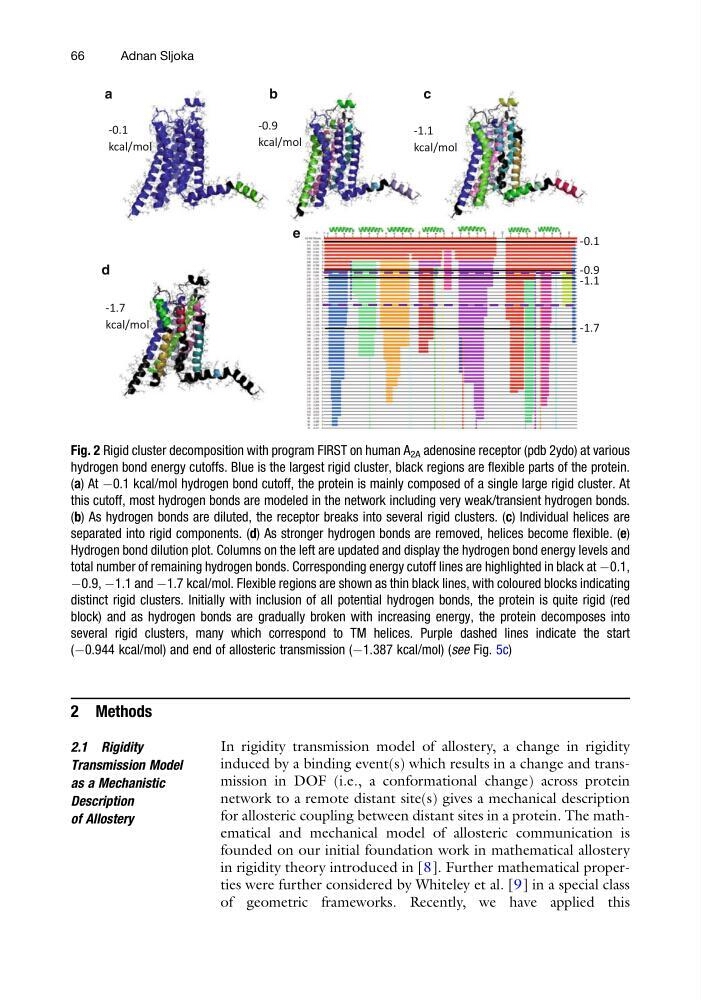
Fig. 2 Rigid cluster decomposition with program FIRST on human A 2A adenosine receptor (pdb 2ydo) at various
hydrogen bond energy cutoffs. Blue is the largest rigid cluster, black regions are flexible parts of the protein.
(a) At À0.1 kcal/mol hydrogen bond cutoff, the protein is mainly composed of a single large rigid cluster. At
this cutoff, most hydrogen bonds are modeled in the network including very weak/transient hydrogen bonds.
(b) As hydrogen bonds are diluted, the receptor breaks into several rigid clusters. (c) Individual helices are
separated into rigid components. (d) As stronger hydrogen bonds are removed, helices become flexible. (e)
Hydrogen bond dilution plot. Columns on the left are updated and display the hydrogen bond energy levels and
total number of remaining hydrogen bonds. Corresponding energy cutoff lines are highlighted in black at À0.1,
À0.9, À1.1 and À1.7 kcal/mol. Flexible regions are shown as thin black lines, with coloured blocks indicating
distinct rigid clusters. Initially with inclusion of all potential hydrogen bonds, the protein is quite rigid (red
block) and as hydrogen bonds are gradually broken with increasing energy, the protein decomposes into
several rigid clusters, many which correspond to TM helices. Purple dashed lines indicate the start
(À0.944 kcal/mol) and end of allosteric transmission (À1.387 kcal/mol) (see Fig. 5c)
66
Adnan Sljoka
2.1 Rigidity
Transmission Model
as a Mechanistic
Description
of Allostery
In rigidity transmission model of allostery, a change in rigidity
induced by a binding event(s) which results in a change and transmission in DOF (i.e., a conformational change) across protein
network to a remote distant site(s) gives a mechanical description
for allosteric coupling between distant sites in a protein. The mathematical and mechanical model of allosteric communication is
founded on our initial foundation work in mathematical allostery
in rigidity theory introduced in [8]. Further mathematical properties were further considered by Whiteley et al. [9] in a special class
of geometric frameworks. Recently, we have applied this
a
b
c
d
e
-0.1
kcal/mol
-0.9
kcal/mol
-1.1
kcal/mol
-1.7
kcal/mol
-0.1
-0.9
-1.1
-1.7
Fig. 2 Rigid cluster decomposition with program FIRST on human A 2A adenosine receptor (pdb 2ydo) at various
hydrogen bond energy cutoffs. Blue is the largest rigid cluster, black regions are flexible parts of the protein.
(a) At À0.1 kcal/mol hydrogen bond cutoff, the protein is mainly composed of a single large rigid cluster. At
this cutoff, most hydrogen bonds are modeled in the network including very weak/transient hydrogen bonds.
(b) As hydrogen bonds are diluted, the receptor breaks into several rigid clusters. (c) Individual helices are
separated into rigid components. (d) As stronger hydrogen bonds are removed, helices become flexible. (e)
Hydrogen bond dilution plot. Columns on the left are updated and display the hydrogen bond energy levels and
total number of remaining hydrogen bonds. Corresponding energy cutoff lines are highlighted in black at À0.1,
À0.9, À1.1 and À1.7 kcal/mol. Flexible regions are shown as thin black lines, with coloured blocks indicating
distinct rigid clusters. Initially with inclusion of all potential hydrogen bonds, the protein is quite rigid (red
block) and as hydrogen bonds are gradually broken with increasing energy, the protein decomposes into
several rigid clusters, many which correspond to TM helices. Purple dashed lines indicate the start
(À0.944 kcal/mol) and end of allosteric transmission (À1.387 kcal/mol) (see Fig. 5c)
66
Adnan Sljoka