

and the locked dihedral angles associated with double and peptide
bonds together with non-covalent interactions impose additional
constraints (bars). Each atom is treated as a fully rigid body with six
trivial degrees of freedom (DOF) and rotatable bonds (hinges) as a
set of five bars (edges), where each bar removes a single DOF,
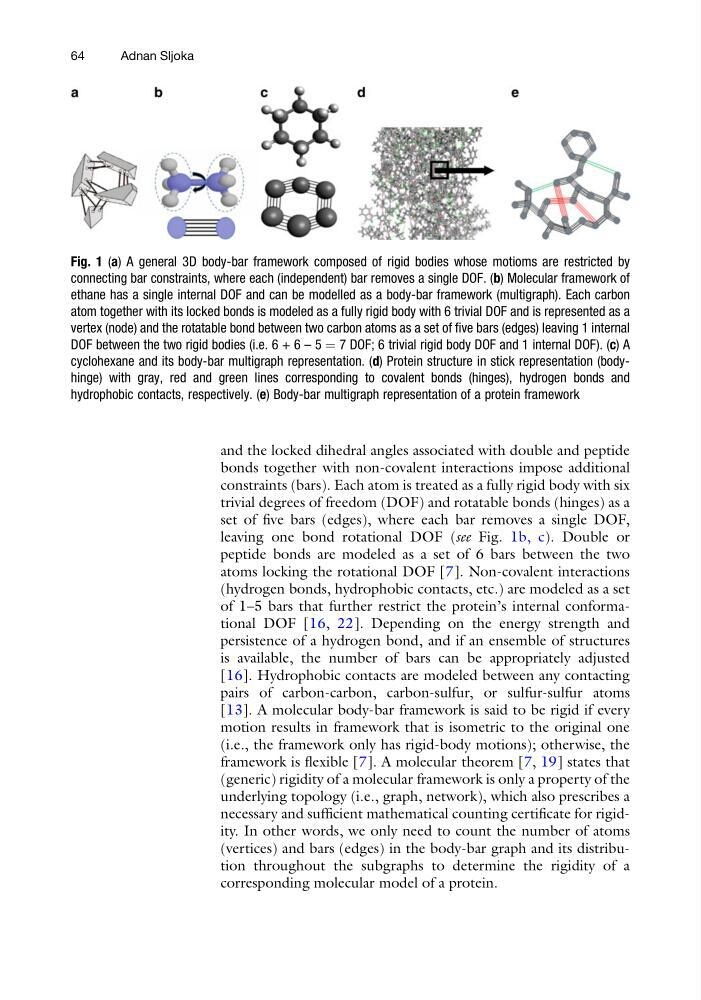
leaving one bond rotational DOF (see Fig. 1b, c). Double or
peptide bonds are modeled as a set of 6 bars between the two
atoms locking the rotational DOF [7]. Non-covalent interactions
(hydrogen bonds, hydrophobic contacts, etc.) are modeled as a set
of 1–5 bars that further restrict the protein’s internal conformational DOF [16, 22]. Depending on the energy strength and
persistence of a hydrogen bond, and if an ensemble of structures
is available, the number of bars can be appropriately adjusted
[16]. Hydrophobic contacts are modeled between any contacting
pairs of carbon-carbon, carbon-sulfur, or sulfur-sulfur atoms
[13]. A molecular body-bar framework is said to be rigid if every
motion results in framework that is isometric to the original one
(i.e., the framework only has rigid-body motions); otherwise, the
framework is flexible [7]. A molecular theorem [7, 19] states that
(generic) rigidity of a molecular framework is only a property of the
underlying topology (i.e., graph, network), which also prescribes a
necessary and sufficient mathematical counting certificate for rigidity. In other words, we only need to count the number of atoms
(vertices) and bars (edges) in the body-bar graph and its distribution throughout the subgraphs to determine the rigidity of a
corresponding molecular model of a protein.
Fig. 1 (a) A general 3D body-bar framework composed of rigid bodies whose motioms are restricted by
connecting bar constraints, where each (independent) bar removes a single DOF. (b) Molecular framework of
ethane has a single internal DOF and can be modelled as a body-bar framework (multigraph). Each carbon
atom together with its locked bonds is modeled as a fully rigid body with 6 trivial DOF and is represented as a
vertex (node) and the rotatable bond between two carbon atoms as a set of five bars (edges) leaving 1 internal
DOF between the two rigid bodies (i.e. 6 + 6 – 5 ¼ 7 DOF; 6 trivial rigid body DOF and 1 internal DOF). (c) A
cyclohexane and its body-bar multigraph representation. (d) Protein structure in stick representation (bodyhinge) with gray, red and green lines corresponding to covalent bonds (hinges), hydrogen bonds and
hydrophobic contacts, respectively. (e) Body-bar multigraph representation of a protein framework
64
Adnan Sljoka
bonds together with non-covalent interactions impose additional
constraints (bars). Each atom is treated as a fully rigid body with six
trivial degrees of freedom (DOF) and rotatable bonds (hinges) as a
set of five bars (edges), where each bar removes a single DOF,
leaving one bond rotational DOF (see Fig. 1b, c). Double or
peptide bonds are modeled as a set of 6 bars between the two
atoms locking the rotational DOF [7]. Non-covalent interactions
(hydrogen bonds, hydrophobic contacts, etc.) are modeled as a set
of 1–5 bars that further restrict the protein’s internal conformational DOF [16, 22]. Depending on the energy strength and
persistence of a hydrogen bond, and if an ensemble of structures
is available, the number of bars can be appropriately adjusted
[16]. Hydrophobic contacts are modeled between any contacting
pairs of carbon-carbon, carbon-sulfur, or sulfur-sulfur atoms
[13]. A molecular body-bar framework is said to be rigid if every
motion results in framework that is isometric to the original one
(i.e., the framework only has rigid-body motions); otherwise, the
framework is flexible [7]. A molecular theorem [7, 19] states that
(generic) rigidity of a molecular framework is only a property of the
underlying topology (i.e., graph, network), which also prescribes a
necessary and sufficient mathematical counting certificate for rigidity. In other words, we only need to count the number of atoms
(vertices) and bars (edges) in the body-bar graph and its distribution throughout the subgraphs to determine the rigidity of a
corresponding molecular model of a protein.
Fig. 1 (a) A general 3D body-bar framework composed of rigid bodies whose motioms are restricted by
connecting bar constraints, where each (independent) bar removes a single DOF. (b) Molecular framework of
ethane has a single internal DOF and can be modelled as a body-bar framework (multigraph). Each carbon
atom together with its locked bonds is modeled as a fully rigid body with 6 trivial DOF and is represented as a
vertex (node) and the rotatable bond between two carbon atoms as a set of five bars (edges) leaving 1 internal
DOF between the two rigid bodies (i.e. 6 + 6 – 5 ¼ 7 DOF; 6 trivial rigid body DOF and 1 internal DOF). (c) A
cyclohexane and its body-bar multigraph representation. (d) Protein structure in stick representation (bodyhinge) with gray, red and green lines corresponding to covalent bonds (hinges), hydrogen bonds and
hydrophobic contacts, respectively. (e) Body-bar multigraph representation of a protein framework
64
Adnan Sljoka