

metabolites or ions, one has to determine free energies of the
binding reactions and calculate ΔΔG.
The same principle of breaking a complex reaction into a series
of smaller, experimentally accessible reactions whose sum leads to a
final reaction product could be applied to dissect the mechanisms of
cooperativity in areas such as the assembly of RNA-protein complexes and RNA folding. Dissection of mechanisms of cooperativity
often requires special tricks, typically aimed at disrupting one interaction and probing the thermodynamic worth of another. This
approach is applicable to study large multicomponent systems as
well as to reveal fine structural features, for example determining
whether two functional groups are involved in hydrogen bonding
that stabilizes a secondary structure element.
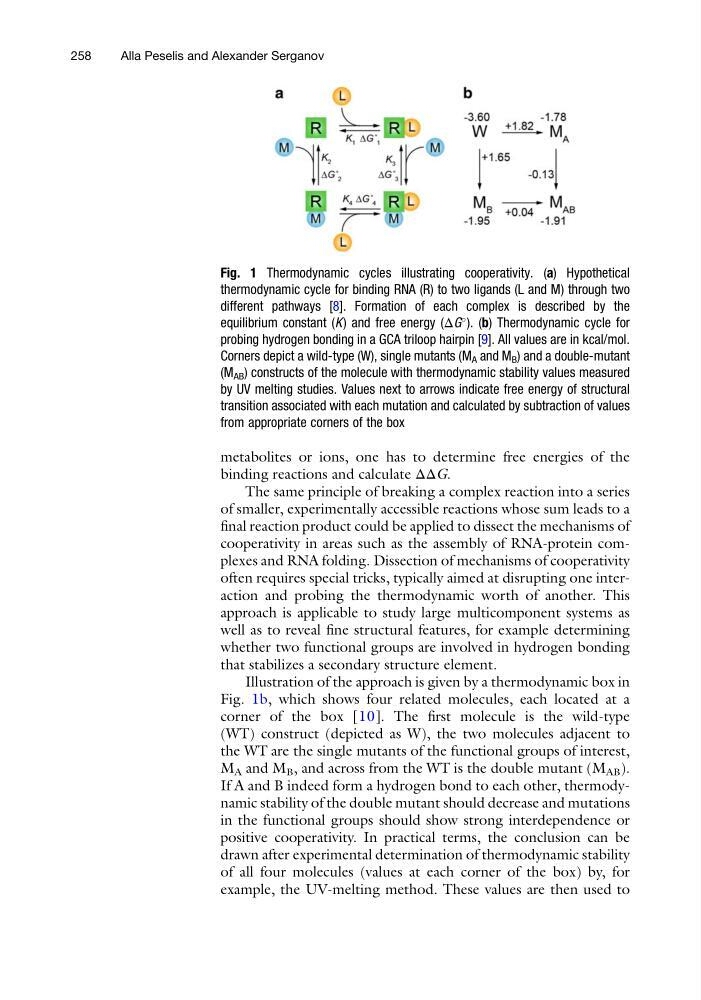
Illustration of the approach is given by a thermodynamic box in
Fig. 1b, which shows four related molecules, each located at a
corner of the box [10]. The first molecule is the wild-type
(WT) construct (depicted as W), the two molecules adjacent to
the WT are the single mutants of the functional groups of interest,
M A and M B , and across from the WT is the double mutant (M AB ).
If A and B indeed form a hydrogen bond to each other, thermodynamic stability of the double mutant should decrease and mutations
in the functional groups should show strong interdependence or
positive cooperativity. In practical terms, the conclusion can be
drawn after experimental determination of thermodynamic stability
of all four molecules (values at each corner of the box) by, for
example, the UV-melting method. These values are then used to
Fig. 1 Thermodynamic cycles illustrating cooperativity. (a) Hypothetical
thermodynamic cycle for binding RNA (R) to two ligands (L and M) through two
different pathways [8]. Formation of each complex is described by the
equilibrium constant (K ) and free energy (ΔG
). (b) Thermodynamic cycle for
probing hydrogen bonding in a GCA triloop hairpin [9]. All values are in kcal/mol.
Corners depict a wild-type (W), single mutants (M A and M B ) and a double-mutant
(M AB ) constructs of the molecule with thermodynamic stability values measured
by UV melting studies. Values next to arrows indicate free energy of structural
transition associated with each mutation and calculated by subtraction of values
from appropriate corners of the box
258
Alla Peselis and Alexander Serganov
binding reactions and calculate ΔΔG.
The same principle of breaking a complex reaction into a series
of smaller, experimentally accessible reactions whose sum leads to a
final reaction product could be applied to dissect the mechanisms of
cooperativity in areas such as the assembly of RNA-protein complexes and RNA folding. Dissection of mechanisms of cooperativity
often requires special tricks, typically aimed at disrupting one interaction and probing the thermodynamic worth of another. This
approach is applicable to study large multicomponent systems as
well as to reveal fine structural features, for example determining
whether two functional groups are involved in hydrogen bonding
that stabilizes a secondary structure element.
Illustration of the approach is given by a thermodynamic box in
Fig. 1b, which shows four related molecules, each located at a
corner of the box [10]. The first molecule is the wild-type
(WT) construct (depicted as W), the two molecules adjacent to
the WT are the single mutants of the functional groups of interest,
M A and M B , and across from the WT is the double mutant (M AB ).
If A and B indeed form a hydrogen bond to each other, thermodynamic stability of the double mutant should decrease and mutations
in the functional groups should show strong interdependence or
positive cooperativity. In practical terms, the conclusion can be
drawn after experimental determination of thermodynamic stability
of all four molecules (values at each corner of the box) by, for
example, the UV-melting method. These values are then used to
Fig. 1 Thermodynamic cycles illustrating cooperativity. (a) Hypothetical
thermodynamic cycle for binding RNA (R) to two ligands (L and M) through two
different pathways [8]. Formation of each complex is described by the
equilibrium constant (K ) and free energy (ΔG
). (b) Thermodynamic cycle for
probing hydrogen bonding in a GCA triloop hairpin [9]. All values are in kcal/mol.
Corners depict a wild-type (W), single mutants (M A and M B ) and a double-mutant
(M AB ) constructs of the molecule with thermodynamic stability values measured
by UV melting studies. Values next to arrows indicate free energy of structural
transition associated with each mutation and calculated by subtraction of values
from appropriate corners of the box
258
Alla Peselis and Alexander Serganov