

betweenness values, as calculated and reported in Fig. 4. Hot-spot
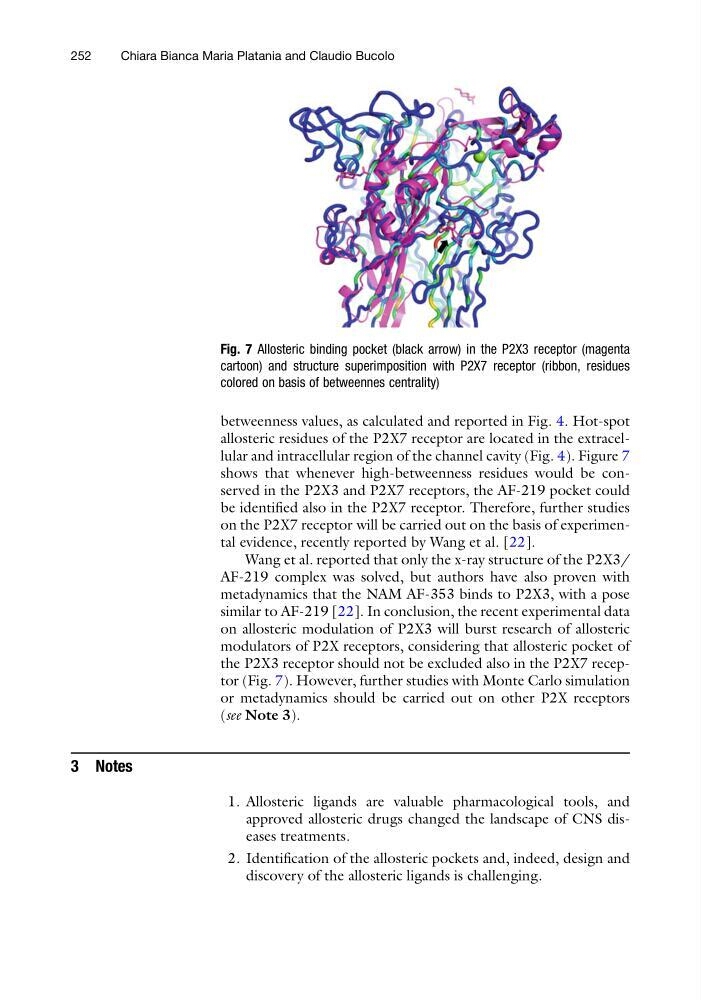
allosteric residues of the P2X7 receptor are located in the extracellular and intracellular region of the channel cavity (Fig. 4). Figure 7
shows that whenever high-betweenness residues would be conserved in the P2X3 and P2X7 receptors, the AF-219 pocket could
be identified also in the P2X7 receptor. Therefore, further studies
on the P2X7 receptor will be carried out on the basis of experimental evidence, recently reported by Wang et al. [22].
Wang et al. reported that only the x-ray structure of the P2X3/
AF-219 complex was solved, but authors have also proven with
metadynamics that the NAM AF-353 binds to P2X3, with a pose
similar to AF-219 [22]. In conclusion, the recent experimental data
on allosteric modulation of P2X3 will burst research of allosteric
modulators of P2X receptors, considering that allosteric pocket of
the P2X3 receptor should not be excluded also in the P2X7 receptor (Fig. 7). However, further studies with Monte Carlo simulation
or metadynamics should be carried out on other P2X receptors
(see Note 3).
3 Notes
1. Allosteric ligands are valuable pharmacological tools, and
approved allosteric drugs changed the landscape of CNS diseases treatments.
2. Identification of the allosteric pockets and, indeed, design and
discovery of the allosteric ligands is challenging.
Fig. 7 Allosteric binding pocket (black arrow) in the P2X3 receptor (magenta
cartoon) and structure superimposition with P2X7 receptor (ribbon, residues
colored on basis of betweennes centrality)
252
Chiara Bianca Maria Platania and Claudio Bucolo
allosteric residues of the P2X7 receptor are located in the extracellular and intracellular region of the channel cavity (Fig. 4). Figure 7
shows that whenever high-betweenness residues would be conserved in the P2X3 and P2X7 receptors, the AF-219 pocket could
be identified also in the P2X7 receptor. Therefore, further studies
on the P2X7 receptor will be carried out on the basis of experimental evidence, recently reported by Wang et al. [22].
Wang et al. reported that only the x-ray structure of the P2X3/
AF-219 complex was solved, but authors have also proven with
metadynamics that the NAM AF-353 binds to P2X3, with a pose
similar to AF-219 [22]. In conclusion, the recent experimental data
on allosteric modulation of P2X3 will burst research of allosteric
modulators of P2X receptors, considering that allosteric pocket of
the P2X3 receptor should not be excluded also in the P2X7 receptor (Fig. 7). However, further studies with Monte Carlo simulation
or metadynamics should be carried out on other P2X receptors
(see Note 3).
3 Notes
1. Allosteric ligands are valuable pharmacological tools, and
approved allosteric drugs changed the landscape of CNS diseases treatments.
2. Identification of the allosteric pockets and, indeed, design and
discovery of the allosteric ligands is challenging.
Fig. 7 Allosteric binding pocket (black arrow) in the P2X3 receptor (magenta
cartoon) and structure superimposition with P2X7 receptor (ribbon, residues
colored on basis of betweennes centrality)
252
Chiara Bianca Maria Platania and Claudio Bucolo