

Tsai in 2013 reviewed the impact of allosteric drugs in the field of
drug discovery; this review highlighted that most of the allosteric
drugs work through non-covalent mechanisms; e.g., positive allosteric modulators of the γ-aminobutyric acid receptor A (GABA-A)
[1]. GABA-A is an ubiquitous receptor in the central nervous
system (CNS) and orthosteric ligands of GABA-A are not used in
therapy, because of their poor pharmacodynamic and safety profile.
In fact, GABA-A competitive agonists, such as muscimol, are
potent psychoactive drugs (sedative-hypnotic, depressant, and allucinogen), while GABA-A antagonists such as bicucullin and picrotoxin are convulsivant drugs. Bicucullin is used as pharmacological
tool, while picrotoxin was used for treatment of barbiturate acute
toxicity. First developed positive allosteric modulators of GABA-A
were barbiturates, used as anxiolytic and hypnotic drugs, but due to
their narrow therapeutic index (low safety), they were largely substituted by benzodiazepines, that bear a good therapeutic index and
are also positive allosteric modulators of GABA-A [2] (see Note 1).
Similarly to the GABA-A receptor, the impact of allosteric modulation of the N-methyl-D-aspartate receptors (NMDARs) would be
huge, since NMDAR drugs showed poor clinical outcome and
serious side-effects [3]. Additionally, allosteric ligands have been
found to modulate the activity of G protein-coupled receptors,
such as the cannabinoid type 1 receptor [4].
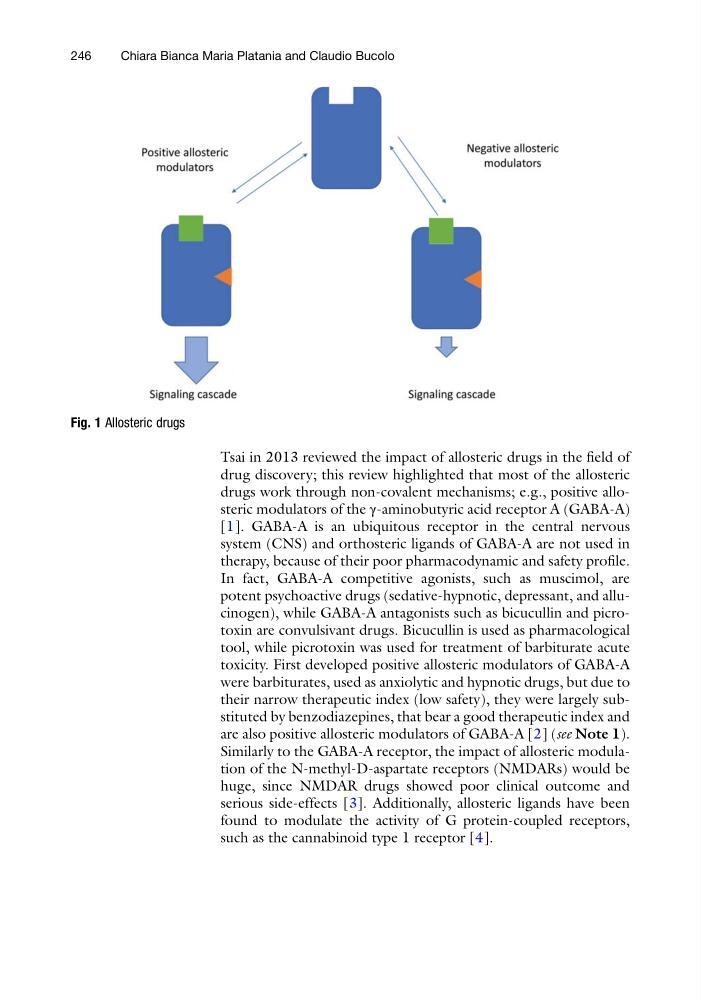
Fig. 1 Allosteric drugs
246
Chiara Bianca Maria Platania and Claudio Bucolo
drug discovery; this review highlighted that most of the allosteric
drugs work through non-covalent mechanisms; e.g., positive allosteric modulators of the γ-aminobutyric acid receptor A (GABA-A)
[1]. GABA-A is an ubiquitous receptor in the central nervous
system (CNS) and orthosteric ligands of GABA-A are not used in
therapy, because of their poor pharmacodynamic and safety profile.
In fact, GABA-A competitive agonists, such as muscimol, are
potent psychoactive drugs (sedative-hypnotic, depressant, and allucinogen), while GABA-A antagonists such as bicucullin and picrotoxin are convulsivant drugs. Bicucullin is used as pharmacological
tool, while picrotoxin was used for treatment of barbiturate acute
toxicity. First developed positive allosteric modulators of GABA-A
were barbiturates, used as anxiolytic and hypnotic drugs, but due to
their narrow therapeutic index (low safety), they were largely substituted by benzodiazepines, that bear a good therapeutic index and
are also positive allosteric modulators of GABA-A [2] (see Note 1).
Similarly to the GABA-A receptor, the impact of allosteric modulation of the N-methyl-D-aspartate receptors (NMDARs) would be
huge, since NMDAR drugs showed poor clinical outcome and
serious side-effects [3]. Additionally, allosteric ligands have been
found to modulate the activity of G protein-coupled receptors,
such as the cannabinoid type 1 receptor [4].
Fig. 1 Allosteric drugs
246
Chiara Bianca Maria Platania and Claudio Bucolo