

What is intriguing is that these changes are at the base of
different states of DBD p53 with different functional and biological
implications and a population shift among the states is observed
upon DNA binding. Indeed, our study proposed a new regulatory
mechanism for p53 functions, which is tightly embedded in the
conformational propensities of the protein structure.
DNA-binding causes a population shifts toward states in which
the residues of the S6-S7 loop lose most of the interaction with
the disordered N-terminal region and are recruited for interactions
with other protein regions that causes an “occluded” conformation
of the S6-S7 loop, in turn affecting the possibility to recruit
biological partners such as Ku70, Ark1, and Nb139. Our predictions suggest that these interactions are favored in the p53 DBD
unbound states [14].
Of particular interest, the Ku70 interaction with p53 is necessary to release and activate Bax to initiate the apoptosis pathway
[16]. It will become interesting to validate the interaction between
p53 DBD and Ku70 experimentally, also considering that another
crucial regulator of p53 nontranscriptional function as Bcl-xL and
Bcl-2 also binds to the p53 DBD at a different region, i.e., competing with the DNA-binding interface directly [22].
Our results suggest that a conformational selection is in play so
that p53 DBD is protected by interactions that are essential to
mediate transcription-independent functions, such as the p53 apoptotic cytosolic functions, as long as the DNA is bound to the
protein and p53 needs to act as a transcriptional activator. We also
observed that Aurora kinases-mediated phosphorylation at Ser215
[96, 97] is another modulator of the p53 S6-S7 loop state and it is
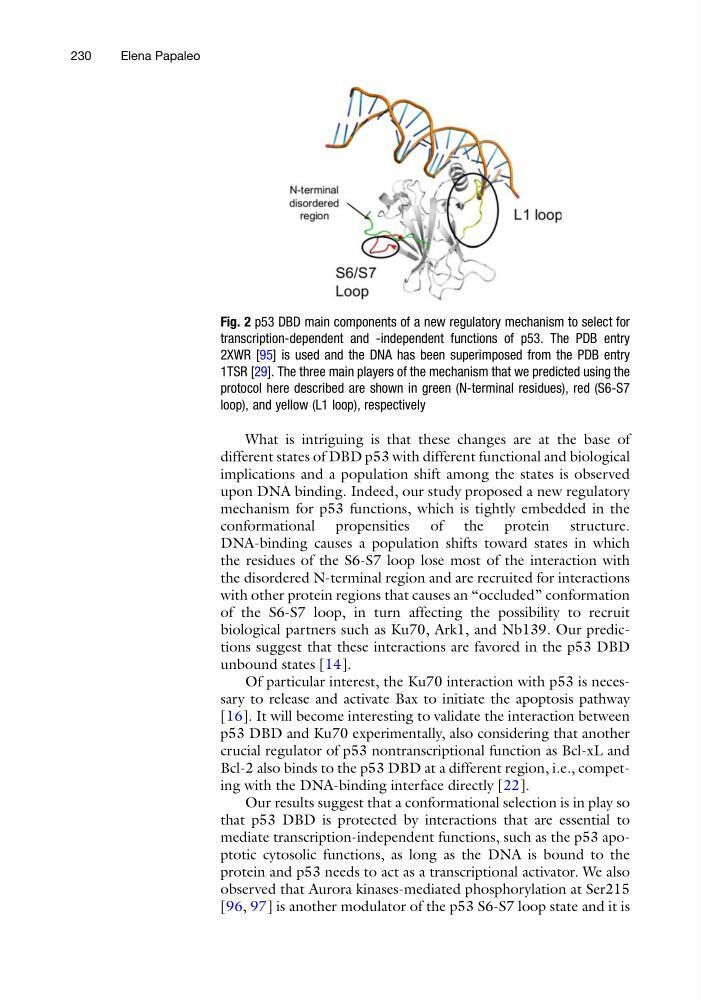
Fig. 2 p53 DBD main components of a new regulatory mechanism to select for
transcription-dependent and -independent functions of p53. The PDB entry
2XWR [95] is used and the DNA has been superimposed from the PDB entry
1TSR [29]. The three main players of the mechanism that we predicted using the
protocol here described are shown in green (N-terminal residues), red (S6-S7
loop), and yellow (L1 loop), respectively
230
Elena Papaleo
different states of DBD p53 with different functional and biological
implications and a population shift among the states is observed
upon DNA binding. Indeed, our study proposed a new regulatory
mechanism for p53 functions, which is tightly embedded in the
conformational propensities of the protein structure.
DNA-binding causes a population shifts toward states in which
the residues of the S6-S7 loop lose most of the interaction with
the disordered N-terminal region and are recruited for interactions
with other protein regions that causes an “occluded” conformation
of the S6-S7 loop, in turn affecting the possibility to recruit
biological partners such as Ku70, Ark1, and Nb139. Our predictions suggest that these interactions are favored in the p53 DBD
unbound states [14].
Of particular interest, the Ku70 interaction with p53 is necessary to release and activate Bax to initiate the apoptosis pathway
[16]. It will become interesting to validate the interaction between
p53 DBD and Ku70 experimentally, also considering that another
crucial regulator of p53 nontranscriptional function as Bcl-xL and
Bcl-2 also binds to the p53 DBD at a different region, i.e., competing with the DNA-binding interface directly [22].
Our results suggest that a conformational selection is in play so
that p53 DBD is protected by interactions that are essential to
mediate transcription-independent functions, such as the p53 apoptotic cytosolic functions, as long as the DNA is bound to the
protein and p53 needs to act as a transcriptional activator. We also
observed that Aurora kinases-mediated phosphorylation at Ser215
[96, 97] is another modulator of the p53 S6-S7 loop state and it is
Fig. 2 p53 DBD main components of a new regulatory mechanism to select for
transcription-dependent and -independent functions of p53. The PDB entry
2XWR [95] is used and the DNA has been superimposed from the PDB entry
1TSR [29]. The three main players of the mechanism that we predicted using the
protocol here described are shown in green (N-terminal residues), red (S6-S7
loop), and yellow (L1 loop), respectively
230
Elena Papaleo