

perturb the structure of the DBD with consequent effects on its
stability [12].
Nevertheless, a detailed investigation in the context of p53
conformational ensemble and its interfaces for cofactor recruitment
is still missing for the mutant variants. We cannot rule out, for some
of them, that apart from the major well-known local effects elicited
by the mutations, more complex and long-range mechanisms are in
act. Moreover, some of the “structural mutations” might still
induce local changes that impair the p53 functions such as DNA
binding or protein-protein interactions in the folded state. Even in
these cases, more detailed studies in light of transcriptiondependent and -independent functions need to be carried out to
reach a complete overview on the effects of the p53 mutations.
1.3 Computational
Framework
Several recent computational studies have been carried out to
model the full-length p53 and its tetramer form and its interaction
with DNA [33–36], which are beyond the scope of this protocol,
which focuses on the study of long-range effects and the structural
ensemble of the DBD. Moreover, we refer to the recent review by
Saha et al. [37] for more details on the computational studies of
p53.
Several molecular dynamics (MD) studies have explored the
local conformational changes of the p53 DBD in the presence and
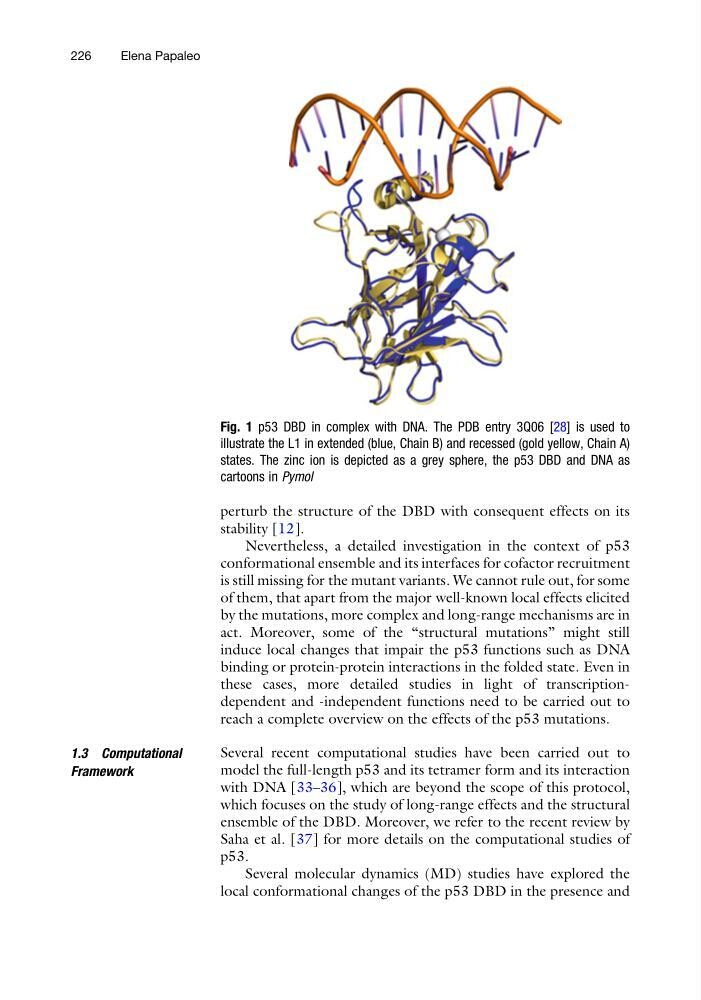
Fig. 1 p53 DBD in complex with DNA. The PDB entry 3Q06 [28] is used to
illustrate the L1 in extended (blue, Chain B) and recessed (gold yellow, Chain A)
states. The zinc ion is depicted as a grey sphere, the p53 DBD and DNA as
cartoons in Pymol
226
Elena Papaleo
stability [12].
Nevertheless, a detailed investigation in the context of p53
conformational ensemble and its interfaces for cofactor recruitment
is still missing for the mutant variants. We cannot rule out, for some
of them, that apart from the major well-known local effects elicited
by the mutations, more complex and long-range mechanisms are in
act. Moreover, some of the “structural mutations” might still
induce local changes that impair the p53 functions such as DNA
binding or protein-protein interactions in the folded state. Even in
these cases, more detailed studies in light of transcriptiondependent and -independent functions need to be carried out to
reach a complete overview on the effects of the p53 mutations.
1.3 Computational
Framework
Several recent computational studies have been carried out to
model the full-length p53 and its tetramer form and its interaction
with DNA [33–36], which are beyond the scope of this protocol,
which focuses on the study of long-range effects and the structural
ensemble of the DBD. Moreover, we refer to the recent review by
Saha et al. [37] for more details on the computational studies of
p53.
Several molecular dynamics (MD) studies have explored the
local conformational changes of the p53 DBD in the presence and
Fig. 1 p53 DBD in complex with DNA. The PDB entry 3Q06 [28] is used to
illustrate the L1 in extended (blue, Chain B) and recessed (gold yellow, Chain A)
states. The zinc ion is depicted as a grey sphere, the p53 DBD and DNA as
cartoons in Pymol
226
Elena Papaleo