

2.2 Protein-Ligand
Binding, Allosteric
Proteins,
and Protein-Protein
Interactions
Databases
Protein-ligand databases provide information on protein-ligand
binding thermodynamics and the structural data (PDB reference).
Correlation between binding affinity data and structural (network
topology) descriptors allows for a deep insight in the binding
mechanism.
BindingDB [8] is a public, web-accessible database (http://
www.bindingdb.org/) of experimental binding affinities, with a
special regard to potential protein-drug targets. At the moment,
the database contains 2291 protein-ligand crystal structures with
BindingBD affinity measurements for proteins with 100% sequence
identity and 5816 crystal structures allowing proteins to 85%
sequence identity.
Analogously, PDBbind database [9] catalogued 5671 proteinligand complexes out of 19,261 experimental structures (in 2003 at
the moment of the database publication), whose 1359 matched
with binding affinity data.
More recently, BioLIP [10] (http://zhanglab.ccmb.med.
umich.edu/BioLiP/) is a database of biologically relevant
protein-ligand complexes; the biological relevance of recorded
complexes requires a careful manual verification. The current version (updated on May 26th, 2017) contains 81,811 protein structures from PDB, of those 23,492 with binding affinity data.
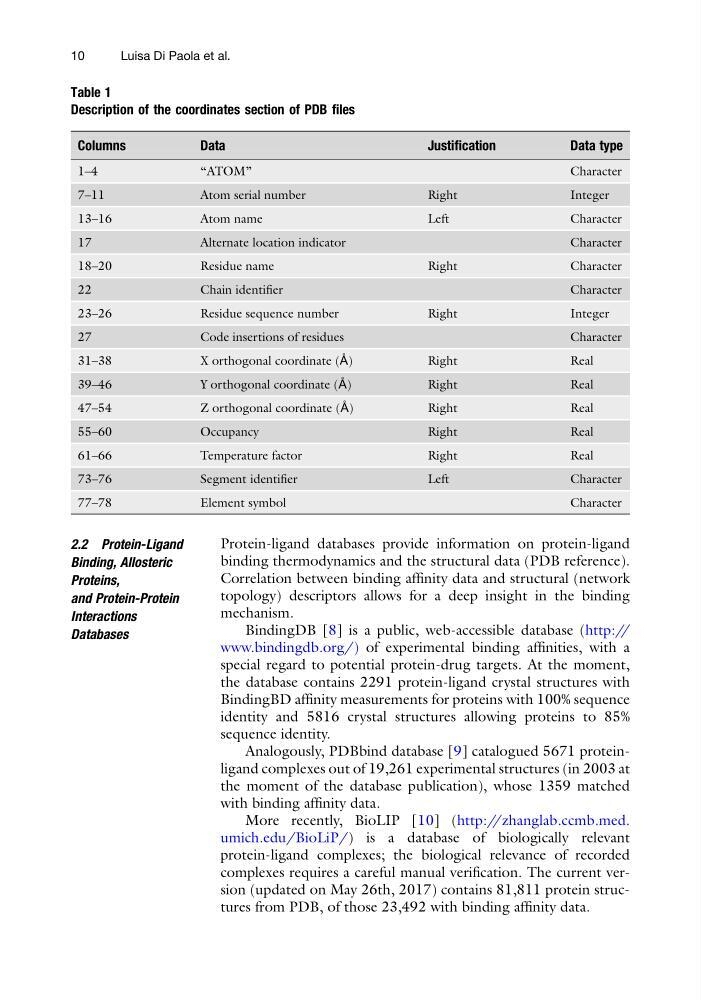
Table 1
Description of the coordinates section of PDB files
Columns
Data
Justification
Data type
1–4
“ATOM”
Character
7–11
Atom serial number
Right
Integer
13–16
Atom name
Left
Character
17
Alternate location indicator
Character
18–20
Residue name
Right
Character
22
Chain identifier
Character
23–26
Residue sequence number
Right
Integer
27
Code insertions of residues
Character
31–38
X orthogonal coordinate (Å)
Right
Real
39–46
Y orthogonal coordinate (Å)
Right
Real
47–54
Z orthogonal coordinate (Å)
Right
Real
55–60
Occupancy
Right
Real
61–66
Temperature factor
Right
Real
73–76
Segment identifier
Left
Character
77–78
Element symbol
Character
10
Luisa Di Paola et al.
Binding, Allosteric
Proteins,
and Protein-Protein
Interactions
Databases
Protein-ligand databases provide information on protein-ligand
binding thermodynamics and the structural data (PDB reference).
Correlation between binding affinity data and structural (network
topology) descriptors allows for a deep insight in the binding
mechanism.
BindingDB [8] is a public, web-accessible database (http://
www.bindingdb.org/) of experimental binding affinities, with a
special regard to potential protein-drug targets. At the moment,
the database contains 2291 protein-ligand crystal structures with
BindingBD affinity measurements for proteins with 100% sequence
identity and 5816 crystal structures allowing proteins to 85%
sequence identity.
Analogously, PDBbind database [9] catalogued 5671 proteinligand complexes out of 19,261 experimental structures (in 2003 at
the moment of the database publication), whose 1359 matched
with binding affinity data.
More recently, BioLIP [10] (http://zhanglab.ccmb.med.
umich.edu/BioLiP/) is a database of biologically relevant
protein-ligand complexes; the biological relevance of recorded
complexes requires a careful manual verification. The current version (updated on May 26th, 2017) contains 81,811 protein structures from PDB, of those 23,492 with binding affinity data.
Table 1
Description of the coordinates section of PDB files
Columns
Data
Justification
Data type
1–4
“ATOM”
Character
7–11
Atom serial number
Right
Integer
13–16
Atom name
Left
Character
17
Alternate location indicator
Character
18–20
Residue name
Right
Character
22
Chain identifier
Character
23–26
Residue sequence number
Right
Integer
27
Code insertions of residues
Character
31–38
X orthogonal coordinate (Å)
Right
Real
39–46
Y orthogonal coordinate (Å)
Right
Real
47–54
Z orthogonal coordinate (Å)
Right
Real
55–60
Occupancy
Right
Real
61–66
Temperature factor
Right
Real
73–76
Segment identifier
Left
Character
77–78
Element symbol
Character
10
Luisa Di Paola et al.