

perspectives. Here we propose an approach that already gave very
interesting results in allostery elucidation [1–3], building upon the
consideration of protein structures as network system having aminoacid residues as nodes and the presence of an effective
non-covalent (and thus folding-induced) contact between residues
as edges.
This approach is conveniently located at half-way between
theoretically intensive and structural/experimental ones: while
relying upon a fully quantitative formalization (network topological
descriptors), the adopted mathematics is intuitive (simple count
statistics on nodes and edges) and free from any physical constraint
or hypothesis. On the other hand, the relation between network
and 3D structure is univocal and clear and the statements coming
from network analysis readily testable by experimental means.
Still more important is the fact that network formalism allows
for a ‘naturally multiscale’ approach to allostery. Network graphtheoretical approaches are located half-way between bottom-up
and top-down approaches focusing on the relation between the
elements of the studied phenomenon. We can roughly describe
the network approach as the answer to the question “What can
we derive from the sole knowledge of the wiring diagram of a
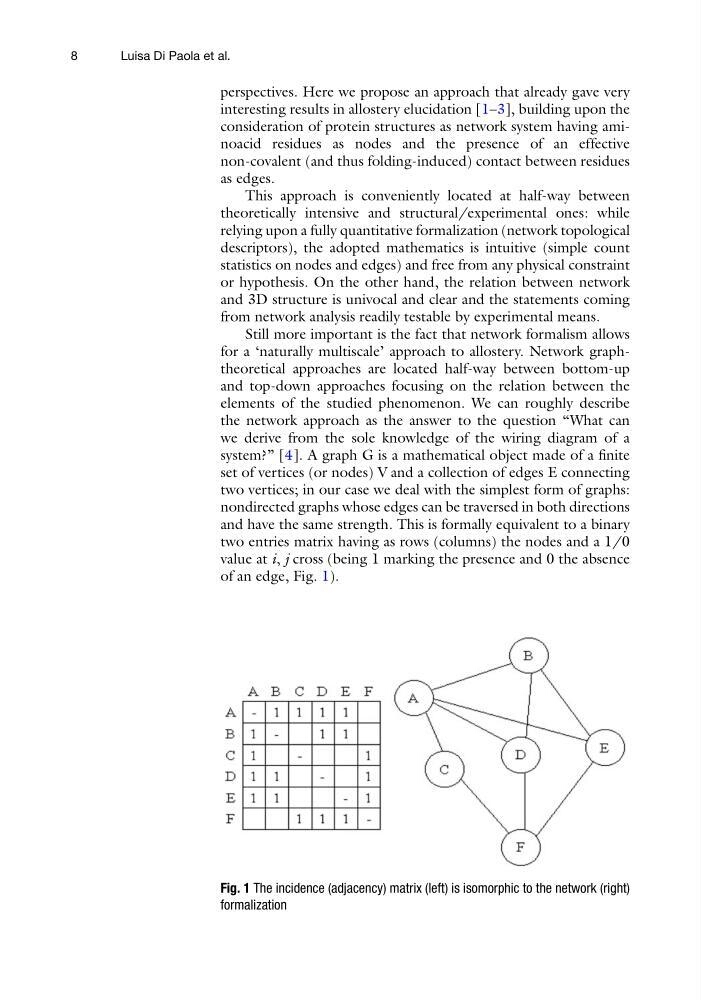
system?” [4]. A graph G is a mathematical object made of a finite
set of vertices (or nodes) V and a collection of edges E connecting
two vertices; in our case we deal with the simplest form of graphs:
nondirected graphs whose edges can be traversed in both directions
and have the same strength. This is formally equivalent to a binary
two entries matrix having as rows (columns) the nodes and a 1/0
value at i, j cross (being 1 marking the presence and 0 the absence
of an edge, Fig. 1).
Fig. 1 The incidence (adjacency) matrix (left) is isomorphic to the network (right)
formalization
8
Luisa Di Paola et al.
interesting results in allostery elucidation [1–3], building upon the
consideration of protein structures as network system having aminoacid residues as nodes and the presence of an effective
non-covalent (and thus folding-induced) contact between residues
as edges.
This approach is conveniently located at half-way between
theoretically intensive and structural/experimental ones: while
relying upon a fully quantitative formalization (network topological
descriptors), the adopted mathematics is intuitive (simple count
statistics on nodes and edges) and free from any physical constraint
or hypothesis. On the other hand, the relation between network
and 3D structure is univocal and clear and the statements coming
from network analysis readily testable by experimental means.
Still more important is the fact that network formalism allows
for a ‘naturally multiscale’ approach to allostery. Network graphtheoretical approaches are located half-way between bottom-up
and top-down approaches focusing on the relation between the
elements of the studied phenomenon. We can roughly describe
the network approach as the answer to the question “What can
we derive from the sole knowledge of the wiring diagram of a
system?” [4]. A graph G is a mathematical object made of a finite
set of vertices (or nodes) V and a collection of edges E connecting
two vertices; in our case we deal with the simplest form of graphs:
nondirected graphs whose edges can be traversed in both directions
and have the same strength. This is formally equivalent to a binary
two entries matrix having as rows (columns) the nodes and a 1/0
value at i, j cross (being 1 marking the presence and 0 the absence
of an edge, Fig. 1).
Fig. 1 The incidence (adjacency) matrix (left) is isomorphic to the network (right)
formalization
8
Luisa Di Paola et al.