

conformational changes in different crystal packing environments,
the authors also solved some of the ligand-bound structures using
crystals with different space groups. The complexes were analogous
to the five kinetic intermediates and to the transition state for the
hydride transfer reaction. The authors used analogues because
actual intermediates are transient and it takes several hours to
collect data for an X-ray structure. The choice of analogue for
such studies is significant. For example, to mimic the transition
state, the authors used methotrexate. This compound has a unique
binding geometry, which has been found to induce the transition
state protein conformation even though methotrexate does not
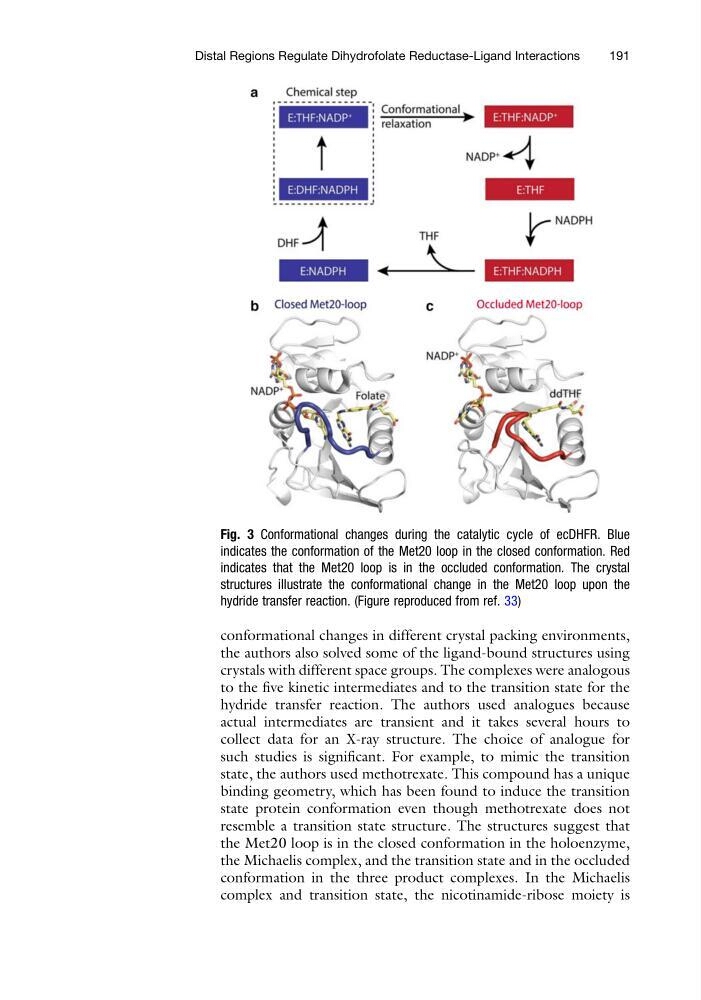
resemble a transition state structure. The structures suggest that
the Met20 loop is in the closed conformation in the holoenzyme,
the Michaelis complex, and the transition state and in the occluded
conformation in the three product complexes. In the Michaelis
complex and transition state, the nicotinamide-ribose moiety is
Fig. 3 Conformational changes during the catalytic cycle of ecDHFR. Blue
indicates the conformation of the Met20 loop in the closed conformation. Red
indicates that the Met20 loop is in the occluded conformation. The crystal
structures illustrate the conformational change in the Met20 loop upon the
hydride transfer reaction. (Figure reproduced from ref. 33)
Distal Regions Regulate Dihydrofolate Reductase-Ligand Interactions
191
the authors also solved some of the ligand-bound structures using
crystals with different space groups. The complexes were analogous
to the five kinetic intermediates and to the transition state for the
hydride transfer reaction. The authors used analogues because
actual intermediates are transient and it takes several hours to
collect data for an X-ray structure. The choice of analogue for
such studies is significant. For example, to mimic the transition
state, the authors used methotrexate. This compound has a unique
binding geometry, which has been found to induce the transition
state protein conformation even though methotrexate does not
resemble a transition state structure. The structures suggest that
the Met20 loop is in the closed conformation in the holoenzyme,
the Michaelis complex, and the transition state and in the occluded
conformation in the three product complexes. In the Michaelis
complex and transition state, the nicotinamide-ribose moiety is
Fig. 3 Conformational changes during the catalytic cycle of ecDHFR. Blue
indicates the conformation of the Met20 loop in the closed conformation. Red
indicates that the Met20 loop is in the occluded conformation. The crystal
structures illustrate the conformational change in the Met20 loop upon the
hydride transfer reaction. (Figure reproduced from ref. 33)
Distal Regions Regulate Dihydrofolate Reductase-Ligand Interactions
191