

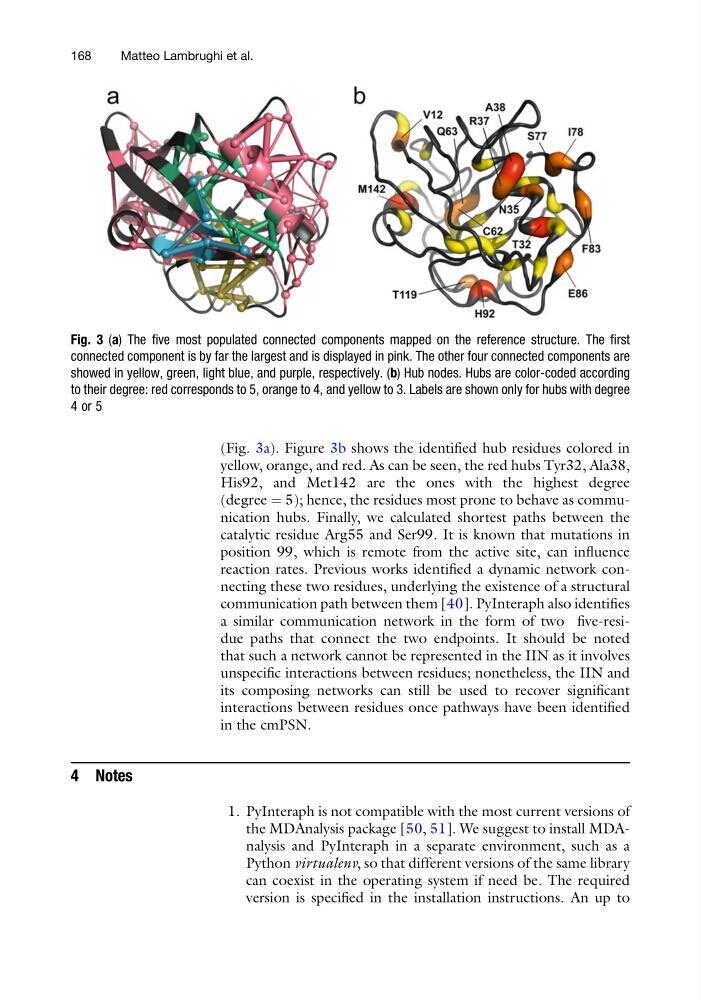
(Fig. 3a). Figure 3b shows the identified hub residues colored in
yellow, orange, and red. As can be seen, the red hubs Tyr32, Ala38,
His92, and Met142 are the ones with the highest degree
(degree ¼ 5); hence, the residues most prone to behave as communication hubs. Finally, we calculated shortest paths between the
catalytic residue Arg55 and Ser99. It is known that mutations in
position 99, which is remote from the active site, can influence
reaction rates. Previous works identified a dynamic network connecting these two residues, underlying the existence of a structural
communication path between them [40]. PyInteraph also identifies
a similar communication network in the form of two five-residue paths that connect the two endpoints. It should be noted
that such a network cannot be represented in the IIN as it involves
unspecific interactions between residues; nonetheless, the IIN and
its composing networks can still be used to recover significant
interactions between residues once pathways have been identified
in the cmPSN.
4 Notes
1. PyInteraph is not compatible with the most current versions of
the MDAnalysis package [50, 51]. We suggest to install MDAnalysis and PyInteraph in a separate environment, such as a
Python virtualenv, so that different versions of the same library
can coexist in the operating system if need be. The required
version is specified in the installation instructions. An up to
Fig. 3 (a) The five most populated connected components mapped on the reference structure. The first
connected component is by far the largest and is displayed in pink. The other four connected components are
showed in yellow, green, light blue, and purple, respectively. (b) Hub nodes. Hubs are color-coded according
to their degree: red corresponds to 5, orange to 4, and yellow to 3. Labels are shown only for hubs with degree
4 or 5
168
Matteo Lambrughi et al.
yellow, orange, and red. As can be seen, the red hubs Tyr32, Ala38,
His92, and Met142 are the ones with the highest degree
(degree ¼ 5); hence, the residues most prone to behave as communication hubs. Finally, we calculated shortest paths between the
catalytic residue Arg55 and Ser99. It is known that mutations in
position 99, which is remote from the active site, can influence
reaction rates. Previous works identified a dynamic network connecting these two residues, underlying the existence of a structural
communication path between them [40]. PyInteraph also identifies
a similar communication network in the form of two five-residue paths that connect the two endpoints. It should be noted
that such a network cannot be represented in the IIN as it involves
unspecific interactions between residues; nonetheless, the IIN and
its composing networks can still be used to recover significant
interactions between residues once pathways have been identified
in the cmPSN.
4 Notes
1. PyInteraph is not compatible with the most current versions of
the MDAnalysis package [50, 51]. We suggest to install MDAnalysis and PyInteraph in a separate environment, such as a
Python virtualenv, so that different versions of the same library
can coexist in the operating system if need be. The required
version is specified in the installation instructions. An up to
Fig. 3 (a) The five most populated connected components mapped on the reference structure. The first
connected component is by far the largest and is displayed in pink. The other four connected components are
showed in yellow, green, light blue, and purple, respectively. (b) Hub nodes. Hubs are color-coded according
to their degree: red corresponds to 5, orange to 4, and yellow to 3. Labels are shown only for hubs with degree
4 or 5
168
Matteo Lambrughi et al.