

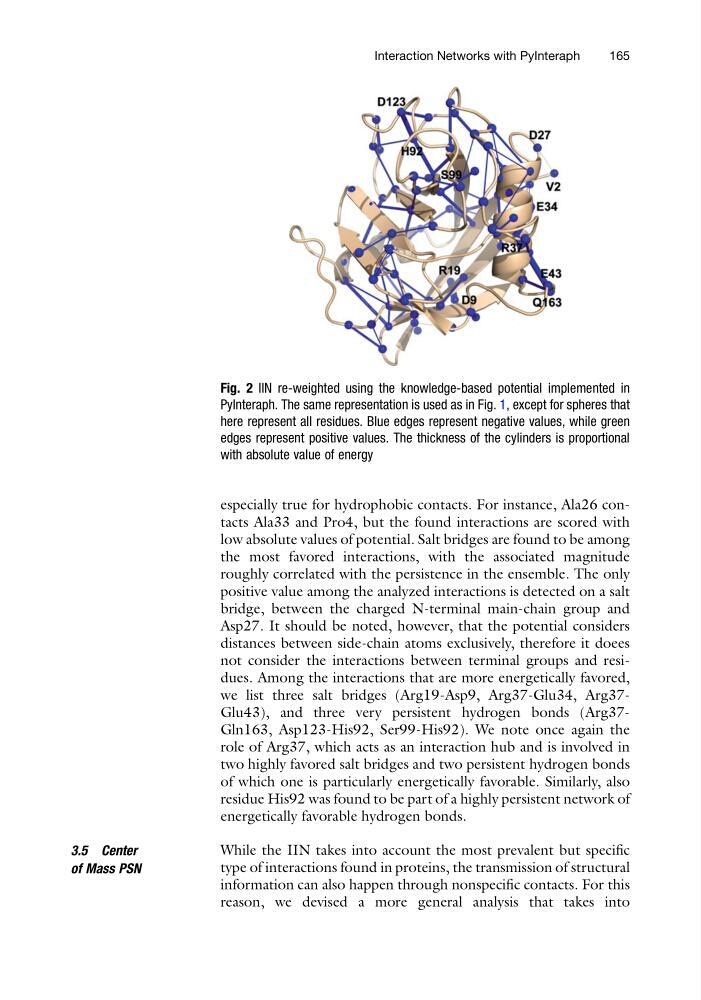
especially true for hydrophobic contacts. For instance, Ala26 contacts Ala33 and Pro4, but the found interactions are scored with
low absolute values of potential. Salt bridges are found to be among
the most favored interactions, with the associated magnitude
roughly correlated with the persistence in the ensemble. The only
positive value among the analyzed interactions is detected on a salt
bridge, between the charged N-terminal main-chain group and
Asp27. It should be noted, however, that the potential considers
distances between side-chain atoms exclusively, therefore it doees
not consider the interactions between terminal groups and residues. Among the interactions that are more energetically favored,
we list three salt bridges (Arg19-Asp9, Arg37-Glu34, Arg37Glu43), and three very persistent hydrogen bonds (Arg37Gln163, Asp123-His92, Ser99-His92). We note once again the
role of Arg37, which acts as an interaction hub and is involved in
two highly favored salt bridges and two persistent hydrogen bonds
of which one is particularly energetically favorable. Similarly, also
residue His92 was found to be part of a highly persistent network of
energetically favorable hydrogen bonds.
3.5 Center
of Mass PSN
While the IIN takes into account the most prevalent but specific
type of interactions found in proteins, the transmission of structural
information can also happen through nonspecific contacts. For this
reason, we devised a more general analysis that takes into
Fig. 2 IIN re-weighted using the knowledge-based potential implemented in
PyInteraph. The same representation is used as in Fig. 1, except for spheres that
here represent all residues. Blue edges represent negative values, while green
edges represent positive values. The thickness of the cylinders is proportional
with absolute value of energy
Interaction Networks with PyInteraph
165
low absolute values of potential. Salt bridges are found to be among
the most favored interactions, with the associated magnitude
roughly correlated with the persistence in the ensemble. The only
positive value among the analyzed interactions is detected on a salt
bridge, between the charged N-terminal main-chain group and
Asp27. It should be noted, however, that the potential considers
distances between side-chain atoms exclusively, therefore it doees
not consider the interactions between terminal groups and residues. Among the interactions that are more energetically favored,
we list three salt bridges (Arg19-Asp9, Arg37-Glu34, Arg37Glu43), and three very persistent hydrogen bonds (Arg37Gln163, Asp123-His92, Ser99-His92). We note once again the
role of Arg37, which acts as an interaction hub and is involved in
two highly favored salt bridges and two persistent hydrogen bonds
of which one is particularly energetically favorable. Similarly, also
residue His92 was found to be part of a highly persistent network of
energetically favorable hydrogen bonds.
3.5 Center
of Mass PSN
While the IIN takes into account the most prevalent but specific
type of interactions found in proteins, the transmission of structural
information can also happen through nonspecific contacts. For this
reason, we devised a more general analysis that takes into
Fig. 2 IIN re-weighted using the knowledge-based potential implemented in
PyInteraph. The same representation is used as in Fig. 1, except for spheres that
here represent all residues. Blue edges represent negative values, while green
edges represent positive values. The thickness of the cylinders is proportional
with absolute value of energy
Interaction Networks with PyInteraph
165