

high content of charged residues, playing roles in protein stability
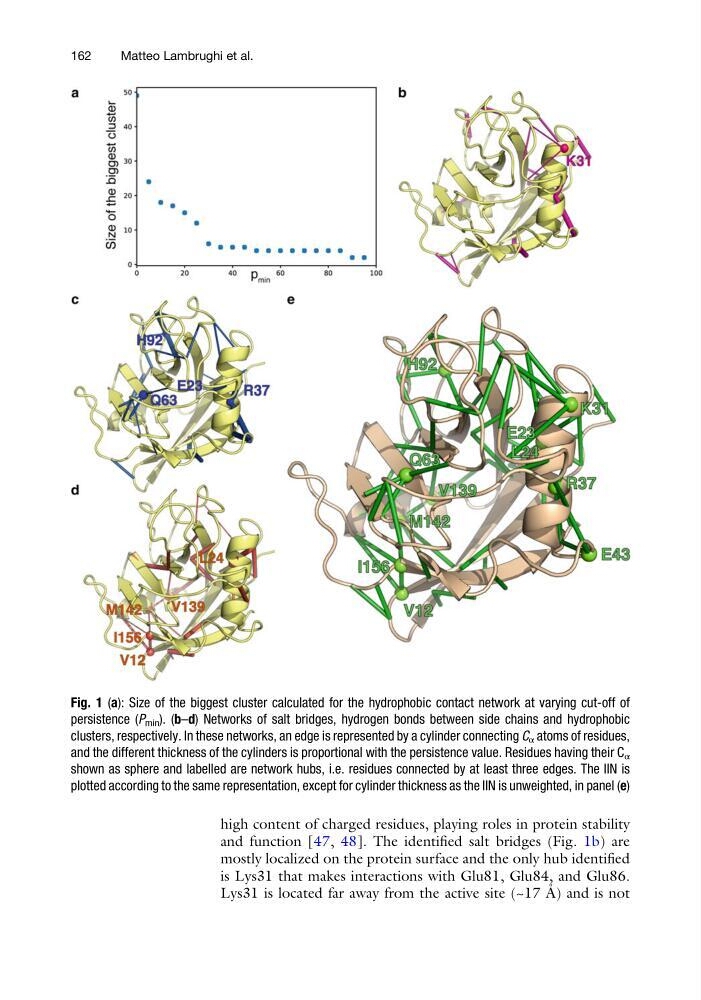
and function [47, 48]. The identified salt bridges (Fig. 1b) are
mostly localized on the protein surface and the only hub identified
is Lys31 that makes interactions with Glu81, Glu84, and Glu86.
Lys31 is located far away from the active site (~17 A ˚ ) and is not
Fig. 1 (a): Size of the biggest cluster calculated for the hydrophobic contact network at varying cut-off of
persistence (P min ). (b–d) Networks of salt bridges, hydrogen bonds between side chains and hydrophobic
clusters, respectively. In these networks, an edge is represented by a cylinder connecting C α atoms of residues,
and the different thickness of the cylinders is proportional with the persistence value. Residues having their C α
shown as sphere and labelled are network hubs, i.e. residues connected by at least three edges. The IIN is
plotted according to the same representation, except for cylinder thickness as the IIN is unweighted, in panel (e)
162
Matteo Lambrughi et al.
and function [47, 48]. The identified salt bridges (Fig. 1b) are
mostly localized on the protein surface and the only hub identified
is Lys31 that makes interactions with Glu81, Glu84, and Glu86.
Lys31 is located far away from the active site (~17 A ˚ ) and is not
Fig. 1 (a): Size of the biggest cluster calculated for the hydrophobic contact network at varying cut-off of
persistence (P min ). (b–d) Networks of salt bridges, hydrogen bonds between side chains and hydrophobic
clusters, respectively. In these networks, an edge is represented by a cylinder connecting C α atoms of residues,
and the different thickness of the cylinders is proportional with the persistence value. Residues having their C α
shown as sphere and labelled are network hubs, i.e. residues connected by at least three edges. The IIN is
plotted according to the same representation, except for cylinder thickness as the IIN is unweighted, in panel (e)
162
Matteo Lambrughi et al.