

proponents [25, 26] and subsequently an alternative hypothesis
was formulated, i.e., the so-called “sequential model” put forward
by Daniel Koshland, George Ne ´methy, and David Filmer
[27]. Nowadays, the allosteric behavior of hemoglobin is still matter of research and comments [28].
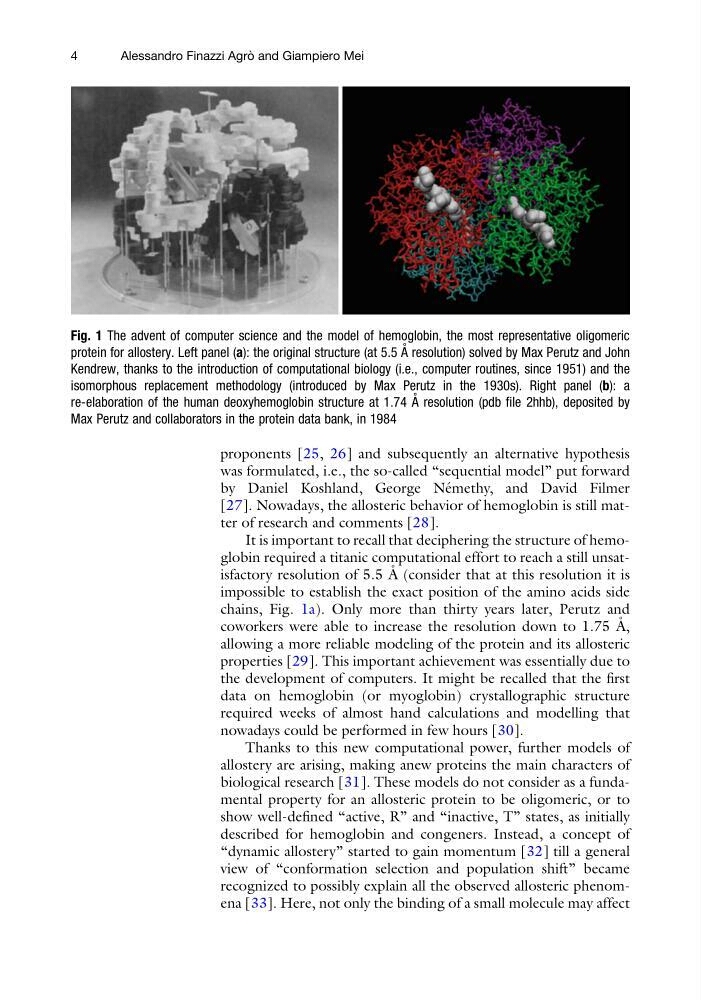
It is important to recall that deciphering the structure of hemoglobin required a titanic computational effort to reach a still unsatisfactory resolution of 5.5 A ˚ (consider that at this resolution it is
impossible to establish the exact position of the amino acids side
chains, Fig. 1a). Only more than thirty years later, Perutz and
coworkers were able to increase the resolution down to 1.75 A ˚ ,
allowing a more reliable modeling of the protein and its allosteric
properties [29]. This important achievement was essentially due to
the development of computers. It might be recalled that the first
data on hemoglobin (or myoglobin) crystallographic structure
required weeks of almost hand calculations and modelling that
nowadays could be performed in few hours [30].
Thanks to this new computational power, further models of
allostery are arising, making anew proteins the main characters of
biological research [31]. These models do not consider as a fundamental property for an allosteric protein to be oligomeric, or to
show well-defined “active, R” and “inactive, T” states, as initially
described for hemoglobin and congeners. Instead, a concept of
“dynamic allostery” started to gain momentum [32] till a general
view of “conformation selection and population shift” became
recognized to possibly explain all the observed allosteric phenomena [33]. Here, not only the binding of a small molecule may affect
Fig. 1 The advent of computer science and the model of hemoglobin, the most representative oligomeric
protein for allostery. Left panel (a): the original structure (at 5.5 A ˚ resolution) solved by Max Perutz and John
Kendrew, thanks to the introduction of computational biology (i.e., computer routines, since 1951) and the
isomorphous replacement methodology (introduced by Max Perutz in the 1930s). Right panel (b): a
re-elaboration of the human deoxyhemoglobin structure at 1.74 A ˚ resolution (pdb file 2hhb), deposited by
Max Perutz and collaborators in the protein data bank, in 1984
4
Alessandro Finazzi Agro ` and Giampiero Mei
was formulated, i.e., the so-called “sequential model” put forward
by Daniel Koshland, George Ne ´methy, and David Filmer
[27]. Nowadays, the allosteric behavior of hemoglobin is still matter of research and comments [28].
It is important to recall that deciphering the structure of hemoglobin required a titanic computational effort to reach a still unsatisfactory resolution of 5.5 A ˚ (consider that at this resolution it is
impossible to establish the exact position of the amino acids side
chains, Fig. 1a). Only more than thirty years later, Perutz and
coworkers were able to increase the resolution down to 1.75 A ˚ ,
allowing a more reliable modeling of the protein and its allosteric
properties [29]. This important achievement was essentially due to
the development of computers. It might be recalled that the first
data on hemoglobin (or myoglobin) crystallographic structure
required weeks of almost hand calculations and modelling that
nowadays could be performed in few hours [30].
Thanks to this new computational power, further models of
allostery are arising, making anew proteins the main characters of
biological research [31]. These models do not consider as a fundamental property for an allosteric protein to be oligomeric, or to
show well-defined “active, R” and “inactive, T” states, as initially
described for hemoglobin and congeners. Instead, a concept of
“dynamic allostery” started to gain momentum [32] till a general
view of “conformation selection and population shift” became
recognized to possibly explain all the observed allosteric phenomena [33]. Here, not only the binding of a small molecule may affect
Fig. 1 The advent of computer science and the model of hemoglobin, the most representative oligomeric
protein for allostery. Left panel (a): the original structure (at 5.5 A ˚ resolution) solved by Max Perutz and John
Kendrew, thanks to the introduction of computational biology (i.e., computer routines, since 1951) and the
isomorphous replacement methodology (introduced by Max Perutz in the 1930s). Right panel (b): a
re-elaboration of the human deoxyhemoglobin structure at 1.74 A ˚ resolution (pdb file 2hhb), deposited by
Max Perutz and collaborators in the protein data bank, in 1984
4
Alessandro Finazzi Agro ` and Giampiero Mei