

In the same spirit, if we plot the assortativity values of PCN
versus LRN we find a signature of very slightly correlated variables
with R
2
¼ 0.02733 and thus in the whole protein network the
assortativity property is independent of the Long Range Network.
If we plot the assortativity values of PCN versus IHSN we find
R
2
¼ 0.0405; thus, the protein assortativity property is independent of the Induced Hot Spot Network. One explanation of these
nonintuitive topological results comes from the fact that the protein structure masks the position of crucial networks. In particular
the Long Range Network is important in order to maintain the 3D
structure and to fold the protein. And looking at the degree correlation of amino acids is not sufficient to guess which one is in the
LRN. We find the same result between LRN and IHSN
(R
2
¼ 0.0058) and between LRN and HSN (R
2
¼ 0.0406) and
thus few correlations between the 3D network (LRN) and the
interface networks (HSN or IHSN). Thus PCN vs HSN, PCN vs
LRN, and LRN vs IHSN are topologically independent, and this
could be a mechanism to prevent propagation of modifications
from one network to another. It is also the reflection of a
non-hierarchical structure of the whole proteins and a relative
independence of each network.
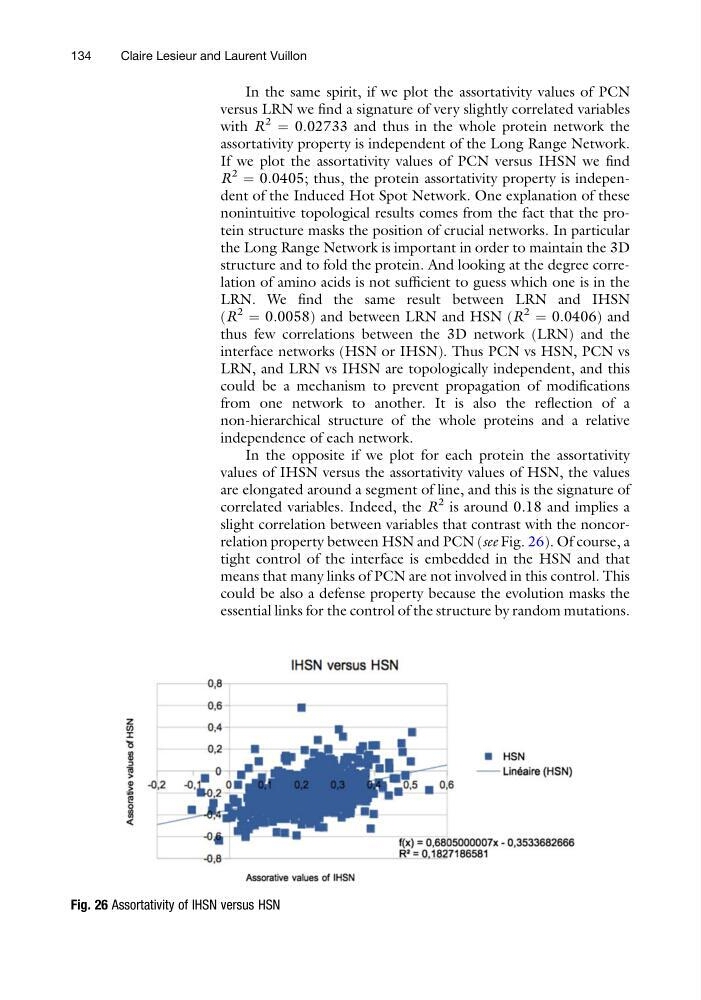
In the opposite if we plot for each protein the assortativity
values of IHSN versus the assortativity values of HSN, the values
are elongated around a segment of line, and this is the signature of
correlated variables. Indeed, the R
2 is around 0.18 and implies a
slight correlation between variables that contrast with the noncorrelation property between HSN and PCN (see Fig. 26). Of course, a
tight control of the interface is embedded in the HSN and that
means that many links of PCN are not involved in this control. This
could be also a defense property because the evolution masks the
essential links for the control of the structure by random mutations.
Fig. 26 Assortativity of IHSN versus HSN
134
Claire Lesieur and Laurent Vuillon
versus LRN we find a signature of very slightly correlated variables
with R
2
¼ 0.02733 and thus in the whole protein network the
assortativity property is independent of the Long Range Network.
If we plot the assortativity values of PCN versus IHSN we find
R
2
¼ 0.0405; thus, the protein assortativity property is independent of the Induced Hot Spot Network. One explanation of these
nonintuitive topological results comes from the fact that the protein structure masks the position of crucial networks. In particular
the Long Range Network is important in order to maintain the 3D
structure and to fold the protein. And looking at the degree correlation of amino acids is not sufficient to guess which one is in the
LRN. We find the same result between LRN and IHSN
(R
2
¼ 0.0058) and between LRN and HSN (R
2
¼ 0.0406) and
thus few correlations between the 3D network (LRN) and the
interface networks (HSN or IHSN). Thus PCN vs HSN, PCN vs
LRN, and LRN vs IHSN are topologically independent, and this
could be a mechanism to prevent propagation of modifications
from one network to another. It is also the reflection of a
non-hierarchical structure of the whole proteins and a relative
independence of each network.
In the opposite if we plot for each protein the assortativity
values of IHSN versus the assortativity values of HSN, the values
are elongated around a segment of line, and this is the signature of
correlated variables. Indeed, the R
2 is around 0.18 and implies a
slight correlation between variables that contrast with the noncorrelation property between HSN and PCN (see Fig. 26). Of course, a
tight control of the interface is embedded in the HSN and that
means that many links of PCN are not involved in this control. This
could be also a defense property because the evolution masks the
essential links for the control of the structure by random mutations.
Fig. 26 Assortativity of IHSN versus HSN
134
Claire Lesieur and Laurent Vuillon