

Network PCN(N,L) is constructed considering the amino acids of
the protein as set of nodes N and, for every two nodes in N there
exists a link in L between these two amino acids (two nodes) if the
two amino acids have at least one atom each in proximity, namely at
a distance less than 5 A ˚ . In fact, a node in the network represents a
union of atoms of a given amino acid and a link between nodes
means that two amino acids are at spatial distance less than 5 A (see
[2, 10]).
In Fig. 4, we find the representation of the Cholera Toxin by
plotting all atoms.
The PDB file contains many information and in particular the
atomic (x, y, z) coordinates of each atom and this is useful to
compute the distance between amino acids (Fig. 5).
By computing the Euclidian distance between two amino acids
and for all of them using a cut off at 5 A ˚ , we construct the Adjacent
Amino Acid Network of each protein (see Fig. 6 for the Adjacent
Amino Acid Network of the Cholera Toxin).
We are able to represent graphically the network, and investigate its geometry and topology. Thus the amino acids could be near
in a chain (called intramolecular residues) or between at least two
chains (called intermolecular residues) (Fig. 7). We remark, in
Fig. 7, that D39 is a Hot Spot because it is linked to the amino
acid 2, 3, 4, and 6 of the H chain.
3 The Four Networks
This chapter is based on the Adjacent Amino Acid Network PCN
(N,L) defined in Subheading 2. And we would like to investigate
sub-networks or induced networks defined formally in the next
paragraphs.
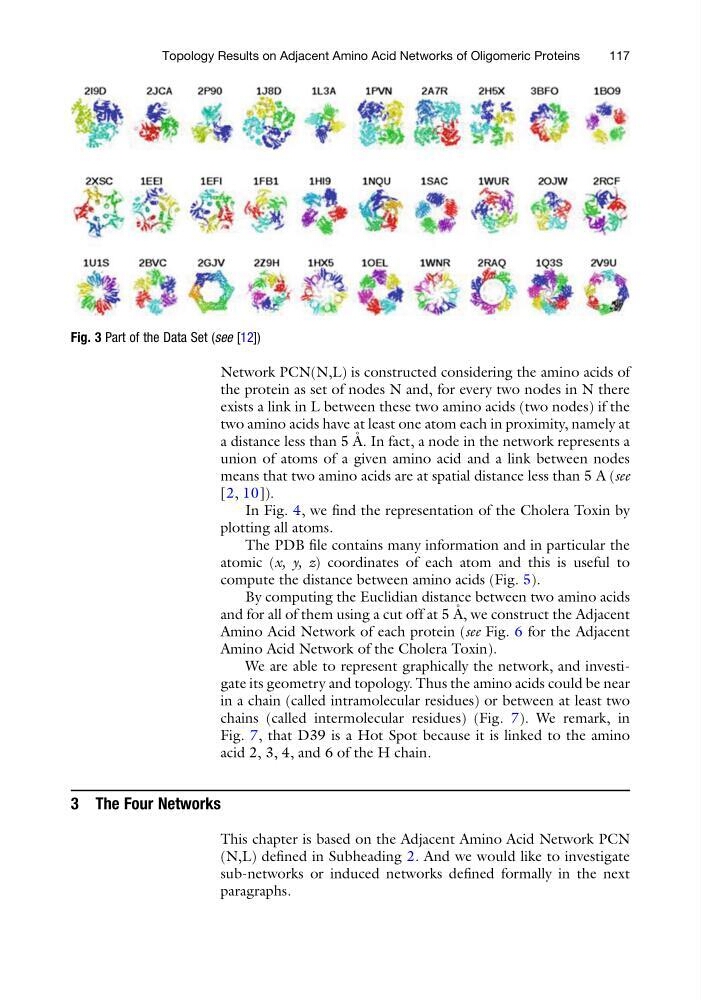
Fig. 3 Part of the Data Set (see [12])
Topology Results on Adjacent Amino Acid Networks of Oligomeric Proteins
117
the protein as set of nodes N and, for every two nodes in N there
exists a link in L between these two amino acids (two nodes) if the
two amino acids have at least one atom each in proximity, namely at
a distance less than 5 A ˚ . In fact, a node in the network represents a
union of atoms of a given amino acid and a link between nodes
means that two amino acids are at spatial distance less than 5 A (see
[2, 10]).
In Fig. 4, we find the representation of the Cholera Toxin by
plotting all atoms.
The PDB file contains many information and in particular the
atomic (x, y, z) coordinates of each atom and this is useful to
compute the distance between amino acids (Fig. 5).
By computing the Euclidian distance between two amino acids
and for all of them using a cut off at 5 A ˚ , we construct the Adjacent
Amino Acid Network of each protein (see Fig. 6 for the Adjacent
Amino Acid Network of the Cholera Toxin).
We are able to represent graphically the network, and investigate its geometry and topology. Thus the amino acids could be near
in a chain (called intramolecular residues) or between at least two
chains (called intermolecular residues) (Fig. 7). We remark, in
Fig. 7, that D39 is a Hot Spot because it is linked to the amino
acid 2, 3, 4, and 6 of the H chain.
3 The Four Networks
This chapter is based on the Adjacent Amino Acid Network PCN
(N,L) defined in Subheading 2. And we would like to investigate
sub-networks or induced networks defined formally in the next
paragraphs.
Fig. 3 Part of the Data Set (see [12])
Topology Results on Adjacent Amino Acid Networks of Oligomeric Proteins
117